Agricultural AI That Survives Contact with Actual Farm Economics
AI systems for agriculture that survive the gap between demo-plot accuracy and 10,000 acres of variable soil, weather, and equipment.
Agricultural AI wins in the demo plot and dies across 10,000 acres of variable soil, weather, and equipment. The platforms are technically good; the incentive alignment, the integration plumbing, and the regulatory exposure are where deployments actually break. Our approach is to engineer vendor-neutral systems designed to survive contact with actual farm economics — equipment integration, recommendation validation, LB525-ready data governance, and MRV pipelines built to pass verification.
The AgTech Graveyard: Why Vendor Survival Is a Buyer Problem
Twenty-one agtech companies entered bankruptcy or liquidation in 2025, burning through $2.8 billion in venture capital. Gro Intelligence, which raised $120 million, shut down because it never found enough buyers for its data products. Plenty, backed by nearly $1 billion from SoftBank and Bezos, filed in March 2025 and emerged only by closing its main facility and pivoting to a single crop. The pattern is consistent: companies that built technology first and understood farming second did not survive contact with actual farm economics. The vendor you choose today needs to still exist in three years.
Scale is no guarantee of alignment. The top five players in precision agriculture — Deere, AGCO/Trimble, Bayer Climate, CNH, and Raven — control roughly 43% of global sales, and their deployment numbers are real, not pitch decks:
- John Deere See and Spray covered 5 million acres in 2025 and saved farmers 31 million gallons of herbicide mix.
- Syngenta Cropwise manages 70 million hectares across 30 countries.
But scale creates its own problem: these platforms optimize for their own ecosystems, their own input products, and their own equipment. The AI is good. The incentive alignment is not.
What Actually Breaks in Agricultural AI Deployments
We see the same three failure modes across engagements:
- Data silos. A typical operation runs yield data through John Deere Operations Center, chemical application records through Bayer Climate FieldView, and soil sampling through an independent lab — with no automated connection between them. ISOBUS standardization covers tractors and implements but stops at the analytics layer. A variable-rate seeding prescription has to travel from a cloud platform through a USB drive or Bluetooth connection to a rate controller that may or may not interpret the task file correctly.
- Accuracy degrades from plot to field. A model trained on research-plot imagery from central Iowa does not reliably distinguish nitrogen deficiency from sulfur deficiency in the clay soils of the Mississippi Delta, where spectral signatures overlap differently (detailed in our technical whitepaper on hyperspectral deep learning for crop analysis).
- Unresolved liability. If an AI system recommends a pesticide application rate that violates EPA FIFRA Section 3 labeling requirements, or recommends inputs that USDA RMA adjusters do not consider standard practice, the farmer bears the financial risk while the software vendor points to the terms of service.
Autonomous Equipment: Real Capability, Real Gaps
The capabilities are legitimate. The John Deere autonomous 9RX tractor ships with a 16-camera perception array providing 360-degree field awareness; tillage autonomy is available now, with full operational autonomy expanding through 2026.
| Platform | Capability / target | Price |
|---|---|---|
| John Deere autonomous 9RX | 16-camera 360° perception; tillage autonomy now, full autonomy expanding through 2026 | — |
| John Deere autonomous 8R | Full autonomy kit | Exceeds $500,000 |
| Monarch MK-V | Fully electric, driver-optional; vineyards and specialty crops | $78,000 |
The gaps are equally real. GPS spoofing and wireless communication vulnerabilities mean an attacker could inject bad position data, causing autonomous equipment to apply inputs at wrong rates or wrong locations. The FBI has flagged agricultural cooperatives as particularly susceptible to ransomware attacks timed to planting and harvesting seasons, when downtime costs are highest. Most farm operations lack dedicated IT staff, so the cybersecurity posture of a $500,000 autonomous tractor connected to cellular networks and cloud platforms often receives less scrutiny than the farm's email account.
Regulation adds another layer. If you export product to the EU or sell equipment there, the EU AI Act classifies AI safety components in agricultural machinery as high-risk, requiring conformity assessment before August 2026. Autonomous tractors, harvesting robotics, and collision avoidance systems all fall under this classification.
The Data Ownership Reckoning: Nebraska's LB525
Nebraska's Agricultural Data Privacy Act (LB525), passed 49-0 in April 2026, is the first state-level law establishing that agricultural producers own data originating from their operations. Starting January 2027, every new contract involving agricultural data collection must include explicit written consent provisions before any controller can use or sell that data. The Attorney General enforces it.
This is not abstract policy. If your operation shares yield data with an ag retailer, equipment telemetry with a manufacturer, and soil data with a carbon credit aggregator, each of those relationships will need restructured consent agreements. The American Farm Bureau's Ag Data Transparent certification — which John Deere and other major vendors have adopted — addresses some of this, but LB525 goes further by creating statutory requirements with enforcement teeth. More states are watching: operations that build portability and consent controls into their data architecture now will avoid painful retrofits when similar laws pass in Iowa, Illinois, and Minnesota.
Carbon, Sustainability, and the MRV Problem
The carbon farming market reached $1.45 billion in 2025, with the EU Carbon Farming Initiative launching in 2026 as a voluntary certification framework. AI-powered digital MRV systems can increase auditor throughput by 2,400%, and the promise is straightforward: use satellite imagery, soil sensors, and machine learning to verify that cover crops were planted, tillage was reduced, and soil organic carbon increased.
The reality is harder. Three challenges persist:
- Monitoring field-level activities across thousands of acres with enough granularity to satisfy Verra or Gold Standard protocols.
- Demonstrating that carbon sequestration will persist beyond the crediting period.
- Managing the inherent variability in agricultural systems, where soil organic carbon measurements from adjacent sampling points can differ by 30% or more.
Most AI-based MRV platforms work well enough to generate internal sustainability reports. Few produce credits that survive independent third-party verification at the rigor that premium carbon markets demand.
Where the Big Consultancies Fall Short
Accenture acquired a European agri-digital consulting firm in February 2025 to strengthen its precision agriculture portfolio. McKinsey offers digital ag transformation strategy. Deloitte advises on sustainability and ESG alignment. All three bring enterprise transformation methodology — but none of them know the difference between an ISOBUS Task Controller and an ISOBUS Virtual Terminal, or why a variable-rate prescription that works on a Deere 4640 display fails on a Raven Viper 4+ running firmware from 2019. They build strategy decks. Our focus is the pipeline itself — from sensor data to prescription map to rate controller output, designed and validated against agronomic fundamentals and regulatory requirements.
What We Build
An engagement is scoped to work across the agricultural AI stack, from the sensor and equipment layer through data integration to decision systems, to produce:
- Vendor-neutral integration designed to connect data across Deere, Case IH, Trimble, AGCO, and independent platforms without locking an operation into one ecosystem.
- AI validation pipelines that test whether recommendation models actually perform at the accuracy they claim across the specific soil types, crop rotations, and microclimates of a given operation — not just on the training data from a research trial (see a working demo of hyperspectral crop analysis).
- Data governance architecture built for LB525 compliance, Ag Data Transparent principles, and the portability requirements that let an operation switch platforms without losing five years of yield history.
- MRV pipeline engineering designed to produce carbon and sustainability credits capable of surviving third-party verification.
- Cybersecurity assessment for autonomous equipment and connected sensor networks — because a $500,000 autonomous tractor with unpatched firmware and default credentials is a six-figure liability.
- Custom model development for operations where the off-the-shelf platform does not fit: specialty crops with small data sets, mixed livestock-crop operations, or multi-state enterprises that need models trained on region-specific conditions (grounded in our research on beyond-visible hyperspectral imaging).
Key Takeaways
- Vendor survival is a buyer risk: 21 agtech failures and $2.8B burned in 2025 (Gro Intelligence, Plenty) mean data portability is a purchasing requirement, not a nicety.
- The plumbing is the problem: ISOBUS stops at the analytics layer, so data silos and plot-to-field accuracy loss — not the AI itself — break deployments.
- Regulation is arriving on a clock: LB525 consent contracts from January 2027 and EU AI Act conformity assessment before August 2026.
- MRV credibility is scarce: a $1.45B market and 2,400% throughput gains still yield few credits that pass Verra/Gold Standard verification.
- Incumbents leave a gap: Accenture, McKinsey, and Deloitte build strategy decks; our focus is the validated sensor-to-rate-controller pipeline.
Solutions for Agriculture & AgTech
 Watch
WatchHyperspectral AI for Precision Agriculture
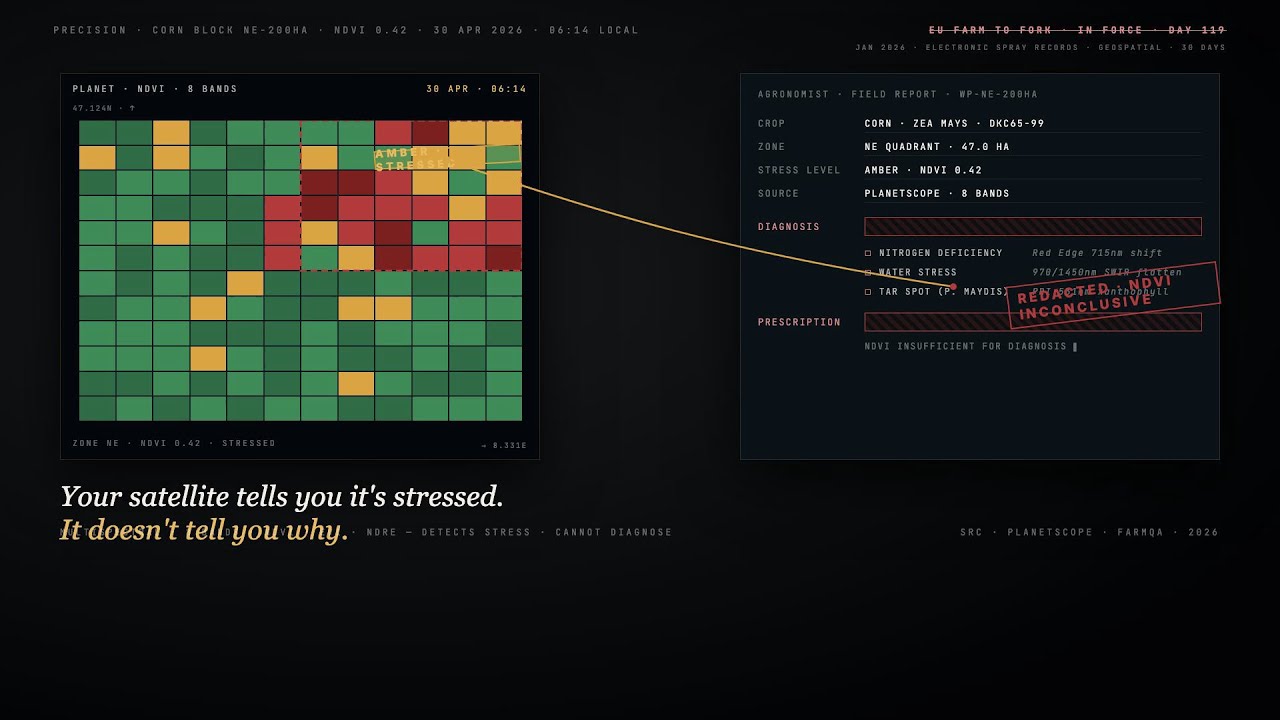
Multispectral monitoring (Planet, Sentinel-2, NDVI) detects that something is wrong. Hyperspectral deep learning diagnoses what is wrong, why, and what to do about it. We build the custom spectral analytics that close the gap between detection and prescription for large-scale farming operations and specialty growers.
Frequently Asked Questions
What does it actually cost to deploy AI on a mid-size row-crop operation, and when does it break even?
Costs range dramatically by scope. Autonomous spraying via John Deere See and Spray adds licensing costs on top of compatible sprayer investment. A full autonomous tractor platform runs $500,000+ (Deere 8R with autonomy kit) or $78,000 (Monarch MK-V for specialty crops). Variable-rate application technology on existing equipment typically costs $15,000-40,000 for controllers, displays, and subscription services. Meta-analysis of global precision ag adoption shows an average 22.3% ROI increase and 18.5% net profit gain, with most operations seeing positive returns within 1-3 growing seasons. But those averages mask enormous variance. A 5,000-acre corn-soy operation with consistent soils and good connectivity captures value faster than a diversified 800-acre specialty operation with variable terrain and limited cellular coverage. We size recommendations to the operation, not to a market report.
Who is liable when AI-generated input recommendations cause crop damage or regulatory violations?
This is the unresolved question in agricultural AI. If an AI system recommends a pesticide concentration that violates EPA FIFRA Section 3 labeling requirements, current law holds the applicator responsible, not the software vendor. Most AI platform terms of service explicitly disclaim liability for agronomic outcomes. Crop insurance adds another layer: USDA RMA adjusters increasingly scrutinize precision ag data during loss verification, and AI-generated management recommendations that deviate from what RMA considers standard agricultural practice can complicate prevented planting and crop loss claims. We build validation layers that test AI recommendations against both agronomic fundamentals and regulatory constraints before they reach the rate controller, creating a documented audit trail that demonstrates due diligence regardless of where formal liability eventually settles.
How does the Nebraska Agricultural Data Privacy Act (LB525) affect my technology contracts?
LB525, passed 49-0 and signed in April 2026, establishes that agricultural producers own data originating from their operations. Starting January 1, 2027, every new contract involving agricultural data collection or processing in Nebraska must include explicit written consent provisions. Controllers cannot sell your data without express written consent through a clear and conspicuous disclosure. The Attorney General enforces it. If you share yield data with an ag retailer, equipment telemetry with a manufacturer, and soil data with a carbon credit aggregator, each relationship needs restructured consent agreements. The American Farm Bureau's Ag Data Transparent certification covers some of these principles, but LB525 creates statutory requirements with enforcement teeth. More states are expected to follow. We help operations audit their current data-sharing arrangements, restructure consent frameworks, and build data architectures with portability controls so that switching platforms does not mean losing years of field history.
How do I connect data across multiple equipment brands and platforms into one usable system?
This is the most common pain point we encounter. A typical operation runs yield data through John Deere Operations Center, chemical records through Bayer Climate FieldView, soil testing through an independent lab, and possibly satellite imagery from a third provider. ISOBUS standardizes machine-to-implement communication but does not extend to the analytics and prescription layer. The result: data lives in silos, and the variable-rate prescription generated in one platform has to be manually transferred (often via USB drive) to a rate controller that may interpret the task file differently. We build integration pipelines that normalize data across platforms, resolve field boundary discrepancies between systems, and produce prescriptions that work correctly on the specific display and controller hardware in the cab. This is not glamorous AI work. It is the plumbing that makes AI recommendations actually reach the field.
How do I evaluate whether an AgTech startup will survive long enough to be worth adopting?
Twenty-one agtech companies entered bankruptcy or liquidation in 2025, destroying $2.8 billion in venture capital. The failure patterns are consistent: companies that prioritized technology over farming economics, built large-scale capacity before securing customers, or relied on a handful of enterprise clients for revenue. Gro Intelligence ($120M raised) failed because it could not find enough buyers. Plenty ($1B raised) survived only by closing its primary facility and pivoting to one crop. Before adopting any platform, look at revenue model (per-acre subscription is more sustainable than enterprise licensing), customer concentration, whether the company has actual farm operations or ag industry veterans in leadership, and whether your data is exportable if the company disappears. We help operations evaluate vendor risk, build data portability safeguards, and architect systems so that no single vendor failure takes your historical data with it.
Can AI-based carbon MRV systems produce credits that actually pass third-party verification?
Some can. Most cannot, at least not at the rigor that premium carbon markets require. The carbon farming market hit $1.45 billion in 2025, and AI-powered digital MRV platforms can increase auditor throughput dramatically. But three persistent challenges limit credit quality: monitoring field-level practices at scale with enough granularity for Verra or Gold Standard protocols, demonstrating that sequestered carbon will persist beyond the crediting period, and managing inherent agricultural variability where soil organic carbon samples from adjacent points in the same field can differ by 30% or more. We build MRV pipelines that address each stage: sensor calibration and ground-truthing for monitoring accuracy, persistence modeling tied to practice commitment agreements, and uncertainty quantification that satisfies registry-level statistical requirements rather than internal reporting thresholds.
What cybersecurity risks come with autonomous farm equipment and connected sensors?
The attack surface on a modern connected farm is larger than most operators realize. GPS spoofing can inject false position data into autonomous tractors, causing misapplication of inputs at wrong rates or locations. The FBI has specifically flagged agricultural cooperatives as targets for ransomware timed to planting and harvesting seasons, when the cost of downtime is highest. IoT sensors, weather stations, and irrigation controllers often run on default credentials with no firmware update schedule. A $500,000 autonomous tractor connected to cellular networks and cloud platforms typically receives less security scrutiny than the farm office laptop. We assess the full connected-equipment stack: RTK correction service authentication, equipment-to-cloud communication encryption, sensor network segmentation, and incident response planning that accounts for the seasonal urgency of agricultural operations.
Why not just hire Accenture or McKinsey for agricultural digital transformation?
They bring enterprise transformation methodology, and for a $500M agribusiness conglomerate restructuring its ERP and supply chain analytics, that can be the right fit. But precision agriculture integration is not enterprise IT. It requires knowing that a variable-rate prescription formatted for a Deere 4640 display will not render correctly on a Raven Viper 4+ running older firmware. It requires understanding why ISOBUS Task Controller messages get dropped when the CAN bus is saturated during high-speed planting. It requires field-testing AI recommendations against the specific soil catena of a given farm, not validating them against a benchmark dataset. Accenture acquired a European precision ag firm in early 2025 precisely because they recognized this gap. We start where the strategy deck ends: at the point where recommendations have to survive contact with actual equipment, actual soil, and actual weather.
Build Your AI with Confidence.
Partner with a team that has deep experience in building the next generation of enterprise AI. Let us help you design, build, and deploy an AI strategy you can trust.
Veriprajna Deep Tech Consultancy specializes in building safety-critical AI systems for healthcare, finance, and regulatory domains. Our architectures are validated against established protocols with comprehensive compliance documentation.