AI Systems for Media Production Compliance and Content Provenance
Custom AI systems for media and entertainment that verify content provenance, enforce multi-guild compliance, and prevent AI-generated fraud across production and distribution.
A single scripted production that uses AI simultaneously touches three separate labor agreements, EU and US disclosure regimes, and a distribution pipeline that strips the provenance it depends on. Our practice is to engineer the compliance, provenance, and verification infrastructure that makes AI tools safe to deploy in a regulated, unionized, litigation-heavy industry — scoped to your specific production types, distribution footprint, and regulatory exposure.
Cross-Guild AI Compliance: WGA, SAG-AFTRA, and DGA on One Production
A single scripted production using AI touches three separate labor agreements with conflicting provisions. The WGA's April 2026 four-year deal prohibits AI from writing or rewriting literary material and now treats unauthorized AI training on writer IP as a compensable violation. SAG-AFTRA's TV/Theatrical contract requires informed consent for digital replicas under Section 26, while the 2025 Interactive Media Agreement adds 7.5x scale compensation for real-time digital replica generation in games. The DGA mandates consultation on AI use in directing but offers no veto power and no training-data restrictions.
If your production uses AI-assisted VFX that alter a performer's face, an AI tool that suggests dialogue alternatives, and an AI system that helps with shot selection, you are operating under three compliance regimes simultaneously — each with different consent requirements, compensation triggers, and enforcement mechanisms.
| Guild | Governing agreement | Core AI provision |
|---|---|---|
| WGA | April 2026 four-year deal | Prohibits AI from writing or rewriting literary material; unauthorized AI training on writer IP is a compensable violation. |
| SAG-AFTRA | TV/Theatrical contract (Section 26); 2025 Interactive Media Agreement | Informed consent required for digital replicas; Interactive Media Agreement adds 7.5x scale compensation for real-time digital replica generation in games. |
| DGA | Directors agreement | Mandates consultation on AI use in directing; no veto power and no training-data restrictions. |
Distribution Multiplies the Regimes
Layer in distribution, and the complexity compounds. EU AI Act Article 50 transparency obligations become fully enforceable on August 2, 2026, requiring explicit labeling of AI-generated audiovisual content. New York's December 2025 synthetic performer disclosure law mandates conspicuous labeling when AI-generated performers appear in advertising, with penalties starting at $1,000 per violation. 47 US states have now enacted some form of deepfake legislation. A production that clears guild compliance in the US can still fail regulatory requirements in its distribution territories.
Our approach is to design AI governance architectures that map these intersecting requirements to your specific production type, distribution footprint, and AI toolset — not a compliance checklist, but a system designed to validate each AI-assisted workflow against the applicable guild provisions, regulatory obligations, and territorial requirements before output reaches distribution.
Content Provenance Breaks Between Camera and Screen
The content authentication ecosystem is splitting into two technical camps. C2PA Content Credentials, backed by Adobe, Microsoft, and the BBC, attach structured metadata manifests to content at creation. Sony's PXW-Z300, announced at IBC 2025, is the first camcorder with native C2PA signing. The alternative approach — signal-based watermarking from Google SynthID and Meta Video Seal (detailed in our research on watermarking generative-AI content) — embeds imperceptible markers directly into pixels and audio frames. Both are necessary. Neither is sufficient alone.
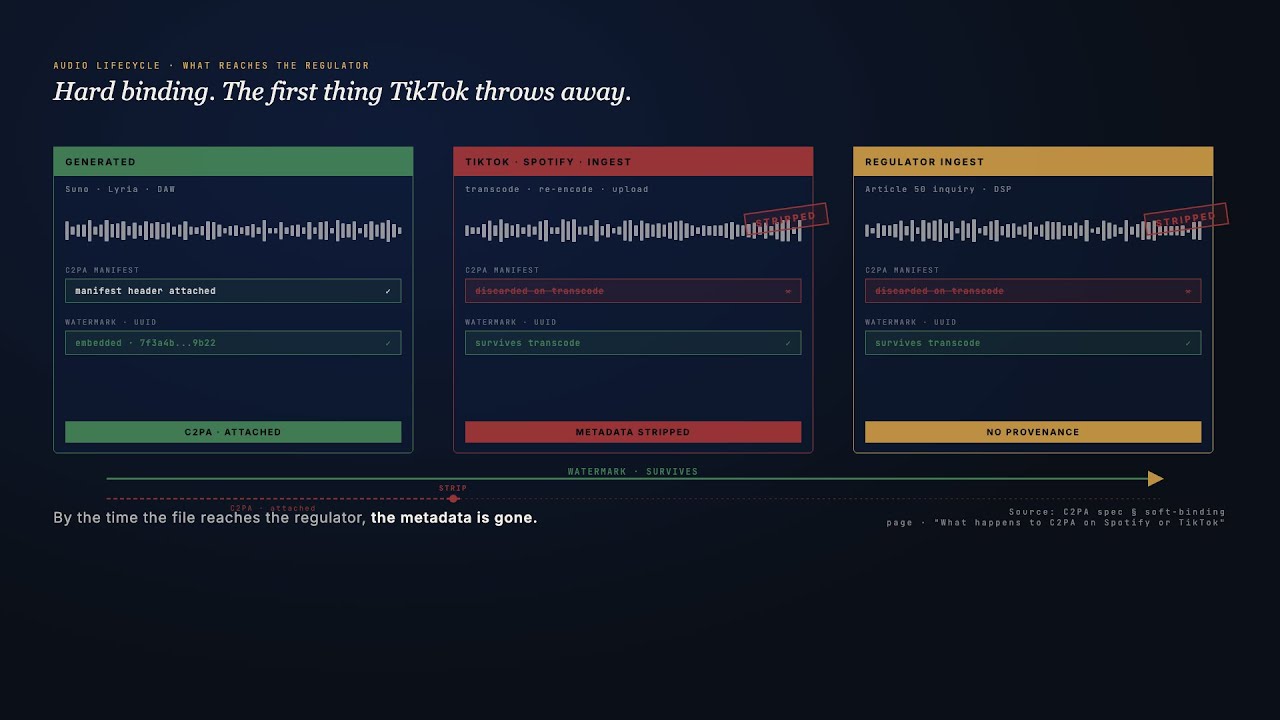
The practical problem is that distribution pipelines strip metadata. When your C2PA-signed footage goes through transcoding, format conversion, CDN delivery, and platform ingest, the manifest can break or disappear entirely. Watermarks persist through these transformations but carry no structured audit trail. C2PA 2.1 addresses this by using watermarks as persistent links back to manifests, but implementation across a real production pipeline — from dailies through DI through deliverables for 40+ territories — requires custom integration work that no single vendor provides.
We design provenance architectures to maintain chain-of-custody from production through distribution: C2PA signing at capture, watermark embedding at key pipeline stages, manifest persistence through transcoding and delivery, and verification endpoints your distribution partners can query. The intended result is a system where any piece of content can prove, at any point in its lifecycle, what is human-created, what is AI-assisted, and what is fully AI-generated.
AI Localization Collapsed the Timeline — Nobody Solved the Compliance
AI dubbing costs dropped from EUR 50-100 per minute of video to EUR 1-2 per minute. Adoption jumped from 5% of content creators in 2023 to 35% in 2026. Amazon Prime Video began testing AI-aided dubbing on licensed titles in March 2025. The business case is obvious: collapsing a 6-week localization pipeline to under a week for 40+ language territories changes the economics of international distribution entirely.
The compliance case is not obvious, and most adopters are not thinking about it:
- Labor grievance — if your AI dubbing tool clones a performer's vocal characteristics without explicit consent under the applicable agreement. SAG-AFTRA's Interactive Media Agreement requires consent for AI voice digital replicas.
- Regulatory violation — if you distribute dubbed content into EU territories without AI-generated labeling. EU AI Act Article 50 requires labeling AI-generated audio.
- Brand crisis — if AI dubbing produces culturally inappropriate translations that go live on a FAST channel with lower editorial oversight.
Our approach is to build localization pipelines in which the AI dubbing tools are wrapped in compliance verification (demonstrated in our working demo of AI audio licensing and provenance): consent validation against applicable guild agreements, cultural adaptation review layers that catch the failures automated translation misses, and AI-generated content labeling that meets Article 50 requirements and persists through distribution. The cost savings of AI dubbing are real, but only if the compliance architecture is built before the content ships.
Streaming Fraud Is an AI Arms Race Platform-Native Tools Cannot Win
Spotify removed over 75 million spam tracks in its 2025 AI music crackdown. YouTube wiped 4.7 billion views in a single January 2026 enforcement wave, terminating 16 channels with 35 million combined subscribers that had been mass-producing AI-generated fake movie trailers. Independent creators are losing roughly $600,000 per day to fraudulent AI-generated streams that dilute royalty pools. The fraud has evolved beyond simple bot plays: Autonomous Streaming Entities now mimic human behavior, simulate social media sharing to dead accounts, and fake localized GPS data to evade geographic detection.
The legal landscape is shifting simultaneously. Warner Music and UMG both settled their RIAA-backed lawsuits against AI music generators in late 2025, pivoting to licensed AI music platforms launching in 2026. Sony's cases remain active. The US Copyright Office has stated that prompts alone do not provide sufficient human control to establish authorship, which means AI-generated tracks in your catalog may not carry enforceable copyright protection. If you cannot distinguish which tracks in your library were AI-generated, you cannot assess your own IP exposure.
We design content verification and fraud detection systems (grounded in our research on neuro-symbolic content verification) intended to go beyond what Spotify's spam filters or YouTube's inauthentic content policies catch: audio fingerprinting that identifies AI-generated content at ingest, provenance verification that tracks how content was created, and royalty-pool protection mechanisms that prevent fraudulent streams from diluting legitimate creator earnings. Platform-native tools react to known fraud patterns. Custom systems are built to identify patterns before they are cataloged.
AI in Production Is Moving from Pilot to Pipeline
NAB 2026 almost doubled its AI exhibitor count from 2025. Avid and Google Cloud announced a partnership to bring agentic AI into Media Composer. Adobe expanded Firefly into a full online video editor. The PGA TOUR runs automated live broadcast production with agentic AI making real-time decisions. The technology is available. The gap is integration reliability and governance.
Each capability arrives with a matching risk:
- AI metadata tagging can process in minutes what manual cataloging takes days to complete, but accuracy on domain-specific content remains inconsistent.
- Publishers deploying AI chatbots for audience engagement (see our working demo of conversational AI for publishers) face defamation risk when those systems hallucinate attribution or fabricate quotes.
- AI recommendation engines drive 80% of Netflix viewing, but emerging transparency laws create liability questions around algorithmic curation.
- AI-assisted VFX tools reduce weeks of rotoscoping to hours, but the VFX/animation industry contracted 7.6% in H1 2025, and workforce concerns are real.
Our approach is to build the integration and governance layer between AI tools and production workflows: connecting AI metadata tagging to your MAM system with accuracy validation for your content domain, building recommendation systems with the transparency mechanisms emerging regulations require, and deploying AI production tools with guild-compliance verification and human oversight that make adoption defensible, not just efficient.
Why Not a Platform Vendor or a Large Consultancy
Avid, Adobe, and the cloud hyperscalers build excellent horizontal AI features into their production tools. They will not build a compliance verification layer that maps your specific production's guild obligations across SAG-AFTRA, WGA, and DGA simultaneously. They will not audit your AI dubbing pipeline for Article 50 labeling compliance in each distribution territory. Adobe Firefly generates video; it does not verify that the generated content meets the provenance requirements of your distribution agreements.
Accenture committed $3.6 billion to its AI practice. McKinsey's QuantumBlack employs roughly 5,000 AI specialists. These firms advise on transformation strategy and integrate platforms. They do not build deterministic provenance chains from camera to CDN, construct fraud detection tuned to your content library, or architect cross-guild compliance verification for productions using AI across writing, performing, and directing.
The AI in media and entertainment market reached $35.77 billion in 2026. Most of that spend goes to platform vendors building general-purpose tools. The compliance, provenance, and verification infrastructure that makes those tools safe to deploy in a regulated, unionized, litigation-heavy industry requires custom engineering for each organization's production types, distribution footprint, and regulatory exposure.
Key Takeaways
- Map every AI-touched workflow to its guild before production starts. Because writing, performing, and directing fall under three different agreements at once, treat consent and compensation as per-workflow gates — not a single sign-off — so a VFX face-alter or a dialogue-suggestion tool can't slip through unchecked.
- Prioritize the Article 50 deadline for anything shipping into the EU. With labeling enforceable from mid-2026, put AI-content disclosure ahead of discretionary features, and clear US guild compliance and territorial disclosure as two separate checks — passing one does not clear the other.
- Build provenance as a persistence problem, not a signing problem. Because manifests break in transcoding and CDN delivery while watermarks carry no audit trail, pair both standards and add manifest-persistence checkpoints across your 40+ territory deliverables — a capture-only signature isn't enough.
- Wrap AI dubbing in compliance before you bank the savings. The per-minute cost collapse only pays off net of consent validation, cultural review, and labeling; build that layer into the pipeline up front rather than retrofitting it after content ships.
- Own fraud detection and IP classification in-house. Since platform-native tools trail evolving Autonomous Streaming Entities and copyright now hinges on documented human contribution per track, invest in custom detection and per-track provenance to protect royalty pools and gauge your own IP exposure.
- Expect to build, not buy, the safety layer. Platform vendors and large consultancies won't construct cross-guild verification or camera-to-CDN provenance for you, so budget for custom engineering scoped to your production types, distribution footprint, and regulatory exposure.
Solutions for Media & Entertainment
 Watch
WatchAI Audio Licensing, Watermarking & Provenance for Media
We build end-to-end audio provenance pipelines for labels, DSPs, distributors, and ad agencies. Watermark embedding and detection, C2PA content credentials, DDEX AI disclosure, licensed voice conversion, takedown workflows, indemnification-grade chain of title. The Article 50 clock is 4 months out.
 Watch
WatchConversational AI for Publishers: RAG Over News Archives
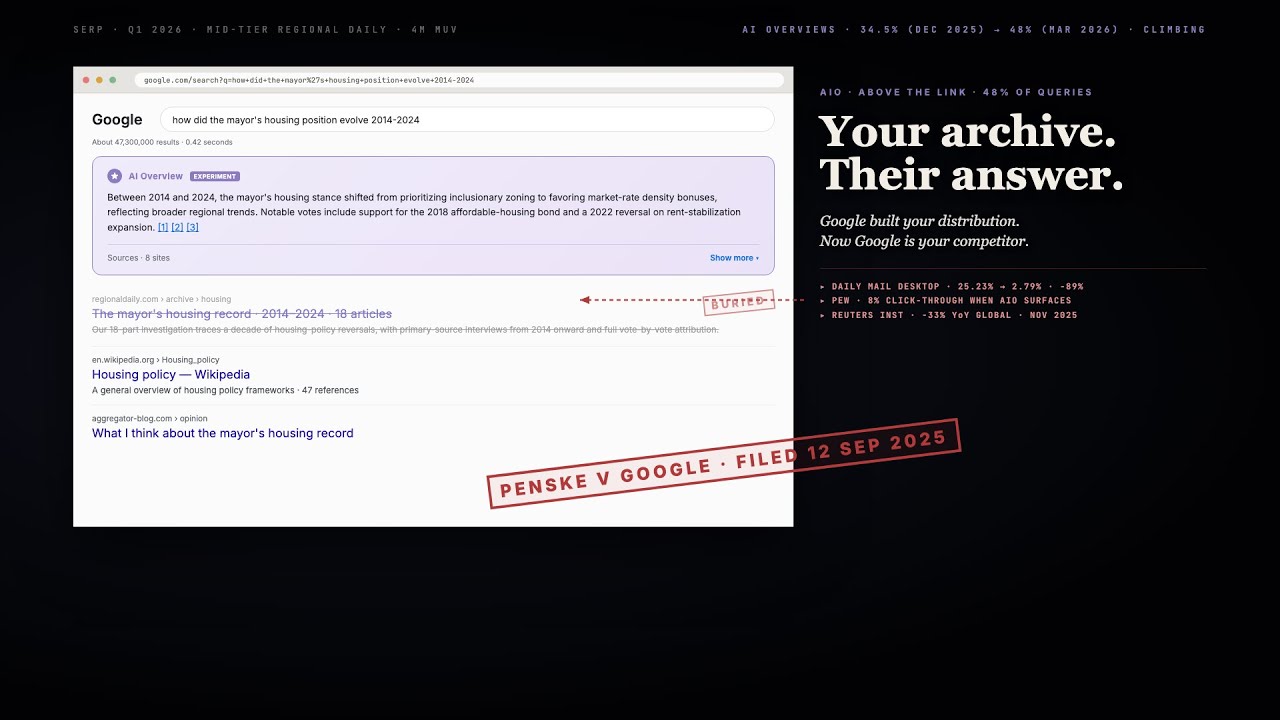
We build conversational AI engines on top of publisher archives. Citation-enforced answers, temporal reasoning, GraphRAG entity resolution, and a parallel licensing strategy that captures revenue from the AI engines you do not control. For mid-tier publishers who cannot afford a six-engineer ML team but cannot afford to wait, either.
Related AI Services
Frequently Asked Questions
How do I comply with SAG-AFTRA, WGA, and DGA AI provisions simultaneously on the same production?
Each guild has different AI requirements. The WGA prohibits AI from writing or rewriting literary material and now treats unauthorized AI training on writer IP as compensable. SAG-AFTRA requires informed consent for digital replicas, with the 2025 Interactive Media Agreement adding 7.5x scale for real-time generation. The DGA mandates consultation but offers no veto. We build compliance verification systems that map each AI-assisted workflow against the applicable guild provisions, flagging consent gaps, compensation triggers, and disclosure requirements before content enters production.
What does EU AI Act Article 50 mean for studios distributing AI-generated content internationally?
Article 50 transparency obligations become fully enforceable on August 2, 2026, requiring explicit labeling of AI-generated audiovisual content including dubbed audio, synthetic performers, and AI-modified footage. Studios distributing into EU territories need content labeling systems that identify AI-generated elements, persist through transcoding and delivery pipelines, and produce audit trails for regulatory review. We build labeling and provenance architectures that meet these requirements across your full distribution footprint.
How do I implement content provenance tracking when C2PA metadata breaks during distribution?
C2PA Content Credentials attach structured provenance data at creation, but transcoding, format conversion, and CDN delivery can strip or break manifests. The solution is layered: C2PA signing at capture, watermark embedding at key pipeline stages as persistent fallback links to manifests, manifest validation checkpoints through post-production, and verification endpoints for distribution partners. Sony's PXW-Z300 supports native C2PA signing at capture, but the end-to-end pipeline from dailies through DI through 40+ territory deliverables requires custom integration.
What is the actual copyright status of AI-generated music after the Suno and Udio settlements?
Warner Music settled with Suno and UMG settled with Udio in late 2025, both pivoting to licensed AI music platforms launching in 2026. Sony's cases remain active. The US Copyright Office stated in January 2025 that prompts alone do not provide sufficient human control to establish authorship, meaning purely AI-generated tracks may not carry enforceable copyright protection. If you distribute AI-generated music, you need provenance systems that track the level of human creative contribution to each track, because copyright status depends on it.
How much does AI localization actually save when factoring in compliance costs?
Raw AI dubbing costs dropped from EUR 50-100 per minute to EUR 1-2 per minute. But compliance adds layers: EU AI Act Article 50 labeling for AI-generated audio, SAG-AFTRA consent requirements for voice digital replicas, cultural adaptation review for the failures automated translation misses, and territory-specific regulatory checks. The net savings are still substantial for most production types, but only if the compliance architecture is built into the pipeline from the start rather than retrofitted after content ships.
How do I detect AI-generated streaming fraud that platform-native tools miss?
Spotify removed 75 million spam tracks and YouTube wiped 4.7 billion views in early 2026, but fraud has evolved past simple bot detection. Autonomous Streaming Entities mimic human behavior, simulate social sharing, and fake GPS data. Custom detection requires audio fingerprinting at ingest to identify AI-generated content, behavioral analysis that catches synthetic listening patterns, and provenance verification that tracks content creation methods. Platform tools react to cataloged fraud patterns. Custom systems identify emerging patterns before they are cataloged.
What AI governance framework works for a media company operating in both the US and EU?
A cross-jurisdictional framework needs to address EU AI Act transparency and labeling obligations, US guild provisions (SAG-AFTRA, WGA, DGA), state-level deepfake laws across 47 states, FTC authority over deceptive AI-generated content, and copyright exposure from AI training data. We build governance architectures that map these overlapping requirements to specific production workflows, creating automated compliance checks at each pipeline stage rather than relying on manual legal review that cannot scale across productions.
Build Your AI with Confidence.
Partner with a team that has deep experience in building the next generation of enterprise AI. Let us help you design, build, and deploy an AI strategy you can trust.
Veriprajna Deep Tech Consultancy specializes in building safety-critical AI systems for healthcare, finance, and regulatory domains. Our architectures are validated against established protocols with comprehensive compliance documentation.