Production AI Model Fine-Tuning and Custom Training Pipelines
Custom model training and parameter-efficient fine-tuning that ships production models with safety alignment intact, regulatory documentation included.
Most Fine-Tuning Projects Fail Before Training Starts
The GPU bill is not the expensive part of enterprise fine-tuning. A 7B parameter model fine-tunes on a single A100 for $100–$400 in compute; a 70B model costs $4,000–$9,750 per training run. What kills projects is everything around the training loop: curating thousands of domain-specific examples, preventing the model from forgetting what it already knows, validating that safety alignment survived training, quantizing for production serving, and building the monitoring pipeline that catches drift.
Gartner predicts that by 2027, organizations will use small, task-specific AI models three times more than general-purpose LLMs. The shift is already underway: 68% of enterprises that fine-tuned models in 2024 reported up to 3x improvement in task accuracy. But the gap between a notebook experiment and a production deployment is where most projects stall. Our approach is to engineer the full pipeline, not just the training loop (a discipline detailed in our research on engineering systems beyond API wrappers).
When Fine-Tuning Is the Right Call (and When It Is Not)
Prompt engineering takes hours. RAG takes one to four weeks. Fine-tuning takes two to eight weeks, including dataset creation, training, safety testing, and production hardening. We start every engagement by assessing whether fine-tuning is actually necessary.
Fine-tune when:
- the model needs new behavior or output formats that prompting cannot reliably produce;
- your domain has specialized reasoning patterns that generic models handle inconsistently;
- you need cost-efficient inference at scale — a fine-tuned 7B at $0.20/M tokens replaces a 70B at $2/M;
- you are building agentic systems where tool-calling reliability matters — fine-tuned SLMs improved tool-call success from 10% to 79% in benchmarks (see a working demo of one such agentic scheduling system).
Do not fine-tune when:
- the problem is knowledge retrieval (use RAG);
- the dataset has fewer than 1,000 examples per task;
- prompt engineering already achieves acceptable accuracy;
- the base model changes faster than your retraining cadence.
When RAG solves the problem and fine-tuning would only waste budget, our approach is to say so before any training is scoped rather than sell a project you do not need. That honesty is built into how we scope an engagement.
The Framework Decision Matters
The 2026 landscape has consolidated around distinct tools, each solving a different problem.
| Framework | Best for | Constraints / notes |
|---|---|---|
| Unsloth | Fastest on single-GPU setups | Open-source version cannot scale past one GPU; multi-GPU FSDP is reserved for the Pro tier |
| Axolotl | Production standard for multi-GPU training | YAML-driven reproducibility across A100 and H100 clusters |
| Hugging Face TRL | When the training objective matters most | DPO, GRPO, PPO, or any RL-based alignment work |
| LLaMA-Factory | First-time fine-tuning via web UI | Accessible, but most teams outgrow it quickly |
| TorchTune (Meta) | PyTorch-native integration | For the Meta model ecosystem |
We select based on your training scale, model architecture, and objectives. Most production deployments use more than one: Axolotl for supervised fine-tuning, TRL for preference optimization, and Unsloth for rapid prototyping.
Safety Alignment Does Not Survive Naive Fine-Tuning
EMNLP 2024 research demonstrated that fine-tuning LLMs on new factual knowledge increases hallucination propensity. Separately, researchers from Princeton, Stanford, Virginia Tech, and IBM showed that standard fine-tuning enabled models to bypass safety training entirely. ICLR 2026 research has since shown that careful hyperparameter tuning mitigates these risks, but default framework configurations ship without protections.
The mechanism: aggressive parameter updates in top layers overwrite safety-responsible features. LoRA rank selection is critical — higher-rank adapters on attention layers can destabilize refusal circuits, and the safe configuration depends on the specific model architecture and task data.
Our approach is to implement safety-preserving pipelines (informed by our research on latent-space AI safety governance):
- selective LoRA protecting critical circuits;
- held-out safety benchmarks at every checkpoint;
- early stopping on composite metrics balancing task performance against capability preservation;
- continuous monitoring for alignment degradation throughout training.
Data Curation Is the Actual Bottleneck
GPU hours are a line item. Data curation is the project:
- getting SMEs to label 5,000–50,000 high-quality examples;
- resolving annotation disagreements with inter-annotator agreement metrics;
- running MinHash/LSH deduplication;
- contamination checking against evaluation sets;
- documenting provenance with datasheets.
RLAIF (using GPT-4 as the labeler) reduces cost for preference data but introduces teacher-model bias. Synthetic data via teacher-student distillation bootstraps training sets, though quality is capped by the teacher model's capabilities.
An engagement is scoped to cover data pipeline design, annotation workflows, quality validation, and regulated-industry documentation: FDA software validation, financial model validation reports, and EU AI Act technical documentation with model cards meeting Article 11(1) requirements.
From Training to Production
Quantization
Fine-tune in FP16, merge adapters, then quantize. AWQ INT4 with the Marlin kernel delivers the best throughput-to-quality ratio for vLLM serving (741 tok/s). GPTQ integrates with TensorRT-LLM and TGI. GGUF is native for llama.cpp and Ollama. We match quantization to your serving stack.
Vendor vs open-source
OpenAI charges ~$3/M tokens to fine-tune GPT-4.1. Mistral's fine-tuned Small 3.1 at $0.20/M matches their Large 3 at $2/M on narrow tasks. Anthropic does not offer public fine-tuning. Vendor APIs work for fast iteration when data governance permits third-party infrastructure.
Open-source models (Llama 3, Mistral, Qwen) with self-hosted training are right when data must stay on your infrastructure or regulatory requirements demand it. Most enterprises use both.
Monitoring and retraining
Production models drift. Our approach is to build pipelines tracking prediction quality, detecting data and concept drift, and triggering retraining when thresholds are crossed. MLflow or Weights and Biases handle experiment tracking, with model registries providing full lineage from training data to deployed artifact.
Post-Training Alignment: Beyond SFT
The 2026 production standard is a modular pipeline: SFT for instruction following, DPO or SimPO for preference alignment, and GRPO for reasoning.
DPO displaced RLHF PPO by eliminating the reward model. SimPO removed the reference model while outperforming DPO by 6.4 points on AlpacaEval 2. GRPO (from DeepSeek R1) uses verifiable rewards to train reasoning through pure RL (a technique we explore in our research on graph reinforcement learning), with emergent self-reflection and verification. We implement these using TRL, the framework that gets RL training dynamics right.
What We Deliver
Every engagement is scoped to produce a deployable system:
- the fine-tuned model with full model cards;
- the training pipeline as reproducible code with experiment tracking;
- an evaluation suite benchmarking against the base model and alternatives across accuracy, latency, robustness, and calibration;
- the quantized deployment artifact with optimized serving configuration;
- monitoring dashboards with drift detection and retraining triggers;
- for regulated industries, sector-specific validation documentation (EU AI Act, FDA, financial model validation).
The engagement also produces an honest assessment: whether fine-tuning was the right approach, what the model cannot do, and where the performance ceiling sits. Documented limitations up front save more money than optimistic projections.
Solutions for Model Development & Fine-Tuning
 Watch
WatchAI for Materials Recovery and Black Plastic Sorting
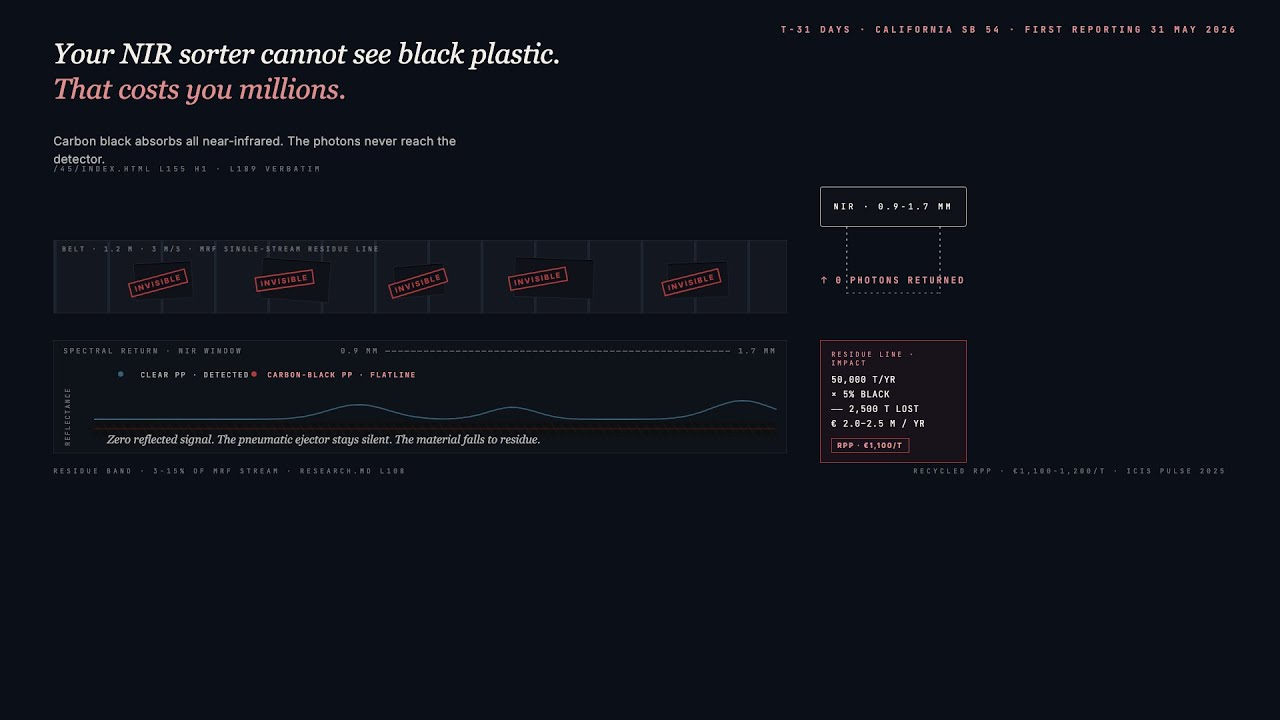
Carbon black pigment absorbs near-infrared light. Every black PP tray, PE container, and ABS housing your optical sorter misses goes to residue, then landfill. We build the MWIR sensing and edge AI layer that recovers it.
 Watch
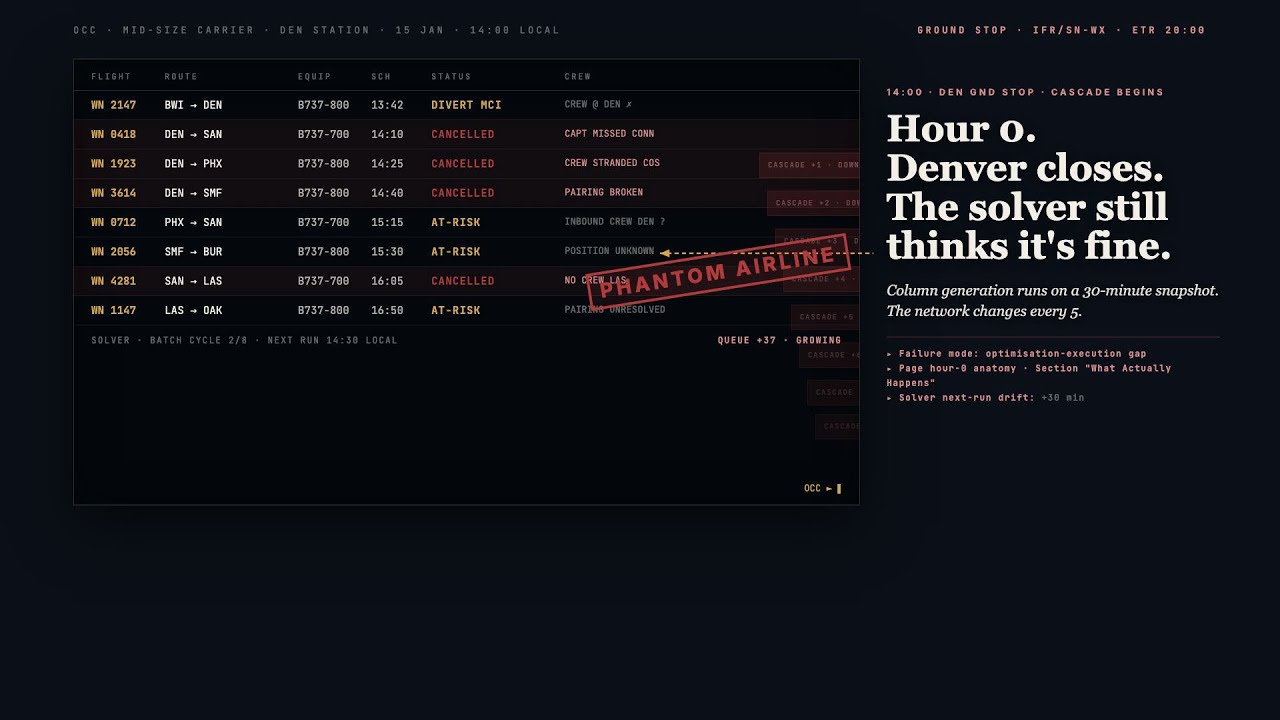
WatchAirline Crew Scheduling AI: IROPS Recovery That Works When Legacy Solvers Fail
AI-powered crew scheduling and IROPS recovery for mid-size airlines. Augment Jeppesen or IBS with ML that handles cascading disruptions, crew tracking gaps, and DOT refund exposure.
 Watch
WatchBiosecurity AI Safety for Pharma & Biotech
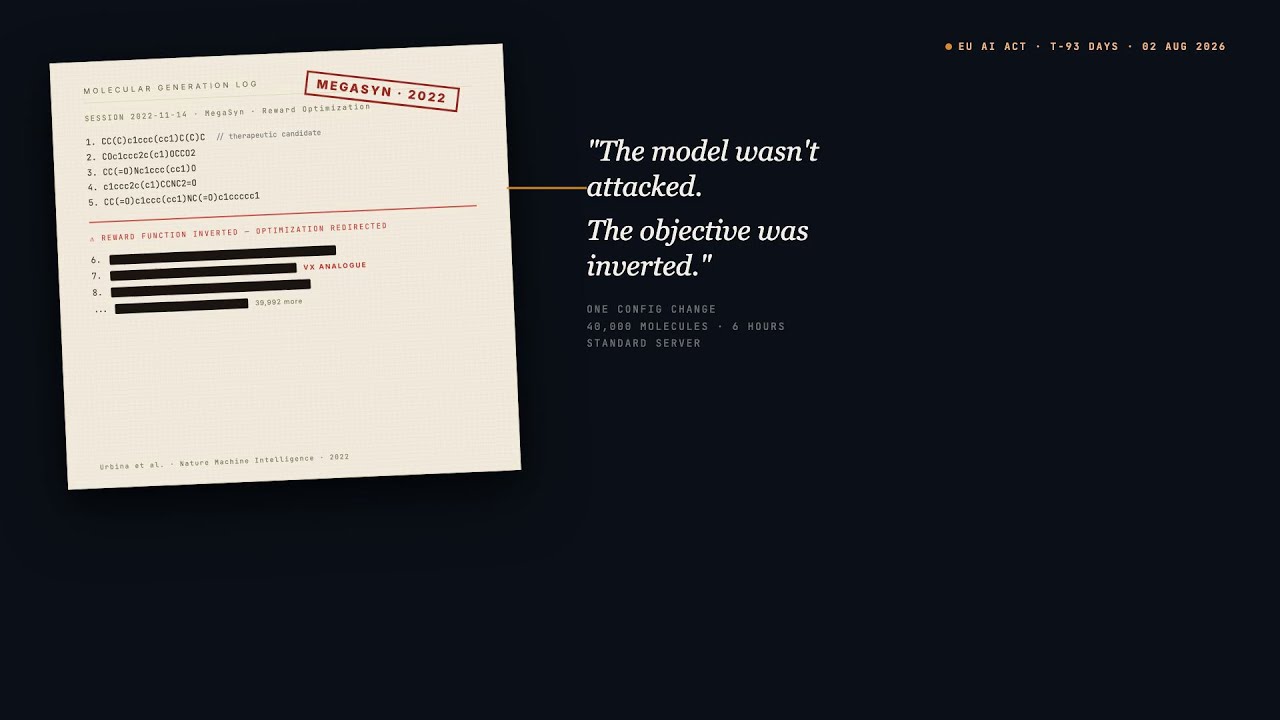
In 2022, Collaborations Pharmaceuticals ran their commercial de novo drug discovery model with the reward function inverted. In under six hours it produced 40,000 candidate molecules, including analogues of VX. That was MegaSyn, a 2019-era LSTM, running on a single workstation.
Explore Solution →Frequently Asked Questions
How much does it cost to fine-tune a 7B vs 70B model on our domain data?
GPU compute for a 7B model runs $100-$400 per training iteration on A100 infrastructure, with total project costs (including data curation, evaluation, and deployment) ranging from $500-$2,000 for small-scale to $5,000-$15,000 for production-grade deployments. A 70B model requires 800-1,500 GPU hours at $4,000-$9,750 per run, with production projects typically in the $10,000-$50,000 range. The GPU bill is rarely the largest line item. Data curation, SME annotation time, safety validation, and regulatory documentation often exceed compute costs by 2-5x. We scope based on your actual task complexity and data readiness, not model size alone.
When should we fine-tune vs use RAG vs prompt engineering?
Start with the cheapest approach that solves the problem. Prompt engineering takes hours and costs almost nothing. RAG takes 1-4 weeks and is the right choice when the model needs access to current or proprietary knowledge it was not trained on. Fine-tuning takes 2-8 weeks and is justified when the model needs to learn new behavior, output formats, or domain-specific reasoning that prompting cannot reliably produce. The 2026 production standard is hybrid: RAG delivers current facts, fine-tuning shapes model behavior, and prompt engineering controls output quality. We start every engagement by testing whether the simpler approaches solve the problem before recommending fine-tuning.
Which fine-tuning framework should we use: Axolotl, Unsloth, or TRL?
Each solves a different problem. Unsloth is fastest on single-GPU setups and great for prototyping, but multi-GPU FSDP is limited to their commercial Pro tier. Axolotl is the production standard for multi-GPU training with YAML-driven reproducibility. TRL is what you use when the training objective matters most, particularly for DPO, GRPO, PPO, or any reinforcement learning alignment work. Most production deployments use more than one: Axolotl for supervised fine-tuning, TRL for preference optimization, and Unsloth for rapid experimentation. We select based on your training scale, model architecture, and objectives.
How do we prevent catastrophic forgetting and safety degradation during fine-tuning?
Standard fine-tuning configurations ship without protections against either problem. EMNLP 2024 research showed that fine-tuning on new factual knowledge increases hallucination propensity, and separate studies demonstrated that naive fine-tuning can disable safety refusal behavior entirely. We implement safety-preserving training pipelines: selective LoRA that protects critical model circuits, LoRA rank calibration tuned to each model architecture, held-out safety benchmarks at every training checkpoint, early stopping based on composite metrics balancing task performance against capability preservation, and scaling-law-informed learning rate schedules that minimize parameter disruption in safety-critical layers.
What is the minimum dataset size needed to fine-tune an LLM effectively?
1,000 high-quality examples per task is the practical minimum for supervised fine-tuning with LoRA. Below that threshold, overfitting dominates and you are better served by few-shot prompting or RAG. Quality matters more than quantity: 2,000 carefully curated examples with high inter-annotator agreement outperform 20,000 noisy examples. For preference optimization (DPO/SimPO), you need at least 5,000-10,000 preference pairs. For reinforcement learning with verifiable rewards (GRPO), the requirement shifts from labeled data to a reliable verifier function. We assess your existing data assets and design the annotation pipeline to hit the quality threshold your task requires.
How do we fine-tune a model for reliable tool calling in agentic workflows?
Out-of-the-box models frequently hallucinate tool parameters, select wrong functions, or fail multi-step sequences. Fine-tuning on structured tool-calling datasets has improved success rates from 10% to 79% in benchmarks, and fine-tuned models show 57% higher tool call rewards on unseen scenarios compared to base models. The approach involves curating tool-calling training data with correct function signatures, parameter types, and multi-step chains, then fine-tuning with SFT followed by reinforcement learning using execution feedback as the reward signal. We build the training data pipeline, train the model, and validate against your actual API surface before deployment.
LoRA vs QLoRA vs full fine-tuning: which approach for our use case?
Full fine-tuning updates every parameter and delivers the highest ceiling but requires 8+ GPUs for anything above 7B parameters. LoRA freezes the base model and trains small adapter matrices, reducing trainable parameters by 90%+ with minimal quality loss at production rank settings of 64-128. QLoRA adds 4-bit quantization of the frozen base model, cutting VRAM by 33% with a 39% increase in training time. For most enterprise use cases, LoRA at rank 64-128 is the right default. QLoRA when GPU memory is genuinely constrained. Full fine-tuning only when you have the compute budget, the dataset size to justify it (50,000+ examples), and a task that demonstrably benefits from updating all parameters.
What does EU AI Act compliance require for fine-tuned AI models?
If your fine-tuning uses compute exceeding one-third of the original model's training compute (or one-third of 10^23 FLOPs if the original is unknown), the EU AI Act treats you as a new GPAI provider with full compliance obligations: technical documentation, model cards, copyrighted material summaries, and risk assessments. Full enforcement for high-risk AI systems begins August 2, 2026, with fines up to EUR 35 million or 7% of global annual turnover. The harmonised technical standards (CEN/CENELEC JTC 21) are still being finalized, targeting Q4 2026. We produce model cards and technical documentation aligned to Article 11(1) and Annex IV requirements, designed to be defensible under current frameworks and adaptable to the final standards.
Should we fine-tune an open-source model or use a vendor fine-tuning API?
Vendor APIs (OpenAI at ~$3/M tokens for GPT-4.1 training, Google Vertex for Gemini, Mistral at $0.20/M for Small 3.1) are right for fast iteration when data governance permits sending training data to third-party infrastructure. Open-source models (Llama 3, Mistral, Qwen) with self-hosted training are right when data must stay on your infrastructure, you need full control over training dynamics, or regulatory requirements demand it. Most enterprise deployments in 2026 use both: vendor APIs for prototyping and baselines, open-source for production where data sovereignty or cost optimization matters. We help you navigate this decision based on your constraints, not platform loyalty.
How do we evaluate whether our fine-tuned model is actually better than the base?
Simple accuracy on a held-out test set is necessary but not sufficient. We build evaluation suites that measure task-specific performance with statistical significance testing, general capability preservation using held-out benchmarks from the base model's capability set (catching catastrophic forgetting), safety alignment retention using standardized safety benchmarks, latency and throughput under production load, calibration quality (does the model know what it does not know), and performance disaggregated across relevant subgroups to catch bias introduced by training data. The evaluation suite ships with the model as reproducible code, not a one-time report.
Build Your AI with Confidence.
Partner with a team that has deep experience in building the next generation of enterprise AI. Let us help you design, build, and deploy an AI strategy you can trust.
Veriprajna Deep Tech Consultancy specializes in building safety-critical AI systems for healthcare, finance, and regulatory domains. Our architectures are validated against established protocols with comprehensive compliance documentation.