AI Systems for Financial Services That Pass Model Risk and Regulatory Review
AI systems for banks, capital markets, asset managers, and fintech builders that produce the model risk, DORA, and fair lending artifacts regulators actually want.
The financial services buyer who walks into an AI engagement in 2026 is not asking whether to deploy LLMs. JPMorgan's LLM Suite already reaches roughly 230,000 to 250,000 employees across about 450 use cases in production, with a target of 1,000 by year end; Goldman Sachs, Morgan Stanley, BBVA, Citi, HSBC, and most tier-1 banks have rolled their own. The real question is how to get a production AI system past model risk validation, fair lending testing, DORA third-party review, and a FINRA supervision exam, and still have it usable on the floor.
What We Build and the Artifacts That Ship With It
Our approach is to build custom AI systems for banks, capital markets desks, asset and wealth managers, payments and fintech infrastructure, and the cross-cutting risk and treasury functions that sit on top — each one scoped so that the artifacts regulators actually ask for are produced alongside the system, not bolted on after a demo has to earn its paperwork:
- Model validation packages built to address "effective challenge" under SR 11-7 and OCC 2011-12 even when the model has 70 billion parameters.
- Retention pipelines that treat LLM prompts and outputs as business communications under FINRA SEA Rule 17a-4, with WORM export to whatever compliance archive the firm already runs.
- Fair lending test harnesses that survive a CFPB review on ECOA disparate impact (detailed in our research on the fair-lending accountability crisis).
- Decision logs that a Reg SCI change-management audit can read without hand-waving.
Which AI Regulations Must a 2026 Financial System Satisfy?
Five regimes now sit over any production deployment at once. We design against this evolving stack, not against a 2021 textbook.
| Regime | Effective date | What it forces on a production system |
|---|---|---|
| DORA | 17 January 2025 | Treats Azure OpenAI, AWS Bedrock, and Google Vertex as critical ICT third parties, with exit-plan obligations. |
| NYDFS 23 NYCRR Part 500 | Guidance issued 16 October 2024 | Document AI-enabled social engineering threats, vendor risk, and access controls. |
| FinCEN Alert FIN-2024-Alert004 | November 2024 | Include deepfake typologies in SAR filings. |
| EU AI Act (high-risk provisions) | Full application 2 August 2026 | Classifies credit scoring and insurance underwriting as high-risk AI. |
| SEC Predictive Data Analytics rule | In reproposal | Has already frozen several advisor-facing AI launches. |
How Do You Stop a Deepfaked CFO From Authorizing a Wire?
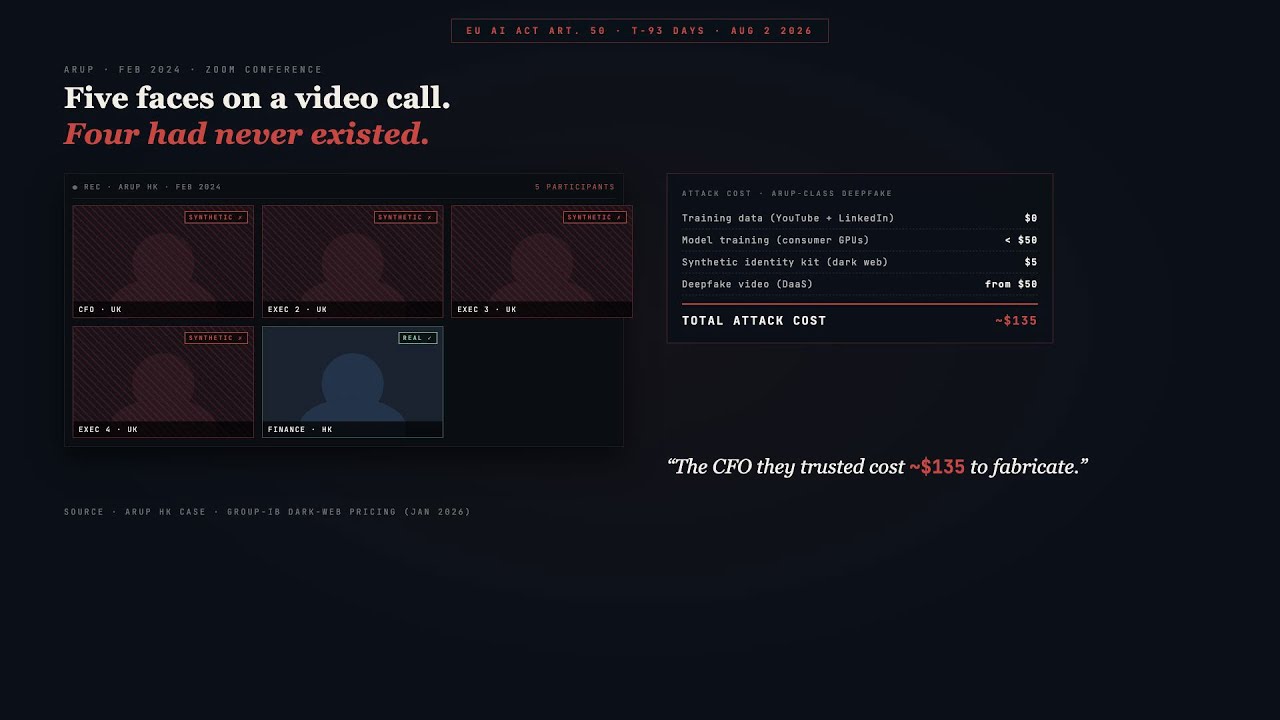
An Arup employee in Hong Kong wired about US$25 million in February 2024 after a deepfaked video call impersonating the CFO and other executives. The existing treasury fraud stack, built around NICE Actimize rules and 2022-era liveness detection, did not catch it.
Our approach is to build real-time video and voice authenticity verification that plugs into the treasury wire workflow, with deterministic gating on high-value movements — so the deepfake risk does not depend on a stressed analyst spotting a synthetic face on a Zoom call (detailed in our research on the Arup deepfake breach).
Can You Validate a 70-Billion-Parameter LLM Under SR 11-7?
"Effective challenge" under SR 11-7 assumes a validator can interrogate model internals; a 70 billion parameter LLM defeats that assumption by construction. Banks are responding in three incompatible ways, none of which passes an exam cleanly:
- They throttle deployment.
- They expand MRM hiring for ML-literate validators — a market that cannot supply at volume.
- They quietly rely on vendor assertions.
Our approach makes the deterministic constraint layer — built on a domain-grounded knowledge graph — the validated component, producing decision paths a validator can audit directly, without reading tensor weights.
The generative model sits behind that layer as a bounded, non-authoritative input — constrained in what it can act on, continuously monitored, and outcome-tested against the evaluation harness — rather than treated as a validated model in its own right. The documentation bundle (inventory, data lineage, evaluation harness, performance monitoring) is produced in the same format MRM teams already use for classical models, so the evidence is legible under the effective-challenge review a horizontal exam applies.
Every Segment Sits on a Different Regulatory Spine
Capital markets, asset management, and retail banking share the same architectural problem but each sits on a different regulatory spine, so we build to the specific spine, not to a generic "financial services AI" template. Find your surface and the obligation the build must respect:
| Deployment / surface | Governing regime & what the build must respect |
|---|---|
| Research summarization agent (sell-side) | Must respect MAR information-barrier rules. |
| Algorithmic trading deployment | Must evidence Reg SCI change management — Knight Capital's $440 million loss in 45 minutes in 2012 still gets cited in every algo-governance discussion. |
| Wealth advisor copilot | Must sit inside Reg BI and CFA Institute ethics guidance, with the SEC Predictive Data Analytics rule over all of it. |
| AI agent acting on a retail customer's behalf | Reg E liability and fiduciary exposure have to be assigned before deployment, not after a complaint. |
| Underwriting model | Must pass CFPB ECOA disparate-impact testing. |
| KYC system | Must detect GenAI-synthesized identity documents at onboarding volume. |
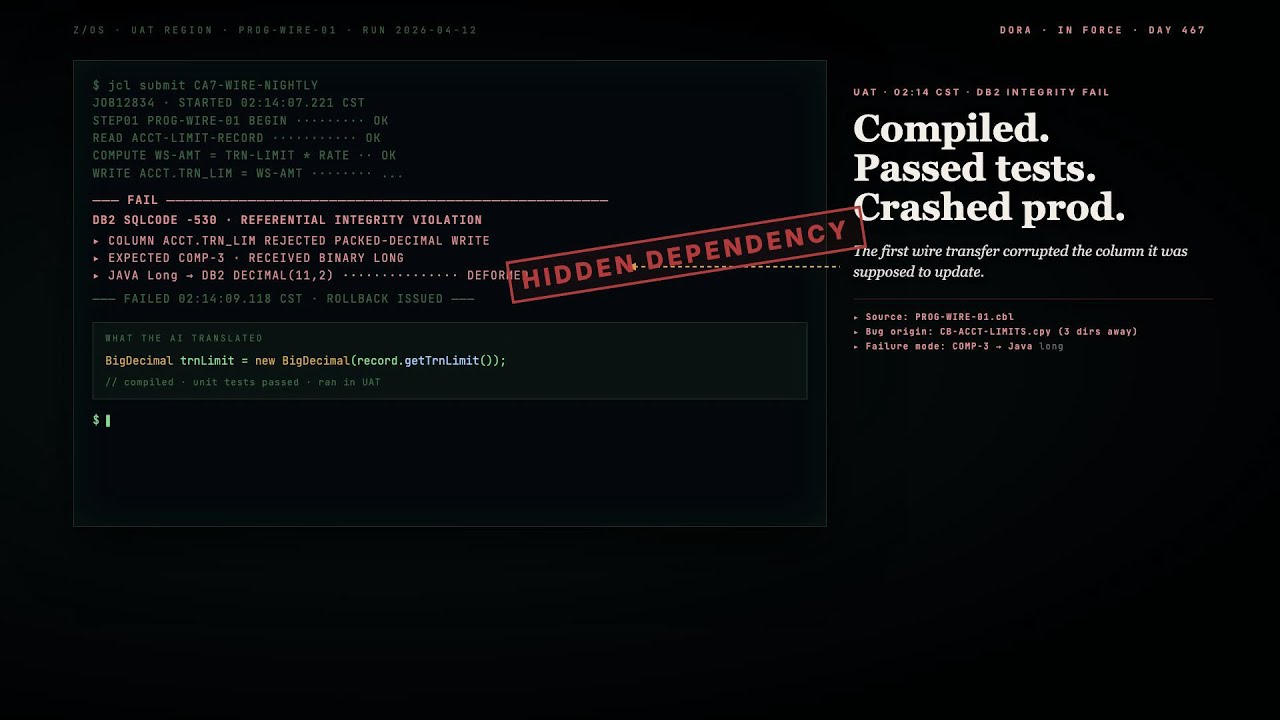
| Core-banking modernization | Rewriting forty-year-old COBOL logic cannot lose batch settlement behavior in translation — see a working demo of legacy COBOL modernization. |
| Privacy-preserving deployment | May need federated learning, differential privacy, or homomorphic encryption rather than a raw cloud LLM. |
| Real-time fraud system | At ISO 20022 payment-rail latency, needs deterministic scoring in front of any LLM signal. |
How This Differs From Platforms, Big 4, and Point Vendors
Each category of provider solves part of the problem; none stitches the full stack. That stitching is the work we focus on — the difference between a system scoped to ship through a risk committee and one that gets parked in a sandbox.
| Provider | What they sell | The gap |
|---|---|---|
| Platform vendors | A horizontal copilot | Not built to the regulatory spine of any one financial-services surface |
| Big 4 firms | A methodology deck and staff augmentation | Governance design, not the deterministic systems engineering that makes a model defensible |
| Specialist FS AI vendors (Kensho, NICE Actimize, Featurespace, ComplyAdvantage, Feedzai, Zest AI, Upstart) | One surface solved well | None stitches the full stack across surfaces |
The full stack is domain ontology, grounded retrieval with provenance, deterministic constraint enforcement, human-in-the-loop gates where fiduciary or consumer-protection risk is present, regulator-defensible decision logs, continuous evaluation, and third-party-concentration-safe architecture.
Key Takeaways
- Adoption is settled — the open question is passing SR 11-7 model validation, fair lending testing, DORA review, and FINRA supervision while staying usable.
- Every engagement is scoped to ship the regulator-facing artifacts — SR 11-7 / OCC 2011-12 validation packages, FINRA 17a-4 WORM retention, CFPB fair lending harnesses, and Reg SCI decision logs.
- The deterministic constraint layer over a domain knowledge graph is the validated component — it bounds a 70-billion-parameter LLM as a monitored, non-authoritative input, so the evidence a validator inspects never depends on reading tensor weights.
- Our approach is to build to the specific regulatory spine of each segment, stitching the full stack that platforms, Big 4 firms, and point vendors each leave incomplete.
Solutions for Financial Services
 Watch
WatchAlgorithmic Trading Compliance AI
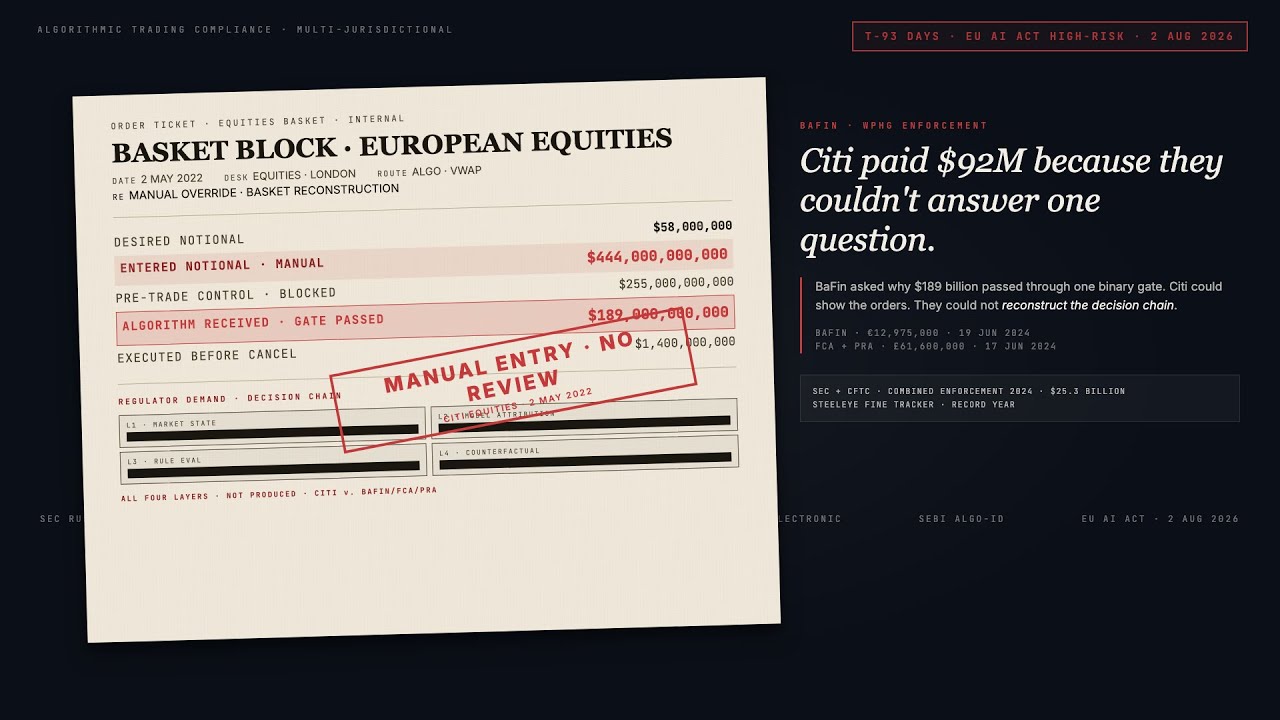
Regulators are done accepting order logs as audit evidence. After the August 2024 flash crash wiped $1 trillion in value and Citigroup paid $92 million in fines for a single algorithmic failure, the question has shifted from "do you have controls? " to "can you reconstruct every decision your algorithm made?
 Watch
WatchEnterprise AI Validation for Regulated Industries
Klarna replaced 700 customer service agents with AI. Costs dropped 40%. Then satisfaction collapsed, repeat contacts spiked, and Q1 2025 ended with a $99 million net loss.
 Watch
WatchEnterprise Deepfake Detection & Video Call Fraud Prevention
In February 2024, attackers used AI-generated deepfakes of an entire executive team to steal $25. 6 million from Arup in a single video call. Since January 2026, standard cyber insurance policies explicitly exclude deepfake fraud.
 Watch
WatchFinancial Compliance Formal Verification for Banks
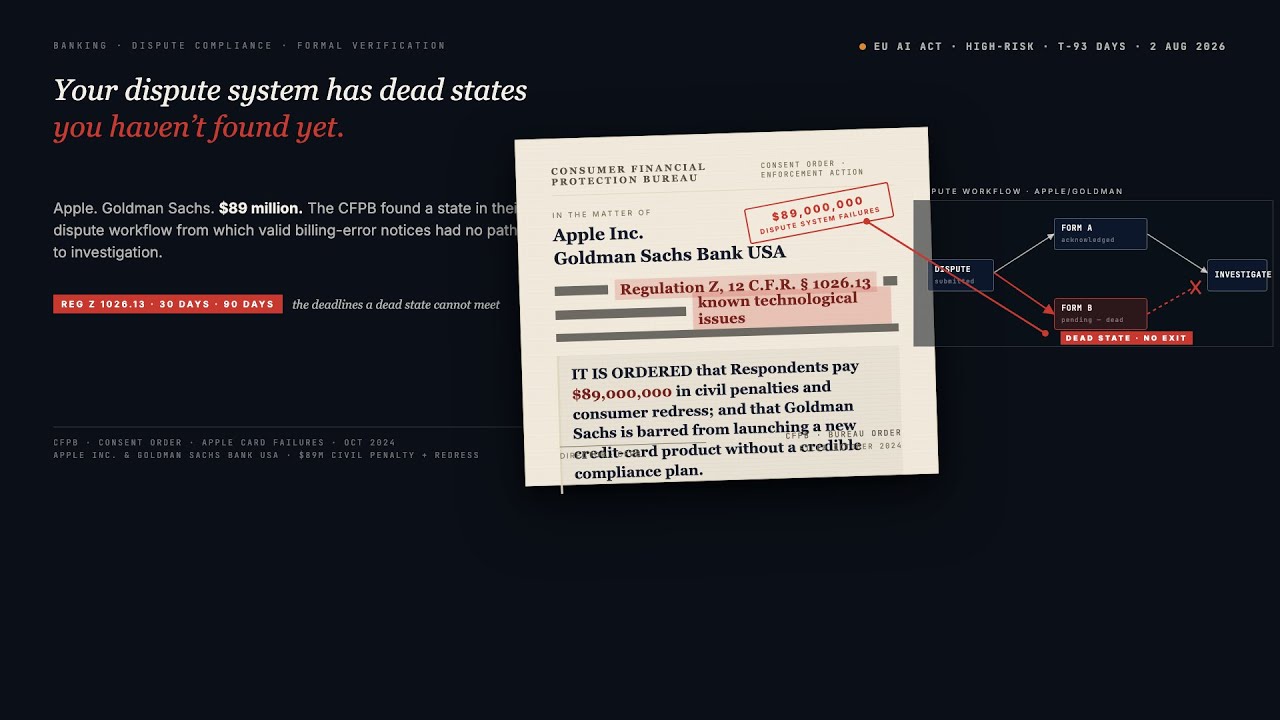
Apple and Goldman Sachs had thousands of engineers, billions in revenue, and a dispute resolution workflow that silently dropped tens of thousands of valid billing error notices into a technical void. The CFPB found it. They paid $89 million.
 Watch
WatchLegacy COBOL Modernization with Knowledge Graph Intelligence
70-80% of mainframe modernization projects fail. Not because the technology is wrong, but because the tools treat code as text instead of topology. We build the map of your codebase before touching a single line, so your migration succeeds where others have burned through millions and delivered nothing.
 Watch
WatchTax Compliance AI Verification
Thomson Reuters "Ready to Review" auto-prepares 1040s. CCH Axcess Expert AI drafts advisory insights across 10,000 firms. Blue J answers tax research questions with a disagree rate under 1 in 700.
Related AI Services
Frequently Asked Questions
Can we deploy an LLM inside an underwriting or risk workflow without failing SR 11-7 model validation?
Yes, but the validation package has to be architected up front. We wrap the LLM in a deterministic constraint layer backed by a domain knowledge graph, produce decision paths a validator can audit without reading tensor weights, and generate the SR 11-7 and OCC 2011-12 documentation bundle (model inventory, data lineage, evaluation harness, performance monitoring, effective-challenge evidence) in the same format your MRM team already uses for classical models. Retrofitting this later after a horizontal review almost never ends well.
What does DORA mean for a bank using Azure OpenAI, AWS Bedrock, or Google Vertex as its primary AI stack?
DORA came into force on 17 January 2025 and treats cloud AI providers as critical ICT third parties. That triggers three obligations: a Register of Information listing the provider, a concrete exit plan that can be executed without material business disruption, and third-party concentration analysis. We design architectures that keep the reasoning layer, retrieval layer, and decision logs portable across at least two providers, so the exit plan is not a slide but a tested runbook.
How do we detect deepfake CFO video calls before a treasury wire goes out?
The Arup Hong Kong US$25 million deepfake in February 2024 proved that 2022-era liveness detection plus traditional rule-based treasury controls is not enough. We build real-time video and voice authenticity verification into the wire approval workflow, combined with deterministic gating on high-value movements: any wire above a dynamic threshold requires out-of-band verification over a channel the attacker cannot spoof. The objective is to remove the deepfake-detection decision from a stressed analyst looking at a Zoom grid.
What does the EU AI Act's August 2026 high-risk deadline actually require for credit scoring and insurance underwriting?
From 2 August 2026, credit-scoring systems and insurance risk-pricing systems are classified as high-risk AI under the Act. Providers and deployers must maintain a quality management system, technical documentation, logging and traceability, human oversight, and post-market monitoring. For banks, the harder obligation is the interaction with existing ECOA, GDPR, and consumer-credit regimes: one system has to satisfy all of them simultaneously. Our builds produce one integrated documentation spine rather than four parallel ones.
How do we handle FINRA SEA Rule 17a-4 record retention for LLM prompts and outputs at a broker-dealer?
Every LLM interaction at a broker-dealer is a business communication and has to be retained in non-rewriteable, non-erasable (WORM) format with supervisory review under FINRA Rule 3110. Most SaaS LLM vendors do not export in a WORM-ready format out of the box. We build a retention and supervision pipeline that captures prompt, system instruction, retrieval context, model output, and disposition, exports it to Smarsh, Global Relay, or whatever archive the firm already uses, and produces the supervisory review queue your compliance team expects.
How do we run CFPB-grade fair lending disparate-impact testing on a GenAI-assisted underwriting signal?
CFPB and OCC expect that any decision input, including LLM-generated features, is tested for ECOA and FHA disparate impact across protected classes. We build a fair lending harness that treats the LLM output as a feature, runs adverse-impact ratio and standardized mean difference tests, checks for proxy variables that correlate with protected attributes, and produces a written justification for any observed disparity along with mitigation. This has to be a recurring test, not a one-time deployment artifact.
How is this different from what Microsoft, Salesforce, or the Big 4 firms sell?
Platform vendors sell horizontal copilots and agent frameworks; they do not ship SR 11-7 documentation, FINRA 17a-4 WORM export, DORA exit-plan templates, or CFPB fair lending harnesses. Big 4 firms sell governance methodology and staff augmentation, strong on decks and operating-model design, weaker on the deterministic systems engineering that makes a model defensible. Specialist financial-services AI vendors each cover one surface well, fraud or trading or AML. We stitch the full stack into a system that ships through a risk committee rather than getting parked in a sandbox. We are vendor-neutral on the foundation layer and opinionated on everything around it.
Build Your AI with Confidence.
Partner with a team that has deep experience in building the next generation of enterprise AI. Let us help you design, build, and deploy an AI strategy you can trust.
Veriprajna Deep Tech Consultancy specializes in building safety-critical AI systems for healthcare, finance, and regulatory domains. Our architectures are validated against established protocols with comprehensive compliance documentation.