AI Litigation Readiness That Survives Adversarial Examination
We prepare AI systems for adversarial legal examination: litigation-grade documentation, evidence preservation, discovery readiness, and multi-jurisdictional defense.
Is Your AI System Defensible Under Adversarial Examination?
Our approach is to build the technical infrastructure designed to make AI systems defensible under legal examination — not compliant in the checkbox sense, but defensible in the sense that a litigator can walk a jury through how a decision was made, a 30(b)(6) corporate designee can testify about the system's behavior without hedging, and an expert witness can satisfy a Daubert challenge on model interpretability.
This is engineering work, not policy drafting. An engagement is scoped to produce evidence preservation architectures, litigation-grade documentation, and discovery-ready artifacts that exist before anyone files suit.
These are not hypothetical risks — they are active dockets with real damages, real discovery orders, and real remediation requirements. The question for organizations deploying AI is not whether they face legal exposure. It is whether their systems can survive what happens next: adversarial discovery, depositions of the engineers who built the models, expert testimony about training data provenance, and regulatory examinations where "we used a vendor tool" is not a defense — a posture we replace with owned infrastructure, as shown in a working demo of a sovereign, private LLM deployment.
What Discovery Looks Like in AI Cases (and Why Most Companies Fail It)
In September 2025, the Southern District of New York established AI discovery standards in the OpenAI copyright litigation. Courts now compel production of a baseline set of artifacts, and plaintiffs' counsel in algorithmic discrimination cases go considerably further.
The baseline courts now compel
- User prompts
- Model outputs and AI-generated drafts
- Metadata with timestamps and model identifiers
- Access logs
- Configuration settings
What discrimination plaintiffs additionally demand
- Source code
- Training data composition
- Model validation reports
- A/B test results
- Internal Slack messages about known bias
- Post-deployment monitoring data
- Every version of the model that ran in production during the relevant period
Most companies fail discovery in one of two ways. Either the evidence does not exist because no one built the infrastructure to capture it — leading to spoliation sanctions and adverse inference instructions. Or the evidence exists but looks damaging, because internal communications reveal engineers flagged bias concerns that were never addressed, or model changes were deployed without documented testing.
Our approach addresses both failure modes. For the first, we design evidence preservation systems to capture decision context automatically at inference time: the model version hash, input features, preprocessing state, confidence scores, and active governance policies. For the second, we design structured model change management workflows where every modification is documented with rationale, testing results, and approval chains — so the discovery record tells a coherent story of responsible development rather than haphazard iteration.
The Regulatory Enforcement Calendar Is Not Waiting
Three major enforcement deadlines converge in mid-2026.
- Colorado SB 205 takes effect June 30, 2026, with penalties up to $20,000 per violation and an affirmative defense available only to organizations demonstrating NIST AI RMF compliance.
- The EU AI Act's high-risk obligations begin enforcement August 2, 2026, with penalties reaching EUR 35 million or 7% of global turnover. Article 73 requires serious incident notification within 2 days for deaths or critical-infrastructure disruptions, and 15 days for other incidents.
- Existing state AG enforcement is already live: Massachusetts settled AI lending discrimination in July 2025, and 36 state AGs formally opposed federal preemption to preserve their enforcement authority.
The enforcement landscape is internally contradictory. The CFPB proposed ending disparate impact enforcement under ECOA in November 2025, while state AGs filed AI discrimination actions under UDAP statutes with per-violation penalties. The FTC reversed its Rytr consent order in February 2026, then issued a comprehensive AI agent enforcement framework in March 2026.
Organizations that built compliance programs to a single regulatory signal are exposed when that signal changes. Our approach is to design defense architectures mapped to the obligations themselves, not to any single regulator's current posture (informed by our research on algorithmic accountability).
Litigation-Grade Documentation vs. Compliance Documentation
There is a meaningful difference between documentation that satisfies a compliance audit and documentation that survives adversarial legal examination.
| Compliance documentation | Litigation-grade documentation |
|---|---|
| Answers "did you follow the process?" | Answers "prove this specific decision was not discriminatory — with evidence that an opposing expert cannot dismantle on cross-examination." |
| Model cards designed for ML practitioners | Model documentation prepared for a Daubert hearing |
The audience, the adversarial scrutiny, and the evidentiary standard are fundamentally different.
An engagement is scoped to produce documentation at the litigation-grade standard: every consequential AI decision is reconstructable from its record — the exact model version, input data, feature values, preprocessing pipeline state, and decision logic are retrievable months or years after the fact.
Domain-specific defenses we document
- Employment AI: the job-relatedness and business necessity defense (the Griggs/Wards Cove burden-shifting framework under Title VII), documented at the system-design level rather than as after-the-fact rationalization.
- Lending and insurance AI: disparate impact testing methodology documented with enough rigor that a plaintiff's statistical expert cannot challenge the testing as inadequate.
- Housing AI: the evidence chain showing voucher-holder treatment was not proxied through credit history or debt factors — the exact attack vector in SafeRent-style litigation, where the algorithm scored applicants using factors that disproportionately disadvantaged Black and Hispanic renters (detailed in our research on the SafeRent algorithmic-integrity mandate).
Mock Discovery: Finding Your Weaknesses Before Opposing Counsel Does
An engagement can include adversarial exercises in which our engineers take the role of a plaintiff's technical expert, probing your AI systems for the weaknesses litigation would exploit:
- Undocumented model changes
- Untested fairness properties across protected groups
- Missing impact assessments
- Audit trail gaps
- Internal communications contradicting published policies
- Data provenance gaps undermining training data integrity claims
The exercise is designed to produce a privileged assessment — under attorney-client privilege when paired with outside counsel — surfacing weaknesses before they become courtroom exhibits.
This is not a tabletop exercise. We draft the interrogatories and document requests opposing counsel would serve, identify custodians whose files would be searched, test whether preservation systems capture what courts require (per the SDNY's 2025 AI discovery standards), and evaluate whether your 30(b)(6) designee can testify without creating more exposure than they resolve. The intended output is a remediation roadmap organized by litigation risk severity, with engineering specifications for closing each gap.
Multi-Jurisdictional Defense Without Parallel Programs
A company with EU customers, Colorado employees, Illinois job applicants, and insurance operations in any of the 23 states that adopted the NAIC AI Model Bulletin faces at least five overlapping regulatory regimes for a single AI system. Building separate compliance programs per jurisdiction does not scale, and it creates inconsistencies that plaintiffs' counsel exploit:
"You told Colorado regulators your bias testing methodology was X, but your EU conformity assessment describes it as Y. Which is it?"
Our approach is to build a unified defense framework where the strictest applicable standard sets the baseline.
- A disparate impact testing protocol that satisfies Colorado SB 205's algorithmic discrimination standard simultaneously produces evidence for EU AI Act Article 10 data governance requirements and Title VII's business necessity defense.
- An incident response procedure that meets Article 73's 2-day notification timeline automatically satisfies the New York RAISE Act's 72-hour window and state AG notification expectations.
Jurisdiction-specific documentation layers generate the right artifacts for each regulator or court without maintaining parallel programs. When a new state law passes or the EU AI Office issues enforcement guidance, the overlay updates. The base controls rarely change, because they are already built to the highest bar.
Board-Level Liability and the Fiduciary Duty Question
AI governance failures create personal liability risk for directors under Delaware's Caremark standard. Boards that fail to implement reporting systems for AI risk face derivative shareholder claims. The SEC listed AI among its top examination priorities for 2025-2026, and boards are expected to document AI oversight frameworks in proxy statements by the 2026 proxy season.
An engagement is scoped to produce the board-facing deliverables designed to close this gap:
- Executive briefing materials that translate technical AI risk into governance language
- Risk registers mapped to fiduciary obligations
- Monitoring systems that give directors documented evidence of active oversight
Not a quarterly slide deck — a structured information system providing the basis to demonstrate good-faith AI risk oversight, the specific standard Caremark requires.
Key Takeaways
- Defensibility is engineering, not policy: evidence preservation architectures, litigation-grade documentation, and discovery-ready artifacts must exist before suit is filed.
- AI discovery now compels prompts, outputs, metadata, source code, training data, and every production model version — capture decision context at inference time or risk spoliation sanctions.
- Three 2026 deadlines converge: Colorado SB 205 (June 30), the EU AI Act's high-risk obligations (August 2), and Article 73 serious-incident notification.
- Vendor tools do not transfer liability; a unified, strictest-standard framework with jurisdiction-specific overlays beats parallel per-regulator programs.
- Board oversight of AI risk is now a Caremark duty-of-care question backed by SEC examination priorities.
Solutions for Regulatory Risk & Litigation Readiness
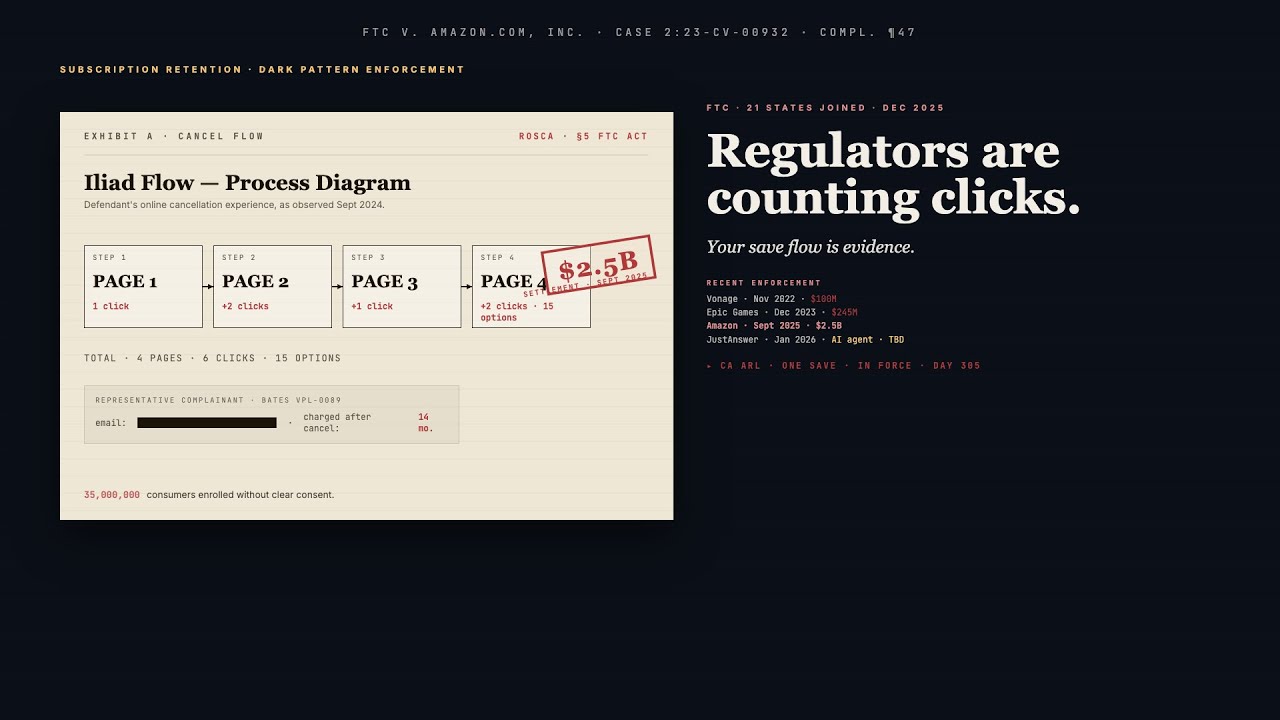 Watch
WatchEthical Subscription Retention AI
Amazon paid $2. 5 billion for a cancel flow that took 6 clicks. Uber is facing 21 state attorneys general over 23 screens to cancel.
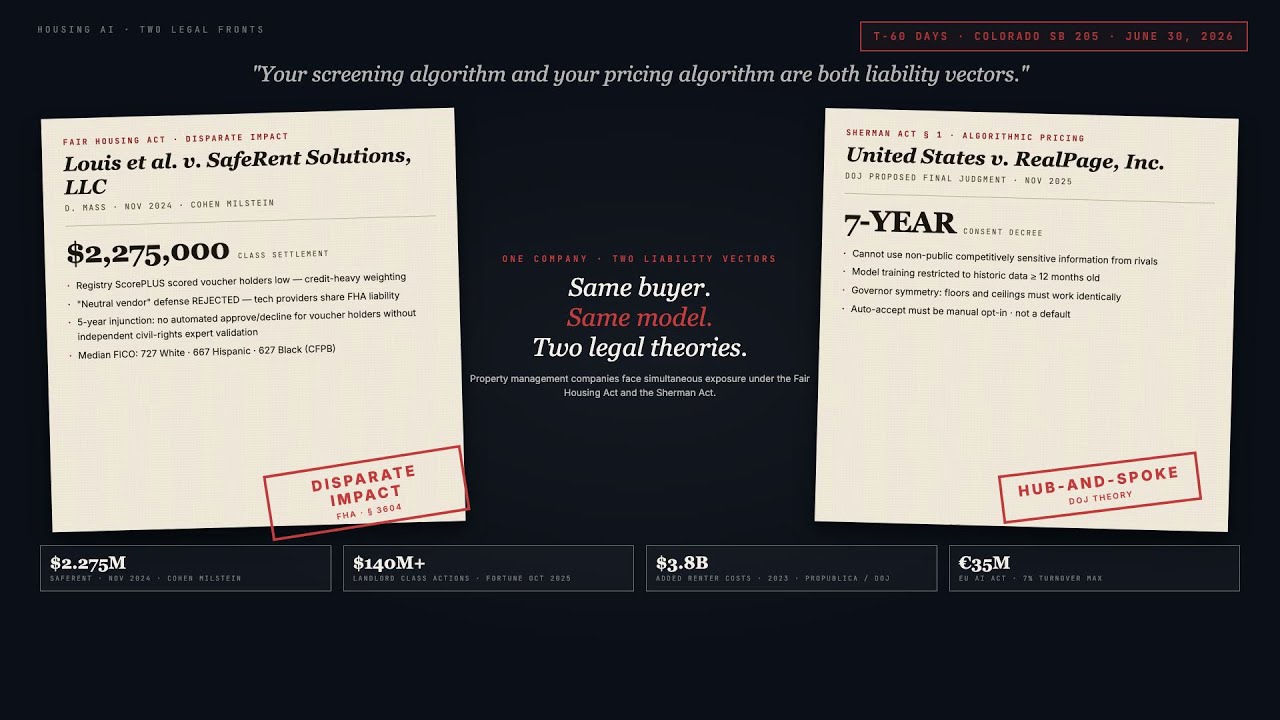 Watch
WatchHousing AI Compliance: Tenant Screening Fairness and Algorithmic Pricing
Property management companies face simultaneous legal exposure on two fronts: tenant screening that discriminates under the Fair Housing Act, and revenue management that coordinates pricing under the Sherman Act. We audit both, engineer compliant architectures, and map your systems against every jurisdiction that matters.
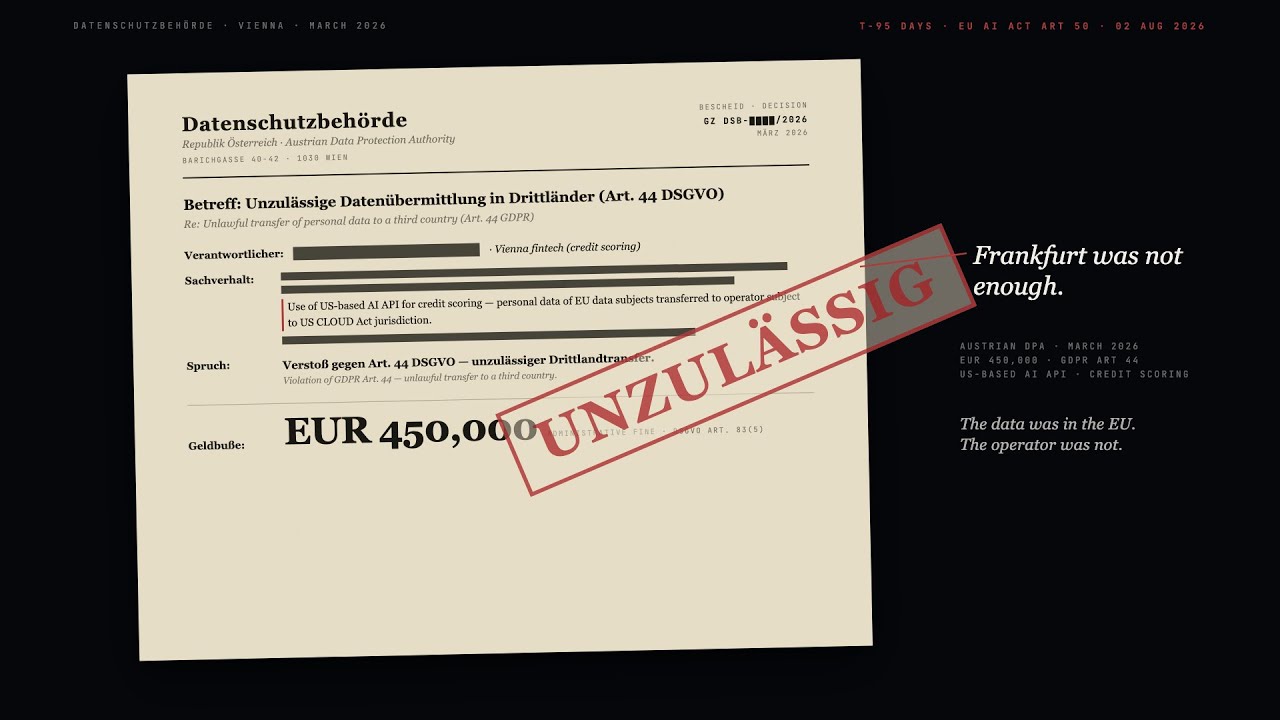 Watch
WatchSovereign AI & Private LLM Deployment
One in five organizations has already suffered a breach from unsanctioned AI tool usage. Banning AI does not work. Building secure, sovereign alternatives does.
Frequently Asked Questions
What does AI litigation discovery actually require and how do we prepare for it?
Following the SDNY's September 2025 AI discovery standards, courts now compel production of user prompts, model outputs, AI-generated drafts, metadata with timestamps and model identifiers, access logs, and configuration settings. Plaintiffs' counsel in discrimination cases go further: source code, training data composition, model validation reports, A/B test results, internal communications about known bias, and every production model version during the relevant period. Preparation means building evidence preservation infrastructure that captures decision context automatically at inference time, not assembling it retroactively after a subpoena lands. We design systems that store the model version hash, input features, preprocessing state, confidence scores, and active governance policies for every consequential decision, queryable by decision ID, time range, or outcome class.
How is litigation-grade AI documentation different from standard model cards or compliance documentation?
Compliance documentation answers 'did you follow the process?' Litigation-grade documentation answers 'prove this specific decision was not discriminatory, with evidence that an opposing expert cannot dismantle on cross-examination.' Model cards designed for ML practitioners lack the adversarial scrutiny standard, the evidentiary chain-of-custody, and the specific legal framework mapping (Daubert for expert testimony, Griggs/Wards Cove for disparate impact burden-shifting, FCRA for consumer report disclosures) that litigation demands. We produce documentation where every consequential decision is reconstructable from its record: exact model version, input data, feature values, preprocessing pipeline state, and decision logic, retrievable months or years after the fact with tamper-evident integrity.
What are the penalty benchmarks for AI regulatory non-compliance in 2026?
The penalty landscape has concrete numbers. Colorado SB 205 (effective June 30, 2026): up to $20,000 per violation under the Consumer Protection Act, with an affirmative defense only for organizations demonstrating NIST AI RMF compliance. EU AI Act (high-risk enforcement August 2, 2026): up to EUR 35 million or 7% of global annual turnover for prohibited practices, EUR 15 million or 3% for high-risk non-compliance. Illinois AIVFA: up to $5,000 per violation plus private lawsuits, with 37 cases filed in the first month of enforcement. FCRA statutory damages: $100-$1,000 per willful violation, which scales dramatically in class actions like the Eightfold AI lawsuit covering data on over one billion workers. State UDAP statutes allow per-violation penalties without proof of individual damages.
Are we liable for AI discrimination when we use a vendor's tool, not our own model?
Yes. Employers remain fully liable for discriminatory outcomes from vendor AI tools under Title VII, FCRA, and state employment laws. In Mobley v. Workday (May 2025), the court held that Workday's 'role in the hiring process is no less significant because it allegedly happens through artificial intelligence rather than a live human being.' The Eightfold AI FCRA class action names employers who used the scoring tool. Colorado SB 205 imposes separate obligations on deployers regardless of whether they built the AI system. You cannot outsource legal liability by outsourcing the technology. We help organizations build the documentation, testing, and oversight infrastructure that demonstrates you exercised due diligence over vendor AI tools, which is the defense that actually matters when a plaintiff's complaint lands.
How do we handle AI compliance when federal and state regulators are moving in opposite directions?
The current environment is internally contradictory. The CFPB proposed ending disparate impact enforcement under ECOA in November 2025, while state AGs simultaneously filed AI discrimination actions under state UDAP statutes. The FTC reversed its Rytr consent order in February 2026, then issued a comprehensive AI agent enforcement framework in March 2026. A December 2025 executive order proposed federal preemption of state AI laws, but 36 state AGs formally opposed it and until courts rule, state laws remain enforceable. We build defense architectures mapped to the statutory obligations themselves, not to any single regulator's current posture. A unified control framework with jurisdiction-specific documentation overlays means that when enforcement priorities shift, the overlay updates while the base controls hold.
What is a mock discovery exercise and what does it actually produce?
A mock discovery exercise is an adversarial simulation where our engineers role-play as plaintiff's technical experts probing your AI systems for litigation vulnerabilities. We draft the actual interrogatories and document requests opposing counsel would serve, identify the custodians whose files would be searched, test whether your preservation systems capture what courts now require under the SDNY's 2025 AI discovery standards, and evaluate whether your 30(b)(6) corporate designee can testify about the system without creating additional exposure. The output is a privileged remediation roadmap (conducted under attorney-client privilege when paired with outside counsel) organized by litigation risk severity, with engineering specifications for closing each gap. This differs from a compliance audit because we are explicitly testing for adversarial weaknesses, not checking against a compliance framework.
Do our board members face personal liability for AI governance failures?
Under Delaware's Caremark standard, directors breach their duty of care when they fail to implement information and reporting systems or fail to adequately monitor management. AI governance is now squarely within this framework. The SEC listed AI among its top examination priorities for 2025-2026, and boards are expected to document AI oversight frameworks in proxy statements by 2026 proxy season. Failure risks Caremark-style derivative shareholder claims, withhold recommendations, and reputational damage. We build the structured information systems that give directors documented evidence of active AI oversight: risk registers mapped to fiduciary obligations, monitoring dashboards showing governance status, and briefing materials that translate technical AI risk into the governance language directors need to demonstrate good-faith oversight.
How do we build disparate impact testing that will hold up against a plaintiff's statistical expert?
The burden-shifting frameworks differ by statute. Title VII (Griggs/Wards Cove) requires the employer to demonstrate job-relatedness and business necessity if a plaintiff establishes disparate impact. ECOA and FHA have their own standards. A plaintiff's statistical expert will challenge sample sizes, testing methodology, protected group definitions, and whether the comparison population was properly constructed. We design testing protocols at the system design level, not as after-the-fact analysis: defining protected group segmentation, selecting appropriate statistical tests (four-fifths rule, regression-based, Bayesian), establishing baseline comparison populations, and documenting the business necessity justification for any feature that produces disparate outcomes. The documentation is structured so that when a plaintiff's expert challenges the methodology, the response is already on the record with the testing rationale, not improvised during deposition.
What do AI consent decree technical remediation requirements typically look like?
Consent decrees in AI enforcement actions follow an emerging pattern: algorithmic disgorgement (destroy improperly collected data and models trained on it), prohibition periods on specific AI uses (Rite Aid received a 5-year facial recognition ban), mandatory deletion of consumer data used in the AI system, independent third-party audits (typically biennial), written risk management and governance programs, consumer notification and opt-out mechanisms, and ongoing compliance reporting to the regulator. The FTC's Rite Aid consent decree is the current template. We reverse-engineer these requirements into proactive infrastructure: data provenance tracking that can prove lawful collection, model lineage documentation that can demonstrate clean training data, and governance programs that already satisfy the typical consent decree's remediation demands. Building this before enforcement is orders of magnitude cheaper than retrofitting under court supervision.
Build Your AI with Confidence.
Partner with a team that has deep experience in building the next generation of enterprise AI. Let us help you design, build, and deploy an AI strategy you can trust.
Veriprajna Deep Tech Consultancy specializes in building safety-critical AI systems for healthcare, finance, and regulatory domains. Our architectures are validated against established protocols with comprehensive compliance documentation.