Sovereign AI Infrastructure Built for Operational Independence
Sovereign AI infrastructure builds: air-gapped GPU clusters, offline MLOps, dependency audits, and regulatory mapping for data-sovereign environments.
Almost $100 billion is flowing into sovereign AI compute in 2026. AI infrastructure that stays inside a controlled boundary is no longer a niche defense requirement — it is becoming the default posture for regulated enterprises and governments worldwide. Our approach is to engineer the infrastructure that makes sovereign AI operationally real, not just strategically declared.
What Sovereign Actually Means (and What It Does Not)
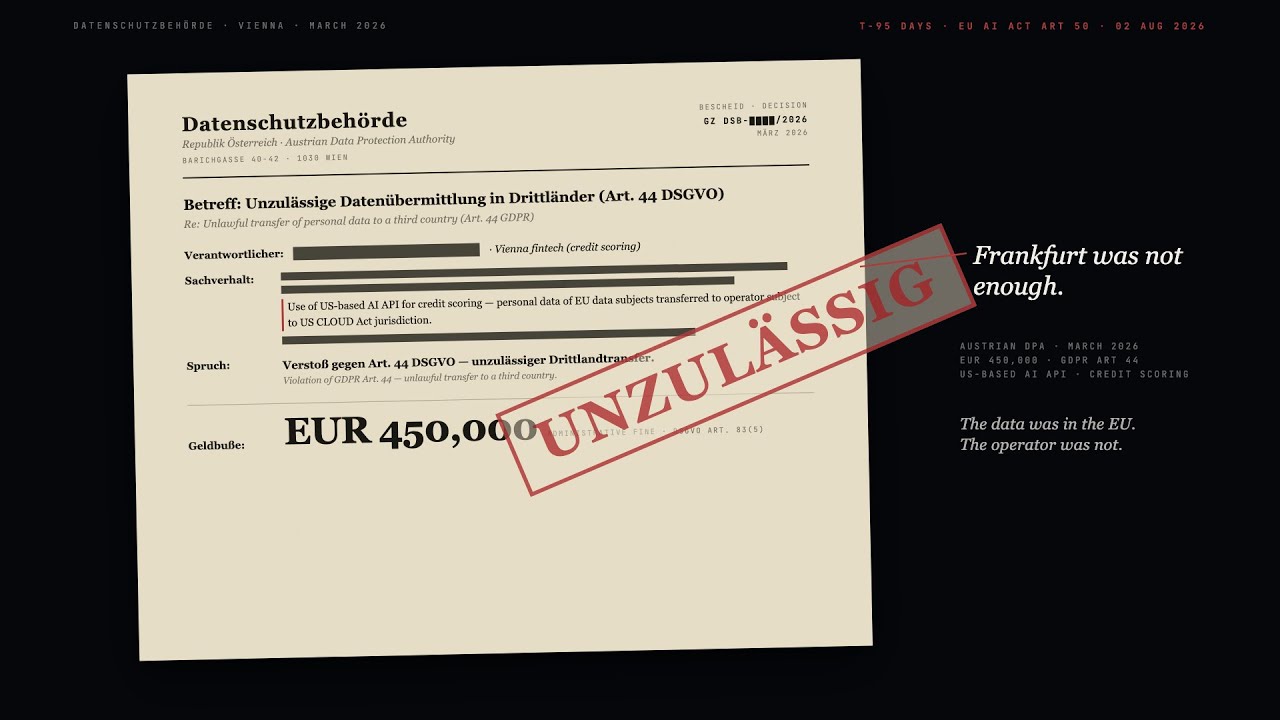
Sovereignty is not data residency. Data residency tells you where your data sits. Sovereignty tells you who controls the stack it runs on. AWS launched its European Sovereign Cloud in January 2026 with 90+ services in a German-incorporated, physically separate entity. That satisfies data residency. It does not satisfy structural sovereignty, because the US CLOUD Act grants extraterritorial access to data regardless of where it is physically stored.
A Callista benchmark from February 2026 found that EU-native providers like Scaleway deliver roughly 4.8x the value per euro compared to AWS, while providing genuine Layer 3 independence: EU ownership, EU operational control, and zero CLOUD Act exposure.
Our method starts by locating exactly where on the sovereignty spectrum a buyer's requirements fall, an approach detailed in our research on architecting sovereign intelligence for the post-trust enterprise. Each posture below is a different architecture, a different cost curve, and a different compliance mapping — and we architect all three:
- Full air-gap with data diodes and zero external network connectivity.
- Private cloud with no US-headquartered vendor in the control path.
- ITAR-compliant infrastructure where AI workloads processing controlled technical data stay within US persons-only boundaries.
The Dependency Audit Nobody Else Does
Most "sovereign" deployments are not sovereign. They leak. Individually, each leak is a minor configuration oversight. Collectively, they mean your air-gapped deployment is not air-gapped. Common culprits:
- The NVIDIA GPU Operator's default Helm chart pulls container images from nvcr.io on every pod restart.
- HashiCorp Vault, since its BSL license change in 2023, includes license validation endpoints that call home by default.
- Default Kubernetes DNS configurations resolve against upstream root servers.
- NTP synchronization targets pool.ntp.org.
- Prometheus exporters phone home to check for updates.
OpenBao, the Linux Foundation fork at version 2.5.0 (February 2026), eliminates the Vault call-home dependency while adding enterprise features like namespaces and horizontal read scalability under an MPL 2.0 license.
Our practice is to run a systematic dependency audit before an environment is declared sovereign, the discipline behind our research on software integrity and resilient systems: every DNS query path, every NTP target, every container image provenance chain, every license validation endpoint, and every telemetry beacon buried in a sub-chart's values.yaml. An engagement produces an audited bill of materials where every external dependency is either mirrored to an internal service or provably eliminated.
This is the work that hardware vendors, cloud providers, and managed platform companies do not do — because their business model does not incentivize finding and fixing the last 2% of leaks that break sovereignty claims under audit.
Air-Gapped GPU Infrastructure That Actually Works Offline
An air-gapped AI cluster is not a standard Kubernetes deployment with the internet cable unplugged. The NVIDIA GPU Operator supports disconnected installation through a local image registry, but the setup requires pre-staging every container image, driver package, and CRD definition.
MIG (Multi-Instance GPU) partitioning provides hardware-level tenant isolation on shared nodes, with 19 supported mixed-strategy profiles for A100 and H100 GPUs. NVIDIA's KAI Scheduler, open-sourced under Apache 2.0 in 2025, adds fractional GPU allocation and topology-aware scheduling that improved cluster utilization from 13% to 37% in production benchmarks.
Our approach is to architect the complete offline artifact supply chain: a Harbor registry with vulnerability scanning, mirrored package repositories with cryptographic verification, an internal certificate authority for mutual TLS, and an internal NTP stratum using GPS or rubidium clock sources — the same foundations behind our working demo of a sovereign private LLM.
For classified environments, we integrate one-way data diodes from vendors like Owl Cyber Defense that provide physics-based assurance of unidirectional data flow at up to 100 Gbps. Model weights (a 70B-parameter model runs 130+ GB) move through these diodes under a cryptographic chain-of-custody: signed artifact bundles, checksum verification at every handoff, and a two-person integrity rule for promotion from staging to production.
Confidential Computing on Sovereign Hardware
The NVIDIA H100 is the first GPU with a hardware Trusted Execution Environment, anchored in an on-die root of trust. In confidential computing mode, an encrypted bounce buffer moves data between CPU and GPU TEEs, ensuring that neither the hypervisor nor the host OS can access model weights or inference data in the clear.
Intel Trust Authority provides composite attestation for Intel TDX CPU TEEs and NVIDIA H100 GPU TEEs in a single verification workflow. This matters where the threat model includes insider access: a sysadmin with root on the host can read GPU memory in a standard deployment, a risk we examine in our research on securing private enterprise LLMs.
Our method is to configure the full attestation chain, from firmware measurement through remote attestation against a sovereign verification service, so the environment can produce cryptographic proof that code and data have not been tampered with — even by the facility operator.
Export Controls Shape What You Can Build and Where
GPU procurement for sovereign AI is now an export control problem. Chips under ECCNs 3A090 and 4A090 (H100, H200, A100, B200, GB200, AMD MI300X) carry export license requirements that vary by destination. A BIS rule effective January 15, 2026 shifted H200 review for China to case-by-case, though Chinese customs then independently blocked imports. A December 2025 investigation uncovered chips shipped under a fake "Sandkyan" brand to evade controls.
For sovereign buyers outside the US, this creates real architectural constraints. Procurement timelines run 8 to 16 weeks even without export complications, and organizations that start procurement after design completes routinely add two to three months.
Our approach folds procurement planning into the architecture phase: identifying which chips are available under which license exceptions, which alternative silicon avoids restrictive tiers, and designing the software stack for hardware portability so a future chip swap does not force re-architecture.
Regulatory Mapping Is Architecture, Not Paperwork
Compliance requirements shape foundational architecture decisions; they do not bolt on afterward. Each regime maps to specific technical constraints:
- GDPR Article 44 restricts personal data transfers outside the EU/EEA, determining where training data can reside.
- ITAR treats AI processing of controlled technical data on non-US infrastructure as an unauthorized export, mandating GovCloud or Azure Government.
- CMMC Level 2 requires FIPS 140-3 Level 1 validated encryption — and many commercial AI tools fail this because they use standard TLS without FIPS-validated modules.
- India's DPDP Rules 2025 use a blacklist approach to data localization, with sector regulators in BFSI imposing stricter mandates.
- GAIA-X Label level 3 certification prefigures the EUCS High+ scheme, requiring complete protection from non-European jurisdictional interference.
In the Gulf, Saudi Arabia's $100 billion sovereign AI fund and the UAE's 5-gigawatt AI campus are driving massive infrastructure buildouts.
Our method is to map each regulatory regime to specific architectural decisions: encryption standards, data residency boundaries, personnel access controls, audit logging granularity, and incident response procedures. That mapping is designed to live alongside the infrastructure-as-code, not in a separate compliance binder that drifts from reality.
The Cost and Timeline Conversation
Lenovo's 2026 TCO study found that on-premises AI infrastructure reaches cloud cost parity in under four months for high-utilization workloads, with up to 18x cost advantage per million tokens versus MaaS APIs. For typical workloads, the breakeven falls between 10 and 15 months.
Build timelines range from 3 to 9 months, extending to 12 for bare-metal builds. Initial costs run $50,000 to $200,000 for LLM/RAG pipeline setup, plus $75,000 to $350,000 for enterprise integration.
We are transparent about when sovereign infrastructure is the wrong answer: low-volume workloads below the TCO crossover, organizations without platform engineering capacity for ongoing operations, and situations where a managed sovereign cloud provider satisfies the regulatory requirement without custom infrastructure. In those cases, our recommendation is to select the right provider rather than build custom.
Why Not Hire a Big Firm
Accenture committed $3 billion to its AI practice. Deloitte offers AI Factory as a Service with NVIDIA. McKinsey's QuantumBlack has roughly 5,000 AI experts. Their sovereign engagements run 4 to 10 months before the first production deployment.
We are infrastructure engineers. An engagement is scoped to produce a working sovereign environment: infrastructure-as-code (Terraform, Helm, Ansible), operational runbooks, capacity planning models, disaster recovery with tested procedures, and CIS benchmark hardening reports.
Deloitte reported that 42% of companies abandoned most AI initiatives in 2025, averaging $7.2 million in sunk costs per project. The antidote is an engagement built to produce working infrastructure rather than another abandoned initiative.
Key Takeaways
- Sovereignty is control of the stack, not data location — the US CLOUD Act pierces data-residency-only setups regardless of where data physically sits.
- We architect all three postures: full air-gap, US-vendor-free private cloud, and ITAR-compliant infrastructure.
- A systematic dependency audit closes the leaks (nvcr.io pulls, Vault call-homes, DNS/NTP/telemetry) that break most sovereignty claims under audit.
- Air-gapped GPU clusters use MIG isolation, the KAI Scheduler (13% → 37% utilization), an offline artifact supply chain, and data diodes at up to 100 Gbps.
- H100 hardware TEEs plus Intel Trust Authority attestation protect model weights even from a root-level insider or the facility operator.
- Regulatory regimes (EU AI Act, GDPR Art. 44, ITAR, CMMC Level 2, India DPDP, GAIA-X) are mapped directly into infrastructure-as-code.
- On-prem can hit cloud parity in under four months at high utilization (up to 18x per-token advantage); the intended output is working infrastructure, not a 4–10 month slide deck.
Solutions for Infrastructure & Sovereign Deployment
 Watch
WatchEnterprise Deepfake Detection & Video Call Fraud Prevention
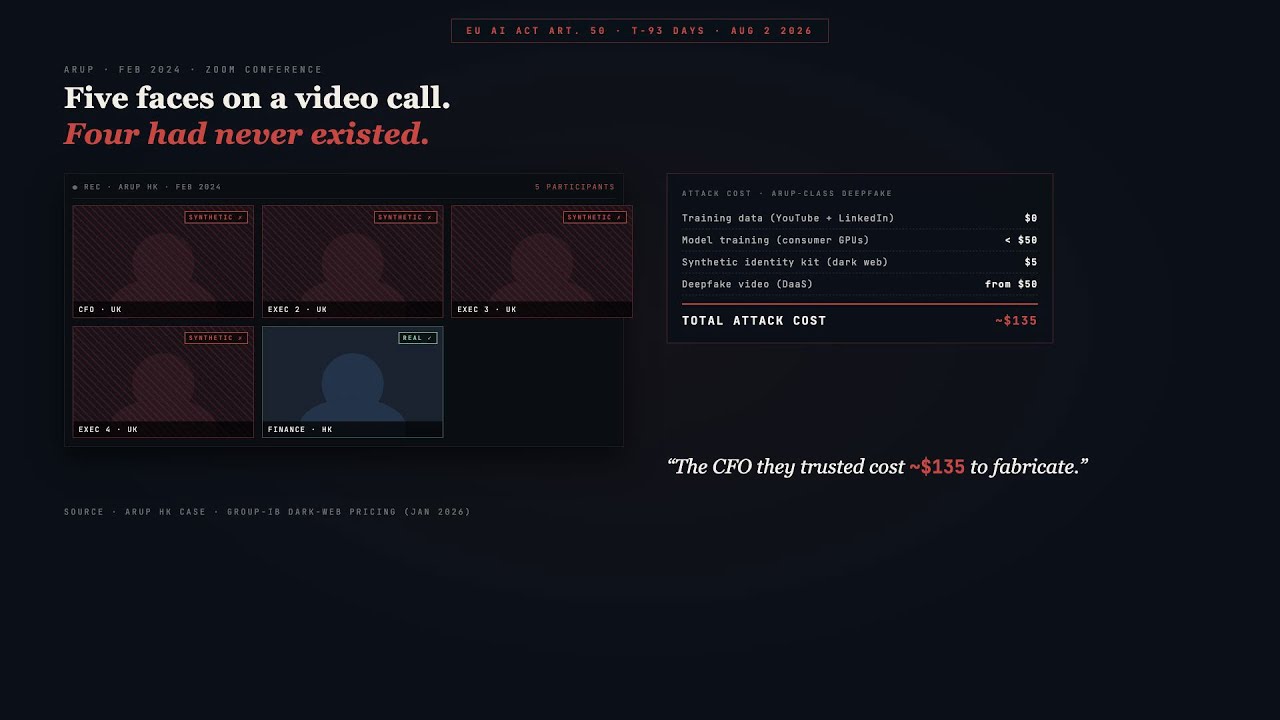
In February 2024, attackers used AI-generated deepfakes of an entire executive team to steal $25. 6 million from Arup in a single video call. Since January 2026, standard cyber insurance policies explicitly exclude deepfake fraud.
 Watch
WatchSmart Meter AI: AMI Predictive Maintenance & Firmware Validation
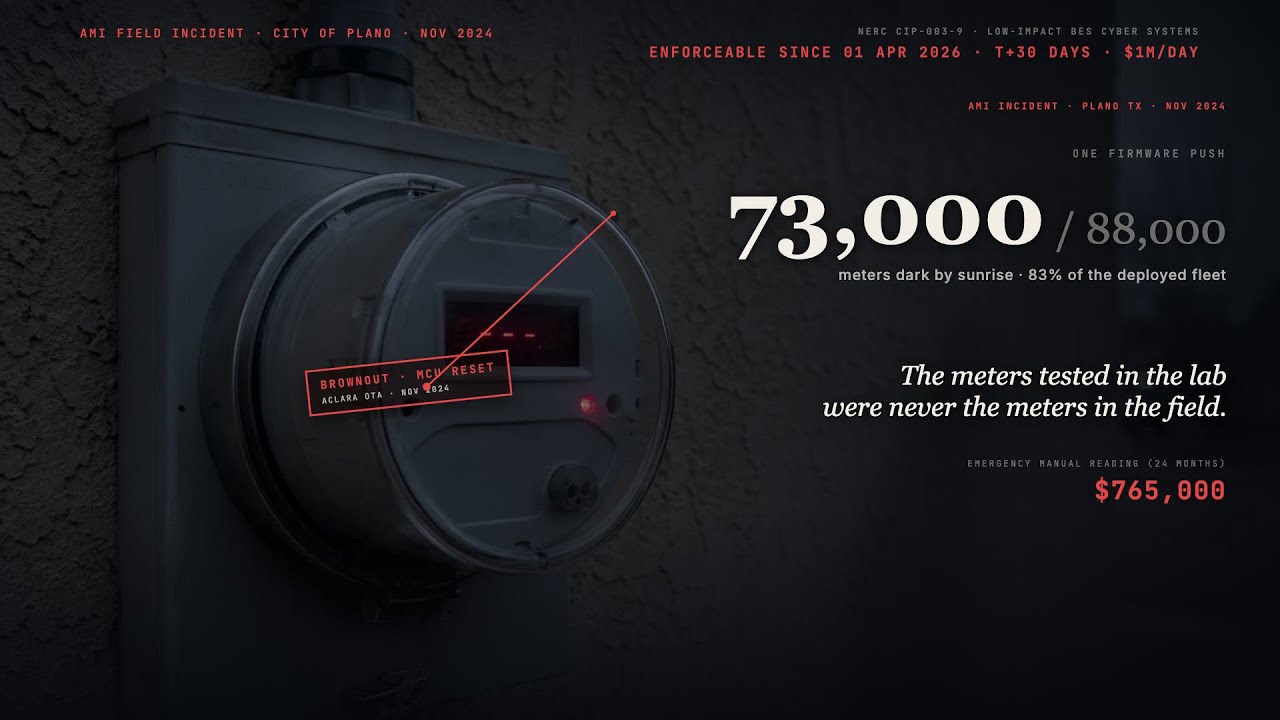
One bad firmware push cost Plano, TX $765,000 and knocked 73,000 meters offline. Memphis is spending $9M on repairs. Your AMI head-end tracks which meters stopped talking.
 Watch
WatchSoftware Update Deployment Integrity & IT Resilience
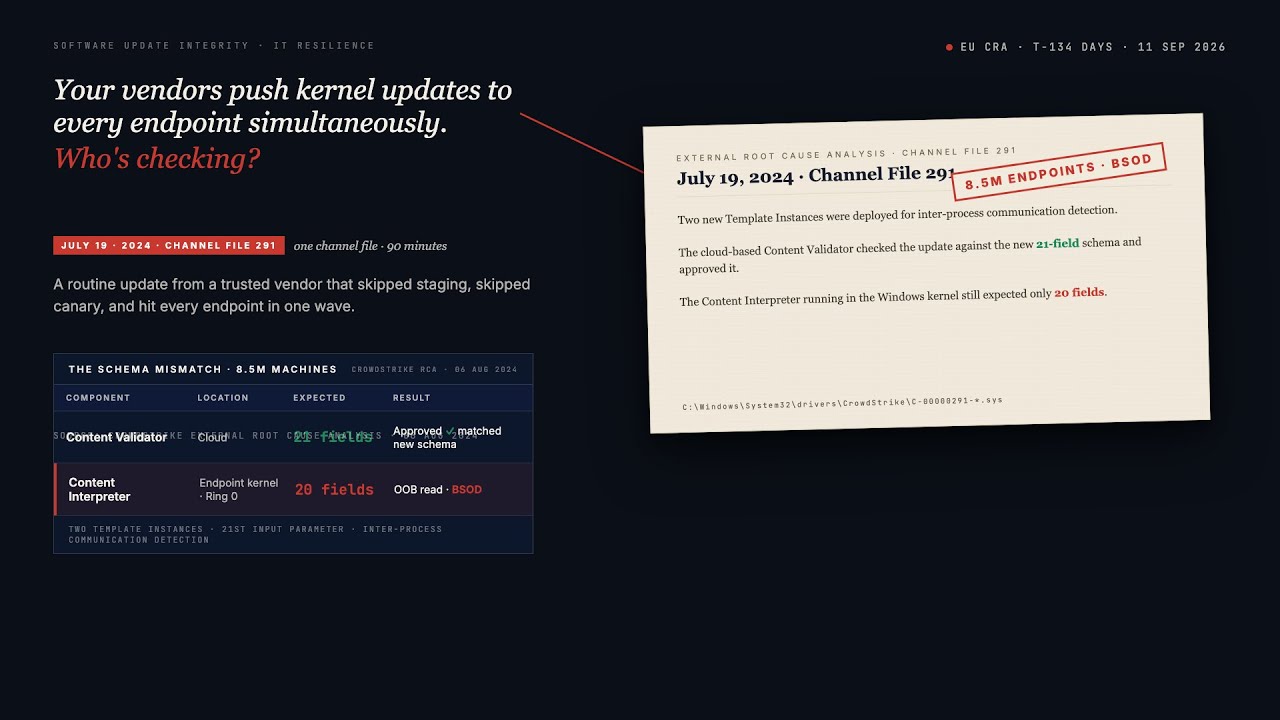
On July 19, 2024, a single configuration file crashed 8. 5 million Windows machines in under 90 minutes. Not malware.
 Watch
WatchSovereign AI & Private LLM Deployment
One in five organizations has already suffered a breach from unsanctioned AI tool usage. Banning AI does not work. Building secure, sovereign alternatives does.
Frequently Asked Questions
How much does sovereign AI infrastructure cost compared to cloud?
The economics depend on utilization. Lenovo's 2026 TCO study found on-premises AI infrastructure reaches cloud cost parity in under four months for high-utilization workloads, with up to 18x cost advantage per million tokens versus model-as-a-service APIs. For typical enterprise workloads, the breakeven falls between 10 and 15 months of continuous use. Initial deployment costs range from $50,000 to $200,000 for LLM and RAG pipeline setup, plus $75,000 to $350,000 for enterprise integration. Organizations that will not reach the TCO crossover point are better served by managed sovereign cloud providers like OVHcloud or Scaleway, which deliver genuine EU sovereignty at roughly 4.8x the value per euro compared to AWS (Callista benchmark, February 2026).
How long does it take to deploy sovereign AI infrastructure?
Timeline ranges from 3 to 9 months, extending to 12 months for full on-premises builds starting from bare metal. The most common bottleneck is hardware procurement: NVIDIA H100 and H200 clusters carry 8 to 16 week delivery windows. Organizations that start procurement after design completes routinely add two to three months. We integrate procurement planning into the architecture phase and run workstreams in parallel: hardware ordering, software stack design, dependency auditing, and regulatory mapping happen concurrently. Organizations with existing private cloud infrastructure can compress timelines significantly.
Is AWS GovCloud or Azure Government truly sovereign?
They satisfy data residency and specific compliance frameworks (FedRAMP High, DoD IL4-6, CMMC Level 2), but they do not provide structural sovereignty. The US CLOUD Act grants extraterritorial access to data held by US-headquartered companies regardless of where the data is physically stored. For ITAR workloads and US defense use cases, GovCloud and Azure Government are the right choice because ITAR itself mandates US-controlled infrastructure. For EU organizations seeking independence from US jurisdictional reach, or for governments building national AI capability, these platforms do not satisfy Layer 3 sovereignty requirements. The distinction matters: 61% of Western European CIOs are now prioritizing local cloud providers specifically to mitigate this risk.
What hidden dependencies break sovereignty in most deployments?
The most common leaks we find: NVIDIA GPU Operator Helm charts pulling container images from nvcr.io on pod restart. HashiCorp Vault license validation call-homes (introduced with the BSL switch in 2023). Default Kubernetes DNS resolving against upstream root servers. NTP synchronization targeting pool.ntp.org. Prometheus exporters checking for updates. Helm sub-chart values.yaml files with hardcoded external registry URLs. Telemetry beacons in monitoring agents. Certificate revocation checks hitting external OCSP responders. Individually minor, collectively these mean your air-gapped deployment is communicating externally. We run a systematic audit of every network dependency before declaring an environment sovereign.
Which NVIDIA GPUs can I procure for sovereign deployment outside the US?
GPU availability depends on your jurisdiction. Advanced computing chips under ECCNs 3A090 and 4A090 (H100, H200, A100, B200, GB200, AMD MI300X) carry export license requirements that vary by destination country and end use. A BIS final rule effective January 15, 2026 adjusted review policies for specific chip-country combinations, but enforcement is fluid. We help navigate procurement: identifying which chips are available under which license exceptions, whether AMD MI300X or Intel Gaudi avoids the most restrictive tiers for your jurisdiction, and designing the software stack for hardware portability so a future chip swap does not force full re-architecture.
How do you update AI models in an air-gapped environment?
Through a cryptographic chain-of-custody pipeline. A 70B-parameter model is 130+ GB, so transfer requires planning. For environments with one-way data diodes (Owl Cyber Defense, Waterfall Security), signed artifact bundles flow inward through physics-based unidirectional channels at up to 100 Gbps. For sneakernet environments, we use encrypted physical media with checksum verification at every handoff and a two-person integrity rule for production promotion. The pipeline includes: model packaging with cryptographic signatures traceable to the training environment, integrity verification at ingestion, staging deployment with automated validation testing, and a promotion gate requiring dual authorization. Every step is logged to a tamper-evident audit trail.
What regulations require sovereign AI infrastructure?
Multiple regulatory frameworks now mandate or strongly incentivize sovereign deployment. The EU AI Act (fully applicable August 2, 2026) requires automatic event logging and data lineage tracking for high-risk systems. GDPR Article 44 restricts personal data transfers outside the EU/EEA. ITAR treats AI processing of controlled technical data on non-US infrastructure as unauthorized export. CMMC Level 2 (rolling into DoD contracts by November 9, 2026) requires FIPS 140-3 validated encryption. India's DPDP Rules 2025 enable sector-specific data localization. The EU's DORA and NIS2 directives are making sovereign cloud mandatory for certain financial and critical infrastructure workloads. GAIA-X Label level 3 prefigures the EUCS High+ certification requiring protection from non-European jurisdictional interference.
When is sovereign AI infrastructure NOT the right choice?
Three situations. First, low-volume inference workloads that will not reach the TCO crossover point where on-premises investment pays back. If your annual cloud AI spend is under $100,000, the capital cost and operational burden of sovereign infrastructure likely outweigh the savings. Second, organizations without the internal platform engineering capacity (or budget for managed operations) to run GPU-accelerated Kubernetes clusters after handoff. Sovereign infrastructure requires ongoing operational investment. Third, workloads where a managed sovereign cloud provider (OVHcloud, Scaleway, Deutsche Telekom) satisfies your regulatory requirements and custom infrastructure adds complexity without benefit. We help clients draw this line before committing capital.
Build Your AI with Confidence.
Partner with a team that has deep experience in building the next generation of enterprise AI. Let us help you design, build, and deploy an AI strategy you can trust.
Veriprajna Deep Tech Consultancy specializes in building safety-critical AI systems for healthcare, finance, and regulatory domains. Our architectures are validated against established protocols with comprehensive compliance documentation.