Manufacturing AI That Scales Past the Pilot Line
AI systems for manufacturers that survive factory conditions, integrate with existing OT infrastructure, and scale past the pilot line.
Manufacturing AI rarely fails at the algorithm. It fails at the integration layer — the point where clean, contextualized data from a 24/7 control network has to reach a model without disrupting the line. Our approach is to build manufacturing AI designed to survive factory conditions, integrate with existing OT infrastructure, and scale past the pilot line, working vendor-neutral across whatever equipment mix is already on your floor.
Why Manufacturing AI Pilots Fail
Here is the pattern we see in nearly every manufacturing AI engagement: a vendor runs a proof of concept on one production line, the accuracy numbers look excellent, and someone presents a slide deck to the VP of Operations. Six months later, the system is either running on that one line with no expansion plan, or the operators have quietly started overriding it because accuracy degraded and nobody budgeted for model retraining.
IDC found that 88% of AI proofs of concept never reach production deployment. In manufacturing specifically, the deployment rate sits around 13 to 16%. The reasons are not mysterious, but they are structural: factory AI fails at the integration layer, not the algorithm layer.
The OT/IT Integration Problem That Blocks Everything
Most manufacturing plants run automation infrastructure designed for reliability and isolation, not data sharing. PLCs communicate over proprietary protocols, SCADA systems log to local historians, and MES platforms sit behind firewalls that plant engineers are understandably reluctant to open. A 2025 Gartner survey found that 61% of manufacturers rate their OT/IT integration as basic or non-existent.
This is the wall AI projects hit. You can build the most sophisticated predictive maintenance model in the world, but if you cannot get clean, contextualized data from the control layer into the model without disrupting a production network that runs 24/7, the model never sees production.
The architecture forward-looking plants are adopting is a Unified Namespace built on OPC UA for machine-level context and MQTT with Sparkplug B (ratified as an ISO/IEC standard in 2023) for enterprise data transport. It replaces point-to-point integration spaghetti with a publish-subscribe architecture where every data source — from a vibration sensor on a CNC spindle to an ERP production order — publishes to a single semantic namespace.
Facilities that implement this report a 60 to 80% reduction in AI deployment time, because the data plumbing is solved once, not re-engineered for every use case. Our approach is to design these architectures for brownfield plants, working with whatever mix of Siemens, Rockwell, Mitsubishi, or legacy equipment is already on the floor.
Predictive Maintenance Beyond the Hype
Vibration analysis for rotating equipment has been a mature discipline since the 1990s — companies like Emerson (CSI), SKF, and Fluke have sold condition monitoring hardware and software for decades. When a vendor tells you they have invented AI-powered predictive maintenance, they usually mean they have added a machine learning layer on top of one condition monitoring stream, typically vibration, and called it predictive.
The real opportunity, and the reason the economics are compelling, is fusing multiple condition monitoring streams with production context: vibration plus thermal imaging plus motor current signature analysis plus acoustic emission, correlated with what the machine was actually producing at the time, produces remaining useful life estimates that single-stream analysis cannot.
ABB surveyed 3,200 plant maintenance leaders and found that two-thirds of companies experience unplanned downtime at least monthly, at an average cost of $125,000 per hour. Across manufacturing, unplanned downtime costs an estimated $50 billion annually. Plants that deploy multi-stream predictive maintenance well report:
- 25 to 40% reduction in maintenance costs;
- 50% fewer unplanned downtime incidents;
- ROI typically realized within 12 to 18 months.
An engagement is scoped to build the sensor fusion pipeline, the edge inference layer (detailed in our research on edge-native AI latency in manufacturing), and the integration with your CMMS — whether that is SAP PM, Maximo, or Fiix — so the maintenance team sees actionable work orders, not raw model outputs.
Quality Inspection That Holds Up Under Production Conditions
AI vision inspection works. Documented deployments show defect detection rates 90% better than manual inspection, with accuracy between 95 and 99% at speeds human inspectors cannot sustain. The problem is that those numbers come from validation sets collected under controlled lighting, with consistent part orientation, on clean optics.
Six weeks into production — after lighting has shifted with the seasons, tooling has worn, material lots have changed, and particulate from grinding or welding has coated the camera lens — accuracy degrades silently. The system does not throw an error; it just starts passing defective parts or rejecting good ones. If it rejects too many good parts, the line supervisor overrides it. If it passes defective parts, you find out from customer returns. Both outcomes are worse than not having the system at all, because you carry the cost of deployment plus a false sense of coverage.
Our approach is to design inspection systems that account for production drift:
- Environmental monitoring that triggers recalibration when lighting or contamination conditions change beyond thresholds;
- Dataset pipelines that automatically collect and label edge cases for model updates;
- Degradation detection that alerts quality engineers before accuracy drops below the control limit.
The inspection model is the easy part. The production-hardened deployment is where the engineering lives — see our working demo of edge AI manufacturing inspection.
The Digital Twin Gap
64% of digital twin projects never move beyond the pilot phase, and the root cause is almost always data, not simulation technology. Building a physics-based simulation of a production line is straightforward if you have the CAD models and process parameters. Keeping it synchronized with reality requires live data feeds from every relevant sensor, actuator, and controller, contextualized with production schedules, material lots, and maintenance history.
Most plants do not have that pipeline. Their historian data is incomplete, inconsistently tagged, and stored in formats that need custom ETL before feeding anything useful. Siemens demonstrated its Digital Twin Composer on NVIDIA Omniverse at Hannover Messe 2026, with PepsiCo as a launch partner. The simulation engines are real; the gap is in the data infrastructure that feeds them. Our approach starts with the data foundation, not the simulation layer.
Cybersecurity When OT Meets AI
Connecting factory control networks to AI systems opens an attack surface that most manufacturing IT teams are not equipped to defend. Threat actors targeting the manufacturing sector increased by 71% between 2024 and early 2025, and the average time to identify and contain a manufacturing breach is 272 days, well above the cross-industry average.
The challenge is that OT cybersecurity and IT cybersecurity are different disciplines. IEC 62443 defines zone and conduit security architecture for industrial automation, and NIST published its Cybersecurity Framework 2.0 Manufacturing Profile (IR 8183 Rev 2) in 2025. But most AI deployments punch holes in the OT network boundary to get data out, creating exactly the kind of ungoverned lateral movement path these frameworks are designed to prevent. Our approach is to design AI data architectures that respect OT network segmentation — using edge compute and unidirectional data diodes where needed — so the AI gets its data without turning the control network into an attack vector.
The Regulatory Shift: AI-Enabled Machinery
The EU Machinery Regulation 2023/1230 replaces the Machinery Directive 2006/42/EC on January 20, 2027, with no transition period. For the first time, the regulation explicitly covers AI-based safety functions in machinery. Manufacturers must:
- Document data governance practices, training data versions, and system design specifications for traceability;
- Provide a detailed explanation of AI decision-making processes.
If you sell machinery with AI-enabled safety functions into the EU market, your compliance program needs to be running now, not six months before the deadline. Our approach helps manufacturers map their AI-enabled machinery to the new requirements, build the documentation artifacts, and prepare the technical files that conformity assessment bodies will review.
Scaling Past the Pilot Line
The biggest waste in manufacturing AI is not a failed pilot — it is a successful pilot that never scales. The plant proved the concept on Line 3, the metrics looked good, and nothing happened because nobody planned for the integration work, the retraining pipeline, or the infrastructure to support 12 lines instead of one. Deloitte reports that agentic AI adoption in manufacturing will quadruple from 6% to 24% in 2026. The demand is there; the execution gap is in scaling, not piloting.
We structure engagements around production deployment from day one: the pilot line is a template, the data architecture supports multi-line expansion, the retraining pipeline is automated, and MES/ERP integration is parameterized. Because that plumbing is designed once and reused, extending from one line to twelve is intended to be a configuration change measured in weeks rather than another eighteen-month engagement.
Why Not the Big SI or the Platform Vendor?
Platform vendors like Siemens, Rockwell, and PTC build excellent automation infrastructure, but their AI capabilities are designed to keep you inside their ecosystem. A Siemens-heavy plant gets Siemens AI; a Rockwell plant gets Rockwell AI. If your plant runs mixed automation — which most do — neither vendor has an incentive to build the cross-platform integration layer, and switching automation vendors can cost more than building a new facility.
Large consultancies charge $300 to $500 per hour, run these engagements for 6 to 18 months, and staff from general pools. They manage programs well, but the people writing the SOW rarely debug PLC communication faults or design edge deployments that survive welding-cell EMI (see our whitepaper on edge-native AI for manufacturing). Our model is to work vendor-neutral, build custom for each plant's equipment mix and data architecture, and staff with engineers who have factory floor experience — a smaller, focused team, no platform lock-in.
Key Takeaways
- Manufacturing AI fails at the integration layer, not the algorithm — which is why only 13 to 16% of pilots reach production.
- A Unified Namespace on OPC UA and MQTT Sparkplug B solves the data plumbing once, cutting AI deployment time 60 to 80%.
- Multi-stream predictive maintenance (vibration, thermal, current signature, acoustic emission) delivers 25 to 40% lower maintenance costs and 50% fewer downtime incidents, with ROI in 12 to 18 months.
- Vision inspection and digital twins live or die on production-hardened data pipelines, not the model or the simulation engine.
- OT-aware security (IEC 62443, NIST IR 8183 Rev 2) and EU Machinery Regulation 2023/1230 readiness must be designed in now, ahead of the January 20, 2027 deadline.
- Our engagements are built vendor-neutral and custom, designed to scale from one line to twelve in weeks.
Solutions for Industrial Manufacturing
 Watch
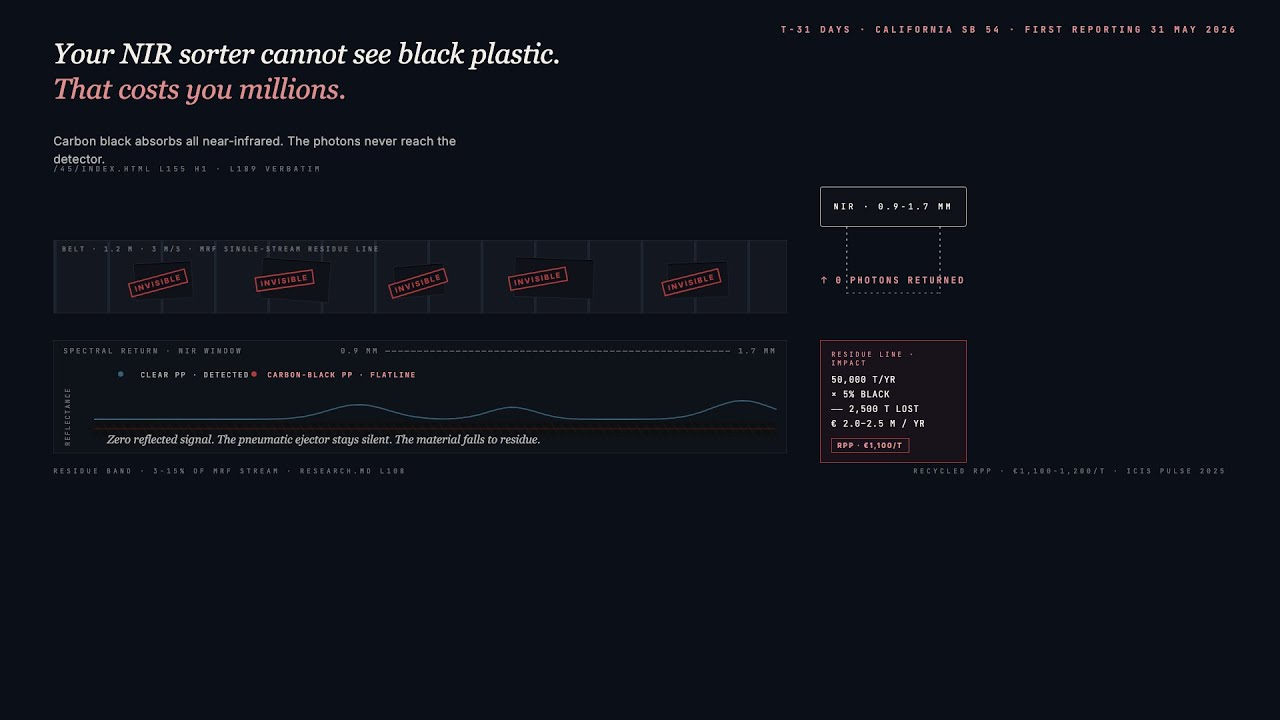
WatchAI for Materials Recovery and Black Plastic Sorting
Carbon black pigment absorbs near-infrared light. Every black PP tray, PE container, and ABS housing your optical sorter misses goes to residue, then landfill. We build the MWIR sensing and edge AI layer that recovers it.
 Watch
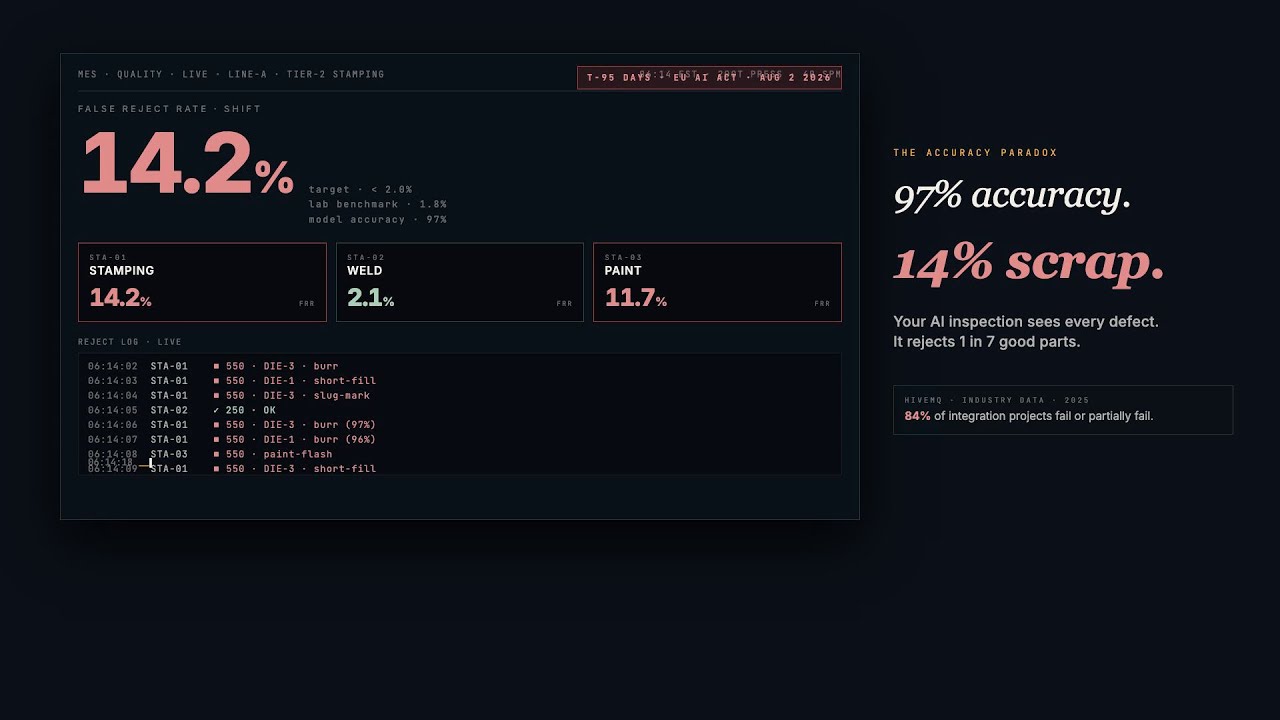
WatchEdge AI for Manufacturing Quality Inspection
Whether you are evaluating AI-based inspection for the first time, recovering from a cloud pilot that could not meet cycle time, or scaling a working prototype to 15 plants, the problem is the same: getting edge AI into production is an integration and operations challenge, not a hardware purchase.
Frequently Asked Questions
Why do 88% of manufacturing AI pilots fail to reach production?
The model is almost never the problem. The integration layer is. Manufacturing AI pilots fail because they are built on ad hoc data pipelines that do not scale, require manual data preprocessing that nobody maintains after the data scientist moves on, lack integration with the plant's MES, ERP, or CMMS systems, and were never designed for the environmental conditions of a production floor. A 2025 Gartner survey found 61% of manufacturers rate their OT/IT integration as basic or non-existent, which means the data foundation that AI needs simply is not there. We structure every engagement around production deployment from the start: the data architecture is designed for multi-line scaling, the model retraining pipeline is automated, and the integration with plant systems is parameterized so expansion is a configuration change, not a re-engineering project.
What is the real cost of unplanned downtime and how does predictive maintenance AI change the math?
ABB surveyed 3,200 plant maintenance leaders globally and found that two-thirds of companies experience unplanned downtime at least monthly, at an average cost of $125,000 per hour. Across manufacturing, unplanned downtime costs an estimated $50 billion annually, with costs rising 50% since 2019. Plants that deploy predictive maintenance well, meaning multi-stream condition monitoring (vibration plus thermal plus current signature plus acoustic emission) fused with production context data, report 25 to 40% reduction in maintenance costs and 50% fewer unplanned downtime incidents, with ROI typically realized within 12 to 18 months. The critical word is 'well.' Single-sensor, single-algorithm deployments rarely deliver these returns because they miss the failure modes that only show up across multiple data streams.
How do we get factory floor data into AI models without disrupting the control network?
The architecture that works is a Unified Namespace built on OPC UA for machine-level data context and MQTT with Sparkplug B for enterprise data transport. OPC UA provides the rich semantic data model, describing what each data point means in its operational context. MQTT Sparkplug B (ratified as an ISO/IEC standard in 2023) provides efficient publish-subscribe transport that reduces network traffic by 80 to 95% compared to polling. Edge gateways sit at the OT/IT boundary, reading from PLCs and SCADA systems on the control side and publishing to the namespace on the IT side, without opening bidirectional paths into the control network. Facilities implementing this architecture report 60 to 80% reduction in AI deployment time because new use cases consume data that is already in the namespace rather than requiring new point-to-point integrations.
What does the EU Machinery Regulation 2023/1230 require for AI-enabled safety functions?
The EU Machinery Regulation 2023/1230 replaces the Machinery Directive 2006/42/EC on January 20, 2027, with no transition period. For the first time, it explicitly covers software and AI systems that perform safety functions in machinery. Manufacturers must maintain documentation of data governance practices, training data versions, and system design specifications to support traceability. They must also provide a detailed explanation of the AI's decision-making process for maintenance, training, and incident analysis. The regulation also introduces new cybersecurity requirements for connected machinery. If you manufacture or integrate AI-enabled machinery for the EU market, your compliance program and technical documentation need to be in progress now.
Why does AI inspection accuracy degrade after a few weeks in production?
Validation accuracy is measured under controlled conditions: consistent lighting, clean optics, known part orientations, stable material lots. Production conditions are different. Lighting shifts seasonally and as bulbs age. Camera lenses accumulate particulate from grinding, welding, or coolant mist. Tooling wear changes part geometry within tolerance but outside the training distribution. Material lot changes introduce surface finish variations the model has never seen. None of these trigger an error. The system just starts making more wrong decisions. We address this with environmental monitoring that triggers recalibration when conditions drift, automated dataset pipelines that collect and label edge cases for model updates, and degradation detection that alerts quality engineers before accuracy drops below control limits. The inspection model is the straightforward part. Keeping it accurate under production conditions is the engineering challenge.
How do we secure OT networks that now feed AI systems?
Threat actors targeting manufacturing increased 71% between 2024 and early 2025, and the average time to identify and contain a manufacturing breach is 272 days. Most AI deployments create risk by punching holes in OT network boundaries to extract data, creating ungoverned lateral movement paths. The right approach uses IEC 62443 zone and conduit architecture as the foundation, with edge compute nodes that sit at the OT/IT boundary and push data outbound through unidirectional paths. The AI model consumes data from the IT side of the boundary, never reaching into the control network directly. NIST's Cybersecurity Framework 2.0 Manufacturing Profile (IR 8183 Rev 2) provides the risk management framework. We design AI data architectures that comply with both IEC 62443 and the NIST manufacturing profile, so the plant gets AI capabilities without expanding its attack surface.
Is agentic AI for production scheduling real or just rebranded optimization?
Partly both. Production scheduling optimization using constraint solvers and heuristics is decades old. What agentic AI adds is the ability to react autonomously to disruptions: an agent monitors real-time production data, detects a deviation (machine fault, material shortage, rush order), evaluates options against constraints (delivery dates, labor availability, changeover costs), and adjusts the schedule without waiting for a human planner. Deloitte projects agentic AI adoption in manufacturing will quadruple from 6% to 24% in 2026. Over 40% of manufacturers with scheduling systems plan to add AI-driven capabilities this year. The technology works for well-defined scheduling problems with clear constraints and measurable outcomes. Where it struggles is in plants with high variability, frequent engineering changes, or poor data quality, because the agent's decisions are only as good as the data and constraint models it operates on.
Why hire a specialized consultancy instead of our automation vendor's AI services or a Big Four firm?
Platform vendors build AI that deepens your dependency on their ecosystem. Siemens AI is designed for Siemens plants. Rockwell AI works best with Allen-Bradley infrastructure. If your plant runs mixed automation, and most do, neither has an incentive to build the cross-platform integration you need. Switching automation ecosystems can cost more than building a new facility, so vendor AI often locks you in further. Large consultancies charge $300 to $500 per hour, run manufacturing AI projects for 6 to 18 months at $500K to $5M or more, and staff from general pools. They manage programs well but rarely have engineers who have configured OPC UA servers, debugged PLC communication faults during a production run, or designed an edge deployment that survives EMI from a welding cell. We work vendor-neutral across whatever equipment mix is on your floor, build custom for your specific data architecture and integration requirements, and deliver with engineers who have factory floor experience.
Build Your AI with Confidence.
Partner with a team that has deep experience in building the next generation of enterprise AI. Let us help you design, build, and deploy an AI strategy you can trust.
Veriprajna Deep Tech Consultancy specializes in building safety-critical AI systems for healthcare, finance, and regulatory domains. Our architectures are validated against established protocols with comprehensive compliance documentation.