AI Systems for Legal and Professional Services That Survive Scrutiny
AI systems for law firms, corporate legal departments, and professional services that verify citations, integrate vendor stacks, and satisfy bar ethics rules.
Legal AI stopped being optional in 2025. The question is no longer whether your firm or department deploys AI — it is whether the AI you deployed can survive a sanctions motion, a malpractice renewal, a PCAOB inspection, or a bar complaint. Veriprajna's approach is to build the verification and integration layer designed to sit between the AI vendor stack and the professional obligations that govern how your firm or department actually operates.
The Hallucination Rates RAG Has Not Solved
The hallucination problem has not been solved by retrieval augmented generation. Stanford and Yale tested the leading legal research tools in the most rigorous independent study to date — Magesh et al., published in the Journal of Empirical Legal Studies, 2025. These are not edge cases; they are measured rates on standard legal research questions.
| Tool | Measured hallucination rate |
|---|---|
| Lexis+ AI | More than 17% of queries |
| Westlaw AI-Assisted Research | Roughly 33% |
| GPT-4 | 43% |
The verification layers most vendors added after Mata v. Avianca are themselves LLM-based, meaning they can miss subtle mischaracterizations of holdings even when they correctly identify that a case exists — the failure mode our research on citation-enforced GraphRAG for legal AI is built to close.
When Verification Fails: Johnson v. Dunn
Johnson v. Dunn, in the Northern District of Alabama in July 2025, showed what happens when verification fails. The court:
- Disqualified the offending attorneys from representing their client;
- Directed the clerk to notify bar regulators in every state where the attorneys are licensed (the multi-state attribution problem examined in our whitepaper on deterministic liability attribution);
- Ordered the opinion published in the Federal Supplement.
That is a career-level consequence, not a $5,000 fine.
Multi-Jurisdiction Ethics Compliance
Ethics guidance is a patchwork and tightening fast. Over 300 federal judges now have standing orders or local rules requiring AI disclosure and citation certification, with no uniform national standard. A firm operating in twelve jurisdictions needs a compliance matrix, not a single policy — and most legal AI vendors do not provide one.
| Authority | Opinion | Date | Requirement |
|---|---|---|---|
| ABA | Formal Opinion 512 | July 2024 | Baseline obligations around competence, confidentiality, communication, and reasonable fees for GenAI use |
| Texas | Opinion 705 | February 2025 | Human oversight of AI-generated work |
| Florida | Opinion 24-1 | — | Disclosure of AI's impact on billing |
| Oregon | 2025-205 | 2025 | Informed client consent before putting client data into an open AI model |
E-Discovery QA After Free GenAI Review
E-discovery is being repriced and the quality assurance question is wide open. When Relativity and Everlaw made their GenAI features free, they commoditized first-pass review and privilege detection. But seed-set validation methodology — the backbone of defensible TAR 2.0 productions under Federal Rule of Civil Procedure 26(b)(1) — does not transfer cleanly to GenAI-assisted review.
Proportionality arguments change when review costs drop by an order of magnitude, but the quality assurance framework for measuring recall and precision on GenAI outputs is still immature. If your litigation support team is running aiR or EverlawAI without a validation protocol that can withstand a Rule 26(f) meet-and-confer challenge, the cost savings come with discovery risk that surfaces at the worst possible time.
Contract Lifecycle Management Integration Gap
Contract lifecycle management sits in its own integration gap. Ironclad, Icertis, Sirion, and Agiloft all earned Forrester Wave Q1 2025 Leader status. But every corporate legal department that deploys a CLM still has to connect it to matter management, e-billing, regulatory risk monitoring, and the document management system.
Those integrations are custom work that the CLM vendor will scope but not own. The failure mode is not a product deficiency but a data-plumbing gap that causes obligations to fall through the cracks between systems.
Professional Services Beyond Law: Audit, Tax, and Consulting
Professional services beyond law face parallel friction. The common thread is that every professional-services deployment needs a verification and documentation layer that the AI vendor does not provide.
- Audit. PCAOB's 2025 inspection priorities explicitly include AI use in audit engagements. Inspectors are meeting with Big 4 firms, watching AI tool demonstrations, and evaluating whether AI-generated audit evidence meets professional skepticism requirements under AS 1105 and ISQM 1.
- Tax. Tax advisory firms operating under IRS Circular 230 need the same due diligence documentation for AI-assisted tax opinions that they need for human-drafted ones.
- Consulting. Management consulting firms deploying AI in client engagements face independence, confidentiality, and conflict-check requirements that no off-the-shelf tool addresses.
What Veriprajna Builds
Our approach is to build the verification and integration layer designed to sit between the AI vendor stack and the professional obligations that govern how your firm or department actually operates. An engagement is scoped to produce artifacts across five areas; we stay vendor-neutral on the tools your firm already licenses, and opinionated about the verification, compliance, and integration work that no vendor covers.
- Citation verification designed to be deterministic, not another LLM checking the first one — see our working demo of deterministic citation verification.
- Multi-state ethics compliance matrices that map ABA, state bar, and court-specific AI rules to firm-wide policies.
- E-discovery QA harnesses that validate GenAI review output at the same statistical rigor as TAR 2.0 seed sets.
- CLM integration pipelines that connect contract intelligence to matter management, billing, and regulatory-risk systems without custom glue that breaks on the next vendor update.
- PCAOB-ready documentation for AI-assisted audit procedures.
Key Takeaways
- Legal AI adoption is settled — Harvey, CoCounsel Legal, Relativity, and Everlaw are already in production — so the live risk is whether a deployment survives a sanctions motion, malpractice renewal, PCAOB inspection, or bar complaint.
- RAG has not fixed hallucination: measured rates run past 17% (Lexis+ AI), roughly 33% (Westlaw), and 43% (GPT-4), and post-Mata LLM verifiers still miss mischaracterized holdings.
- Johnson v. Dunn (N.D. Ala., July 2025) escalated the stakes to disqualification and multi-state bar referral — a career-level consequence.
- ABA 512, Texas 705, Florida 24-1, Oregon 2025-205, and 300+ federal judges' orders demand a compliance matrix, not a single policy.
- Free GenAI e-discovery, TAR 2.0 validation gaps, CLM integration, and PCAOB/IRS Circular 230/consulting obligations all need a verification and documentation layer no AI vendor provides.
Solutions for Legal & Professional Services
 Watch
WatchLegal AI Citation Verification & Governance
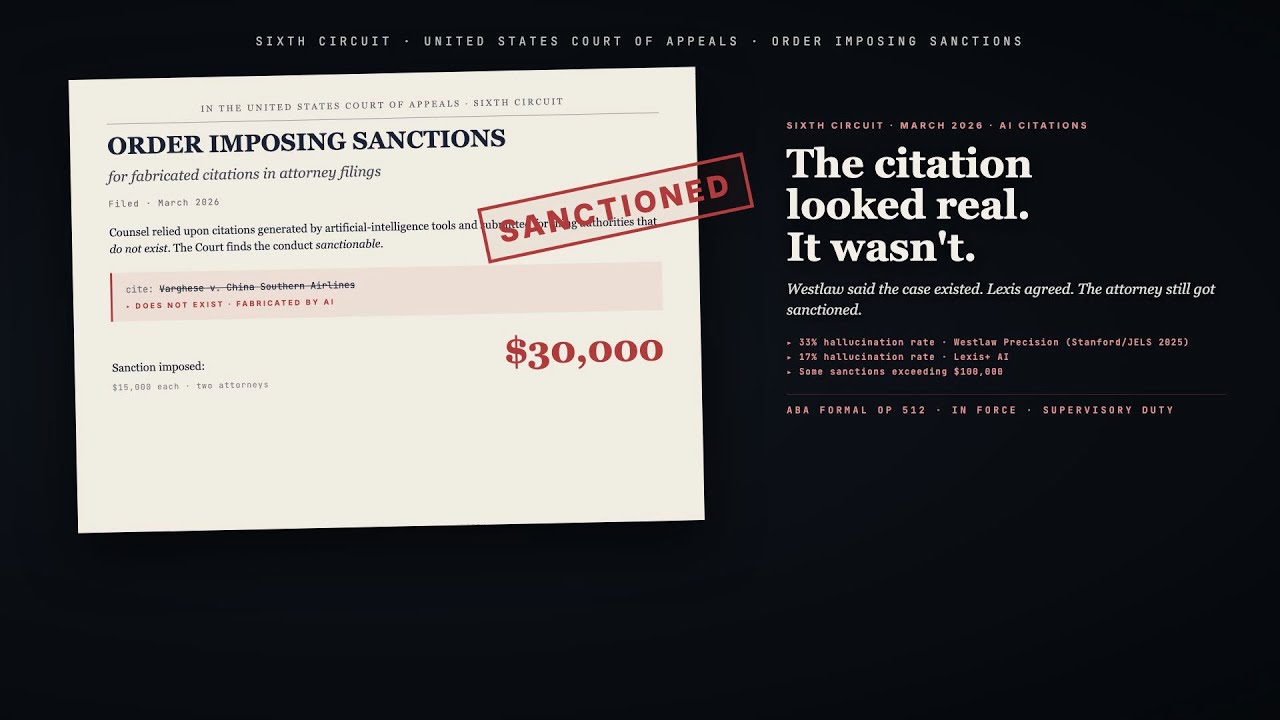
Westlaw Precision hallucinated on 33% of complex queries in peer-reviewed testing. Lexis+ AI, 17%. Sanctions have crossed $30,000 per incident.
Frequently Asked Questions
How do I evaluate whether Harvey, CoCounsel Legal, or Lexis+ AI actually prevents hallucination for my practice areas?
Run a controlled evaluation on your own queries, not the vendor's demo set. The Stanford study (Magesh et al., JELS 2025) found hallucination rates of 17% for Lexis+ AI and 33% for Westlaw AI on standardized legal queries. Your practice-specific rates may differ. We build evaluation harnesses that test citation accuracy, holding characterization, and jurisdictional correctness on your actual research patterns, producing a comparison that reflects your workflow rather than a generic benchmark.
Can a lawyer be disqualified from a case for submitting AI-generated hallucinated citations?
Yes. In Johnson v. Dunn (N.D. Ala., July 2025), the court disqualified the offending attorneys from representing their client for the remainder of the case, directed the clerk to notify bar regulators in every state where the attorneys are licensed, and ordered the opinion published in the Federal Supplement. This went well beyond the $5,000 sanctions in Mata v. Avianca. Over 230 matters globally have now involved AI-hallucinated citations, and courts are escalating consequences.
How do I build a firm-wide AI policy when bar ethics guidance differs by jurisdiction?
You need a compliance matrix, not a single policy document. ABA Formal Opinion 512 sets a baseline, but Texas Opinion 705, Florida 24-1, Oregon 2025-205, and New York opinions each add jurisdiction-specific requirements around oversight, billing disclosure, client consent, and confidentiality. Over 300 federal judges have their own standing orders. We build multi-jurisdiction matrices that map each obligation to specific firm workflows and update as new opinions issue, so your policy stays current without quarterly rewrites.
How do I run quality assurance on GenAI-assisted e-discovery at the same rigor as TAR 2.0?
TAR 2.0 relied on seed-set validation with measurable recall and precision. GenAI review (Relativity aiR, Everlaw AI) uses summarization, concept clustering, and privilege detection that does not map to the same statistical framework. We build QA harnesses that sample GenAI review output, measure agreement rates against human review on stratified samples, and produce defensibility documentation that can withstand a Rule 26(f) meet-and-confer challenge on proportionality and completeness.
What do malpractice insurers want to see in a law firm's AI risk controls?
Carriers are adding AI-specific questions to renewal applications. They want evidence of a written AI acceptable-use policy, mandatory human review of AI-generated work product before filing or delivery, citation verification procedures, data-handling controls to prevent client information from leaking into training data, and a log of which AI tools are approved for which use cases. We help firms build the control framework and produce the documentation artifacts that satisfy both the carrier's questionnaire and the underlying bar ethics obligations.
What does the EU AI Act mean for legal AI tools we deploy in European offices?
AI systems used in legal services fall within the EU AI Act's high-risk category. Full application was set for 2 August 2026, though the timeline may shift to as late as December 2027 pending harmonized standards. Providers and deployers must maintain conformity assessments, risk management systems, human oversight, and post-market monitoring. The AI literacy obligation has been enforceable since February 2025 with penalties up to 35 million euros or 7% of global turnover. Multi-office firms need to assess every AI tool against these requirements now, not at the deadline.
How does PCAOB treat AI-generated audit evidence in inspections?
PCAOB's 2025 inspection priorities explicitly flag AI use in audit engagements. Inspectors are meeting with firms, viewing AI tool demonstrations, and evaluating whether AI-generated evidence meets professional skepticism requirements under AS 1105. The core question is whether an auditor applying AI to a data set exercises the same skepticism they would apply to a client explanation. We build documentation frameworks that trace AI-assisted procedures from input data through model output to auditor judgment, in a format that inspection teams can follow without needing to understand the underlying model architecture.
Build Your AI with Confidence.
Partner with a team that has deep experience in building the next generation of enterprise AI. Let us help you design, build, and deploy an AI strategy you can trust.
Veriprajna Deep Tech Consultancy specializes in building safety-critical AI systems for healthcare, finance, and regulatory domains. Our architectures are validated against established protocols with comprehensive compliance documentation.