Neuro-Symbolic AI Systems That Enforce Your Constraints by Design
Custom hybrid AI systems that embed formal constraint solvers into neural pipelines, making rule violations architecturally impossible.
Your LLM Doesn't Know Your Business Rules. That's the Problem.
Every enterprise running AI in regulated or safety-critical operations hits the same wall: neural models produce probabilistic outputs, but business rules, regulatory requirements, and domain invariants are binary. Something either satisfies a constraint or it doesn't.
Post-hoc filtering — adding a rule-checker after the model generates output — catches obvious violations but misses subtle constraint interactions. Legal query benchmarks still report hallucination rates between 69% and 88%. In regulated industries, those hallucinations increase compliance risk by roughly 25%.
Neuro-symbolic architecture solves this by moving constraint enforcement from "check after" to "built into." We integrate formal constraint solvers directly into your AI pipeline so that every output satisfies your business rules before it reaches downstream systems (detailed in our research on the neuro-symbolic cognitive enterprise). Not probably. Not usually. Every time.
How We Build Constraint-Enforced AI Systems
We work with three integration patterns, chosen based on your latency budget, constraint complexity, and existing infrastructure:
Pattern 1: Solver-in-the-loop
A formal solver — Z3 SMT, Clingo ASP, or MiniZinc depending on constraint type — sits in the inference path and vetoes or corrects outputs that violate specified constraints. We use tiered checking: fast linear feasibility first (sub-millisecond), full satisfiability checking only on boundary cases. This prevents the latency spikes that kill naive SMT integration.
Pattern 2: Differentiable constraint layers
For systems where constraints need to shape model training (not just filter outputs), we embed optimization layers directly in the neural network's forward pass. Techniques like DC3 (Deep Constraint Completion and Correction) enforce equality and inequality constraints through differentiable procedures. The trade-off is quadratic scaling with constraint count, so we apply active-set warmstarting and constraint partitioning to keep inference within your latency budget.
Pattern 3: Constrained decoding for language models
When your system generates structured text (JSON, SQL, API calls, regulatory filings), grammar-constrained decoding ensures syntactic validity at the token level. We build on engines like XGrammar (token mask generation under 40 microseconds) and layer semantic constraint checking on top. The gap between "valid JSON" and "JSON whose content satisfies your 47 regulatory rules" is where our custom work lives (see our research on enforcing regulatory truth in enterprise AI).
What This Looks Like in Practice
The pattern changes with the domain, but the guarantee is the same — the constraint is enforced before the output is trusted:
- Tax compliance: the AI generates filing recommendations, but every recommendation passes through an SMT solver that encodes the relevant tax code sections.
- Airline crew scheduling: the neural optimizer proposes assignments, but a constraint solver enforces FAA rest requirements, union contract rules, and aircraft type qualifications simultaneously — see our working crew-scheduling demo.
- Clinical decision support: treatment suggestions satisfy formulary constraints, contraindication rules, and insurance coverage logic before reaching the physician.
In each case, the constraint specification comes from your domain. We translate your regulatory requirements, business rules, and safety invariants into formal logic that the solver can enforce. That translation is the hard part, and it's where most teams get stuck: formal methods expertise and domain knowledge rarely exist in the same person.
The Vendor Landscape Is Fragmented. That's Why You Need Custom Work.
The neuro-symbolic market is split between academic frameworks and narrow commercial products. Academic frameworks each solve a piece of the puzzle; none covers the full pipeline:
| Framework | What it is | Where it stops |
|---|---|---|
| Scallop | Differentiable Datalog | Scales poorly past 10K facts without GPU acceleration (the Lobster project achieved 3.9x average speedup, but it's a research prototype). |
| DeepProbLog | Probabilistic logic programming | Cannot learn logic rules, only neural predicates. |
| IBM Logical Neural Networks (LNN) | Neuro-symbolic inference | Maintained by a research lab, not a product team. |
On the commercial side, EY-Parthenon's neurosymbolic platform (via Growth Protocol) targets commercial growth strategy, not technical constraint enforcement. AUI's Apollo-1 ($750M valuation, $60M total funding) handles task-oriented dialog, not arbitrary constraint satisfaction. Skan AI does process mining with symbolic business rules, not formal constraint programming.
Constrained decoding tools — XGrammar, llguidance, Outlines — handle syntactic constraints beautifully but stop at structure. They guarantee valid JSON; they don't guarantee that the JSON's content satisfies your regulatory requirements.
We bridge this gap. We take academic constraint frameworks, production-grade solvers, and constrained decoding engines and integrate them into your specific pipeline with your specific constraints. No platform lock-in. No generic "AI governance layer." A system that enforces your rules, verified against your specifications.
When Neuro-Symbolic Is the Right Call (and When It Isn't)
You need this when your AI system makes decisions with legal, financial, or safety consequences and you need to prove (not estimate) that every output satisfies specific rules — tax compliance, medical device software, autonomous vehicle safety envelopes, financial trading constraints, regulatory filings.
You don't need this for recommendation engines, content generation, search ranking, or any system where a wrong answer is annoying but not actionable. If your constraint set is small enough to express as a simple if-then filter, a full neuro-symbolic architecture adds complexity without proportional value. We'll tell you that upfront.
The Cost of Building This In-House
The cost question matters. Constraint programming talent (SMT, ASP, formal verification) is genuinely scarce: the global software engineer shortage is projected at 4 million, and formal methods expertise is a tiny fraction of that. Building this in-house means hiring from a talent pool that barely exists, then retaining people who have lucrative alternatives in chip verification and aerospace. Working with a consultancy whose practice is built specifically around these methods — formal verification, constraint programming, and constrained decoding — lets you engage that capability directly rather than recruit it, compressing your timeline from months of hiring to weeks of building.
What We Deliver
Every engagement produces:
- A formal constraint specification derived from your regulatory and business requirements.
- An integration architecture showing exactly where the solver sits in your pipeline.
- A tiered constraint-checking design with measured latency budgets.
- A test suite that verifies constraint satisfaction under adversarial inputs.
- Ongoing ontology maintenance procedures so your constraint specifications stay current as regulations change.
We also deliver honest assessment of where your current architecture already handles constraints adequately and where neuro-symbolic is actually needed.
Key Takeaways
- Neural outputs are probabilistic; regulatory and business constraints are binary — post-hoc filtering leaves a gap that shows up as 69–88% hallucination rates on legal benchmarks and a roughly 25% lift in compliance risk.
- Three integration patterns cover the range: solver-in-the-loop (Z3, Clingo, MiniZinc), differentiable constraint layers (DC3), and constrained decoding (XGrammar).
- No single academic framework (Scallop, DeepProbLog, IBM LNN) or commercial product (EY-Parthenon, AUI Apollo-1, Skan AI) covers the full pipeline — the value is in custom integration with no platform lock-in.
- Use it when decisions carry legal, financial, or safety consequences and satisfaction must be proven; skip it when a simple if-then filter suffices.
- With formal-methods talent a tiny fraction of a projected 4-million engineer shortage, a consultancy whose practice is built around these methods compresses the timeline from months of hiring to weeks of building.
Solutions for Neuro-Symbolic Architecture & Constraint Systems
 Watch
WatchAI Biomechanics for PT Platforms & Corporate Wellness
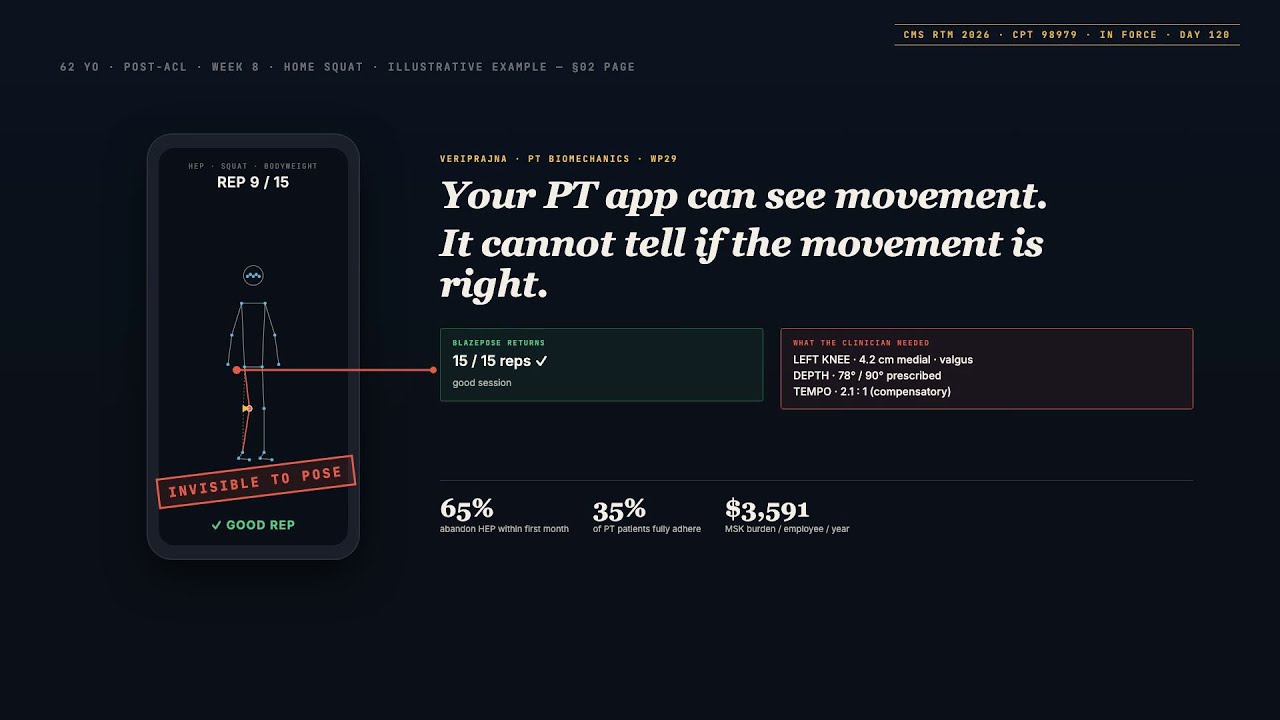
Pose estimation is free. BlazePose, MoveNet, and MediaPipe are open-source and run on any phone. The hard problem is the layer above: exercise-specific biomechanical intelligence that knows a 70-year-old post-knee-replacement patient has different squat depth targets than a 30-year-old corporate athlete.
 Watch
WatchAI Hiring Compliance & Bias Audits for Multi-Jurisdiction Employers
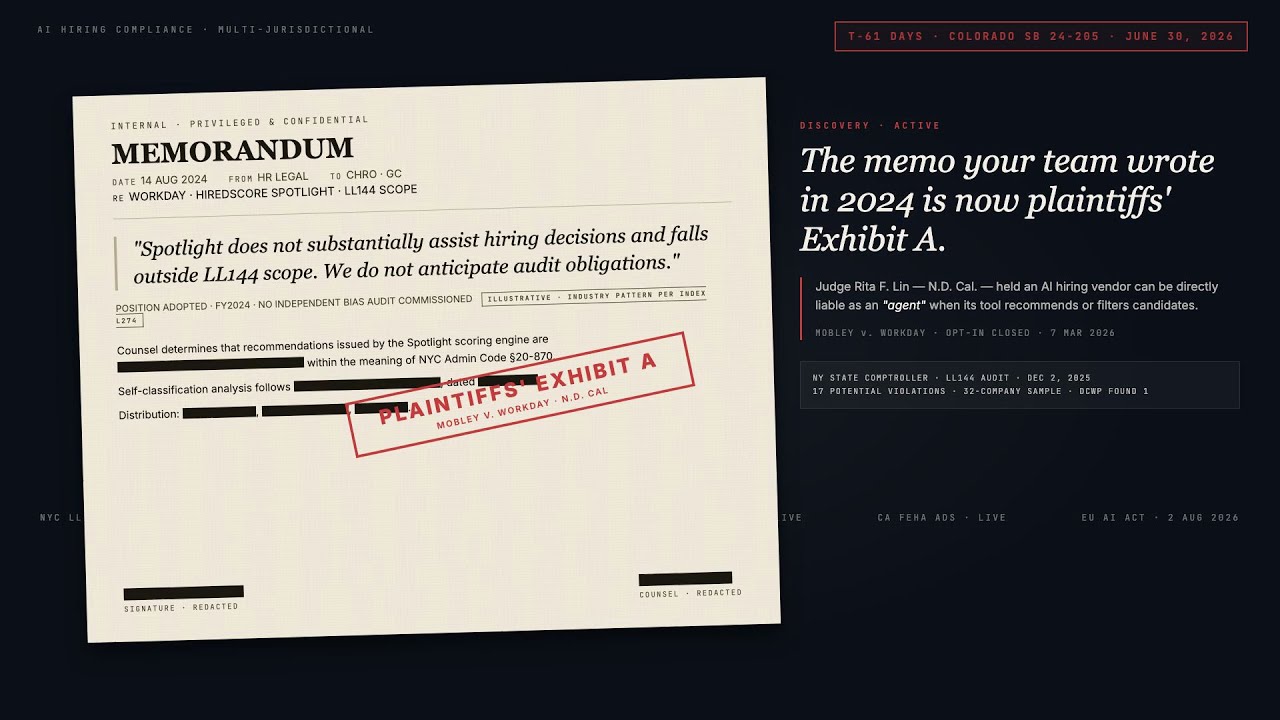
As of April 2026, the CHRO or General Counsel running AEDTs in New York, Colorado, Illinois, Texas, California, or the EU is inside a regulatory window most of their vendors were not built for. Illinois HB 3773 went live January 1. Texas TRAIGA went live January 1.
 Watch
WatchAI Procurement Fairness & Supplier Diversity Compliance
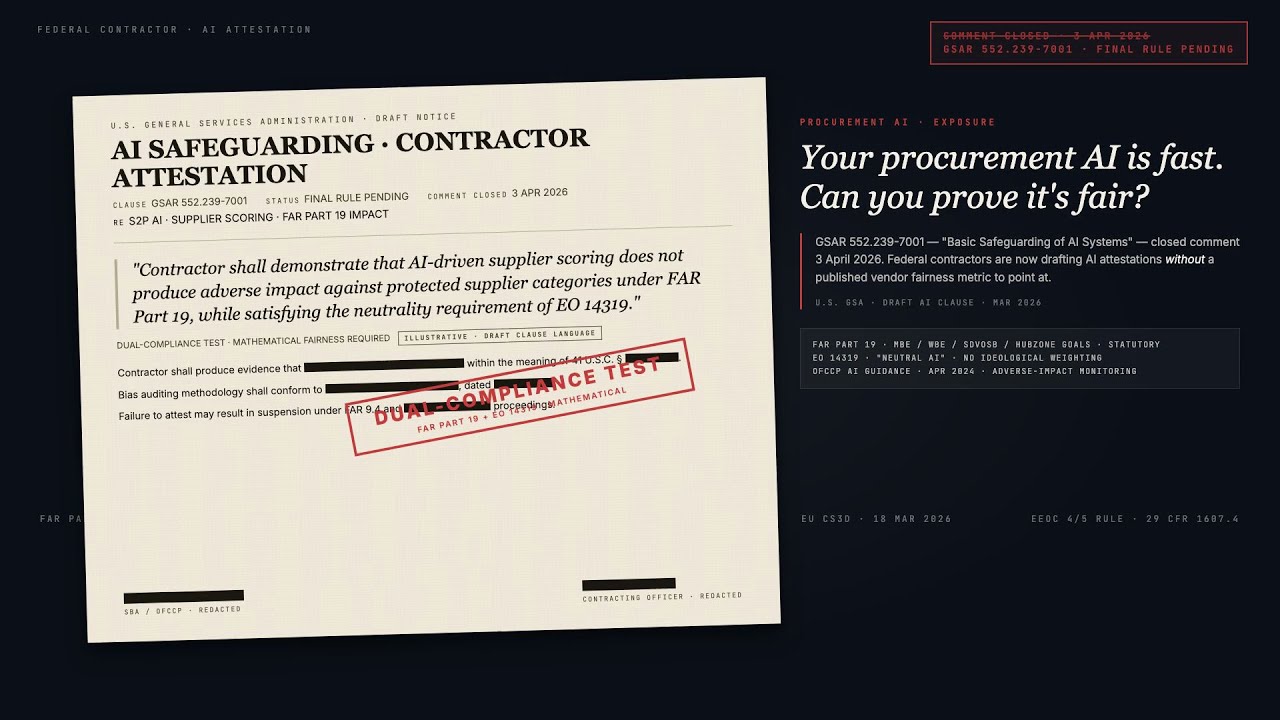
Audit your procurement AI for bias. Veriprajna builds vendor-agnostic fairness testing for SAP Ariba, Coupa, GEP, and Ivalua supplier scoring, ensuring FAR Part 19 compliance and provable algorithmic equity.
 Watch
WatchAI for Architecture & Structural Engineering
Generative AI creates stunning architectural concepts in seconds. Then your structural team spends weeks proving they cannot be built. Eighty percent of construction cost deviation comes from design changes, not construction mistakes.
 Watch
WatchAirline Crew Scheduling AI: IROPS Recovery That Works When Legacy Solvers Fail
AI-powered crew scheduling and IROPS recovery for mid-size airlines. Augment Jeppesen or IBS with ML that handles cascading disruptions, crew tracking gaps, and DOT refund exposure.
 Watch
WatchAlgorithmic Trading Compliance AI
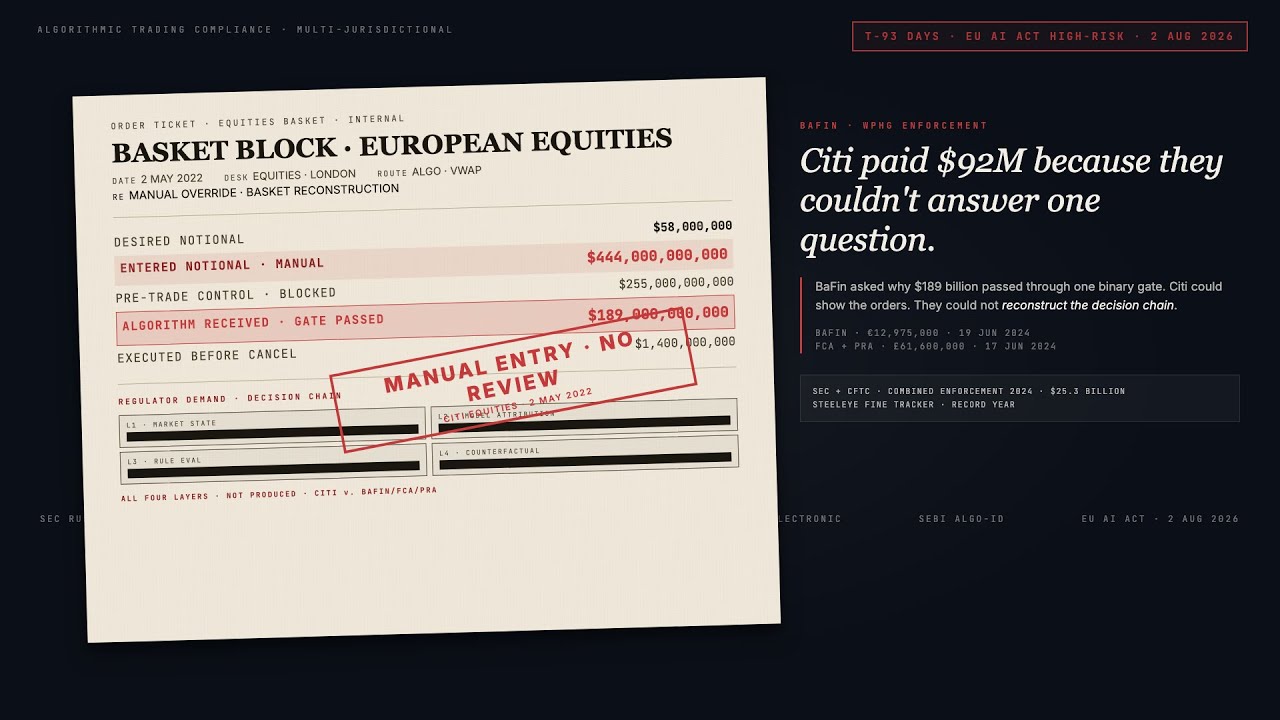
Regulators are done accepting order logs as audit evidence. After the August 2024 flash crash wiped $1 trillion in value and Citigroup paid $92 million in fines for a single algorithmic failure, the question has shifted from "do you have controls? " to "can you reconstruct every decision your algorithm made?
 Watch
WatchBiometric & Facial Recognition Compliance
Whether you have deployed facial recognition and need to know your exposure, or you are evaluating vendors and want to get it right the first time, we audit biometric systems against the regulations, benchmarks, and operational standards that actually matter.
 Watch
WatchBiosecurity AI Safety for Pharma & Biotech
In 2022, Collaborations Pharmaceuticals ran their commercial de novo drug discovery model with the reward function inverted. In under six hours it produced 40,000 candidate molecules, including analogues of VX. That was MegaSyn, a 2019-era LSTM, running on a single workstation.
Explore Solution → Watch
WatchClinical Trial Recruitment AI
80% of clinical trials miss enrollment timelines. The bottleneck is not patient supply. It is matching precision.
 Watch
WatchData Center Grid Interaction AI
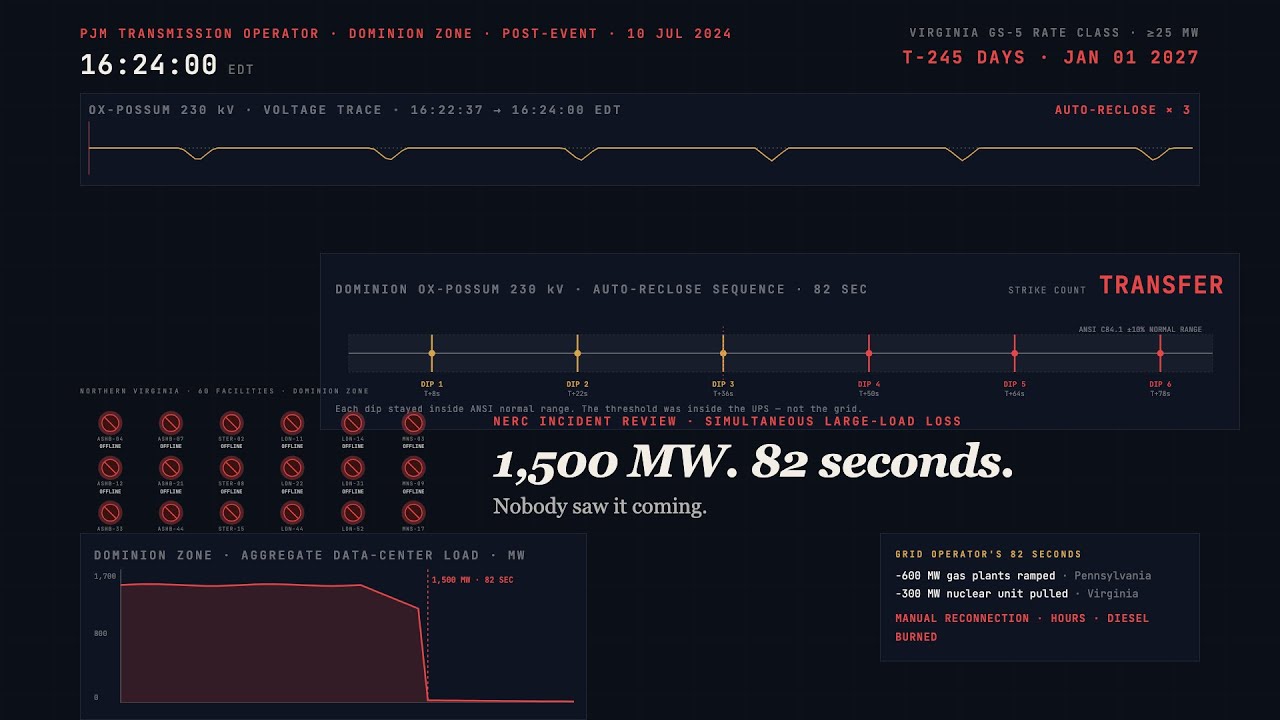
AI-powered grid flexibility orchestration for data centers. Prevent byte blackouts, optimize PJM capacity market costs, and meet NERC large load compliance requirements.
 Watch
WatchEnterprise AI Liability & Guardrails
In December 2023 a chatbot agreed to sell a $76,000 Chevy Tahoe for $1. In January 2024 a delivery chatbot wrote a poem calling its own company useless. In February 2024 a bereavement chatbot invented a refund window that did not exist, and a tribunal held the airline liable.
 Watch
WatchEnterprise AI Validation for Regulated Industries
Klarna replaced 700 customer service agents with AI. Costs dropped 40%. Then satisfaction collapsed, repeat contacts spiked, and Q1 2025 ended with a $99 million net loss.
 Watch
WatchTax Compliance AI Verification
Thomson Reuters "Ready to Review" auto-prepares 1040s. CCH Axcess Expert AI drafts advisory insights across 10,000 firms. Blue J answers tax research questions with a disagree rate under 1 in 700.
Related Industries
Frequently Asked Questions
How much does it cost to implement neuro-symbolic constraint systems in an enterprise?
Implementation cost depends on constraint complexity, integration depth, and your existing infrastructure. A constrained decoding layer for structured LLM output (Pattern 3) is the lightest engagement, typically weeks of work. Solver-in-the-loop architectures with full constraint specification (Pattern 1) run longer because the constraint formalization itself requires deep domain analysis. Published enterprise deployments report 30-45% processing cycle time reductions and individual customer savings of $10M-$28M annually, but those numbers are domain-specific. We scope and price based on your actual constraint landscape, not a generic platform fee.
What is the difference between post-hoc filtering and architectural constraint enforcement?
Post-hoc filtering runs a rule-checker after the model generates output, catching violations after they happen. It's fragile because it can only check what you anticipate: subtle constraint interactions, edge cases in multi-rule systems, and adversarial inputs routinely bypass filters. Architectural constraint enforcement embeds the solver in the inference pipeline itself, using techniques like SMT solvers, differentiable optimization layers (DC3, OptNet), or grammar-constrained decoding. The model physically cannot produce an output that violates the constraint specification. The difference is structural impossibility versus probabilistic detection.
When is neuro-symbolic AI overkill and when do you actually need it?
You need neuro-symbolic architecture when AI decisions carry legal, financial, or safety consequences and you must prove constraint satisfaction, not just estimate it. Tax compliance, clinical decision support, autonomous safety envelopes, algorithmic trading limits. You do not need it for recommendation engines, content generation, search ranking, or systems where a wrong answer is inconvenient but not actionable. If your constraints fit in a simple if-then filter, use the filter. We assess this before recommending architecture.
Which neuro-symbolic framework should I use: Scallop, DeepProbLog, or IBM LNN?
None of them as a standalone production solution. Scallop (differentiable Datalog) is the strongest for end-to-end trainable neuro-symbolic pipelines but scales poorly past 10K facts without GPU acceleration (the Lobster project helps but is research-grade). DeepProbLog handles probabilistic logic well but cannot learn logic rules, only neural predicates, and struggles with continuous distributions. IBM's LNN provides omnidirectional inference with interpretable neurons but is a research project, not a supported product. In practice, we combine production-grade solvers (Z3, Clingo, MiniZinc) with constrained decoding engines (XGrammar, llguidance) and use academic frameworks selectively where their specific strengths apply.
How do you handle Z3 SMT solver timeouts that cause latency spikes in production?
Tiered constraint checking. We partition your constraint set into fast-path constraints (linear arithmetic, simple Boolean combinations) that resolve in sub-millisecond time, and complex constraints (nonlinear arithmetic, quantified formulas) that require full SMT solving. The fast path handles 80-90% of inputs. Only boundary cases escalate to full Z3 checking, with strict timeout budgets and fallback to conservative (constraint-satisfying) default outputs. This architecture keeps P99 latency within your budget while maintaining formal guarantees.
How does constrained decoding differ from full neuro-symbolic constraint enforcement?
Constrained decoding (XGrammar, llguidance, Outlines) enforces syntactic constraints at the token level during LLM generation. It guarantees structurally valid output: correct JSON, valid SQL syntax, conformant API calls. Token mask generation runs under 40 microseconds with modern engines. But syntactic validity is not semantic correctness. Constrained decoding guarantees valid JSON; it does not guarantee that the JSON content satisfies your 47 regulatory rules. Full neuro-symbolic enforcement adds a semantic layer: an SMT solver, ASP engine, or optimization layer that verifies the content against your formal constraint specification. We often combine both: constrained decoding for structure, solver-based checking for meaning.
How do you keep constraint specifications current when regulations change?
Ontology drift is the operational killer of neuro-symbolic systems. Static constraint specifications become liabilities when regulations update quarterly. We build constraint maintenance pipelines: regulatory text is parsed into structured change sets, diffed against the existing formal specification, and the delta is reviewed by domain experts before deployment. We version constraint specifications alongside your model versions so you can trace which rules were active for any historical decision. This is not a one-time deliverable; we design the maintenance process as part of the architecture.
Does neuro-symbolic architecture help with EU AI Act compliance for high-risk systems?
Directly. The EU AI Act (full application August 2026) requires high-risk AI systems to be 'sufficiently transparent to enable deployers to interpret a system's output.' Neuro-symbolic architectures produce constraint-satisfaction proofs alongside outputs: for every decision, you can show which constraints were checked, which were binding, and why the output satisfies all of them. This dual documentation (empirical performance from the neural component plus formal guarantees from the symbolic component) is the strongest compliance posture for high-risk classification. Organizations implementing AI governance frameworks reduce hallucination-related risks by roughly 40%.
Build Your AI with Confidence.
Partner with a team that has deep experience in building the next generation of enterprise AI. Let us help you design, build, and deploy an AI strategy you can trust.
Veriprajna Deep Tech Consultancy specializes in building safety-critical AI systems for healthcare, finance, and regulatory domains. Our architectures are validated against established protocols with comprehensive compliance documentation.