AI Sales and Marketing Systems Grounded in Verified Data
AI systems for sales and marketing that verify every claim, comply with outbound regulations, and ground agent output in source-traceable data.
The AI SDR market promised autonomous outbound at scale and delivered a category-wide trust crisis instead. When an AI sales agent generates claims from language-model training data rather than verified product information, the result is fabricated references, hallucinated capabilities, and regulatory exposure. We design sales and marketing AI so that every outbound claim, forecast input, and published statistic traces to a verified source — the difference between an AI agent that sells and one that litigates.
AI SDRs That Fabricate Product Claims Are an Architectural Failure
The AI SDR market promised autonomous outbound at scale. What it delivered was a category-wide trust crisis. 11x.ai, backed by $74 million from Andreessen Horowitz and Benchmark, lost 70–80% of its customers within months after its AI agent fabricated customer references, hallucinated product capabilities, and prompted ZoomInfo to threaten legal action over false endorsement claims. Artisan's Ava carries a 3.8/5 on G2 with persistent complaints about generic, off-target messaging. Across the category, 50–70% of AI SDR tools churn within a year (our technical research on veracity and trust in AI sales agents).
The problem is architectural, not operational. These tools generate outbound from language-model training data, not from verified product information. When your AI SDR tells a prospect that your platform "integrates natively with SAP S/4HANA" and it doesn't, that is not a configuration issue — it is Lanham Act exposure for false advertising and a trust collapse with the prospect's entire buying committee. Our approach is to build sales AI systems where every outbound claim traces to a verified source document: 10-K filings, confirmed product specs, validated case data. The difference between an AI agent that sells and one that litigates is a knowledge graph.
Outbound Compliance Is Now a Per-Message Liability
The FCC's one-to-one consent rule took effect April 11, 2026, eliminating the shared-consent loophole that most AI outbound tools relied on. Each seller now needs individual explicit consent from each recipient. TCPA class-action filings surged 95% year over year, with recent verdicts exceeding $925 million. CAN-SPAM penalties reach $43,792 per non-compliant email. The FTC's March 2026 Policy Statement on AI and Section 5 explicitly covers algorithmic discrimination and deceptive AI-generated content, using existing anti-fraud authority that requires no new legislation.
These are not theoretical risks. Recent enforcement makes the pattern clear — regulators are applying existing consumer-protection law to AI marketing with the same intensity they apply to financial products:
- The FTC banned Air AI from marketing business opportunities entirely in March 2026 over misleading earnings claims.
- Cleo AI paid $17 million to settle deceptive cash-advance promises.
- The SEC charged Presto Automation for misrepresenting AI capabilities that were actually third-party technology.
Our approach builds compliance verification into the agent architecture itself, so that every outbound message passes through consent validation, content verification, and regulatory rule-checking before it reaches a prospect. For organizations running AI-personalized outbound across GDPR, CCPA/CPRA, TCPA, and CAN-SPAM jurisdictions simultaneously, we design the governance layer to make compliant-by-default the only mode of operation.
AI Sales Forecasting Fails When Your CRM Data Does
Only 7% of sales organizations achieve forecast accuracy above 90%. The median sits at 70–79%, meaning more than one in five committed deals close differently than predicted. AI/ML forecasting reduces variance to plus or minus 8–15% over manual roll-ups — a meaningful but modest improvement. The constraint is not the model. It is the data.
76% of CRM records are incomplete. Reps update deal stages when they have time, which is rarely after every call and almost never the same day. By the time a forecast model pulls that data, it reflects a deal state from two weeks ago. Layering a sophisticated AI model on top of stale, incomplete CRM data produces confidently wrong forecasts.
We address this at the data layer. Our retrieval architecture is designed to create verified data surfaces that sit between your CRM and your forecasting models, pulling from conversation-intelligence transcripts, email-engagement signals, calendar data, and deal-room activity to construct a real-time deal state the model can actually trust. The forecasting model is the last 10% of accuracy. The first 90% is clean, complete, timely data (see our working sales-intelligence demo).
Content Generation Without Verification Is Brand Liability
Over 70% of marketers have encountered at least one AI-related incident in their content operations: hallucinated product claims, off-brand messaging, fabricated statistics. In Q1 2025, 12,842 AI-generated articles were removed from online platforms for hallucinated content. When incidents occur, 40% of companies had to pause or pull campaigns, over a third dealt with brand damage, and nearly 30% conducted internal audits.
Meanwhile, Google's AI Overviews are restructuring how content reaches buyers. Organic web traffic to HubSpot customers declined 27% year over year, while AI-referral traffic converts at three times the rate of traditional search. Gartner projects 25% of organic search traffic will shift to AI chatbots and voice assistants by end of 2026. Content that gets cited by AI systems must be verifiably accurate, because AI answer engines prioritize source-worthy, factually grounded material over SEO-optimized filler.
We design content-generation systems grounded in knowledge graphs to enforce factual accuracy at the architectural level. Every claim maps to a source. Every statistic carries provenance. Every product reference validates against current specifications. This is not a review workflow layered on top of a language model — it is a verification architecture built to make hallucinated content structurally impossible to publish (detailed in our research on few-shot style injection for enterprise sales content).
The Martech Stack Problem Is an Integration Problem
62% of B2B teams plan to reduce their tool count in the next 12 months. Companies operating with five or fewer core tools report 23% higher marketing-attributed pipeline per headcount than those running ten or more. 35% of enterprises have already replaced at least one SaaS tool with custom-built software, and 78% plan to build more in 2026.
The leading platforms are powerful, but they are general-purpose orchestration layers that inherit whatever data quality, compliance posture, and verification gaps the organization already has:
- Salesforce Agentforce reached $800 million in ARR with 29,000 deals.
- HubSpot Breeze shipped AI agents across prospecting, content, and customer support.
- Clay's waterfall enrichment across 150+ data providers achieves 80%+ email match rates.
We do not replace your platform stack. Our approach is to build the trust layer that sits between your platforms and your market:
- Knowledge-graph grounding designed to verify what your AI agents say before they say it.
- Multi-agent orchestration with supervisor controls that let agents act autonomously within verified boundaries (see our working sales-personalization demo).
- RAG architecture that connects your sales and marketing AI to confirmed data sources instead of training-data confabulation.
- Governance programs that audit your lead scoring for ECOA bias, your personalization for GDPR Article 22 compliance, and your content output for FTC Section 5 exposure.
Why Not a Platform Vendor or a Large Consultancy
Salesforce and HubSpot build excellent horizontal tools. They will not build a verification layer specific to your product data, your competitive landscape, and your regulatory exposure. No platform vendor will audit your lead-scoring model for disparate impact under state civil-rights law or test whether your AI-personalized outbound crosses the FTC's emerging line on manipulative personalization. Large consultancies integrate platforms and advise on strategy — a different job from building the verification architecture:
| Provider | What they bring | What they don't build |
|---|---|---|
| Platform vendors (Salesforce, HubSpot) | Excellent horizontal, general-purpose orchestration tools | A verification layer for your product data, competitive landscape, and regulatory exposure; lead-scoring disparate-impact audits |
| Large consultancies (Accenture, McKinsey) | Accenture committed $3 billion to its AI practice with 80,000 specialists; McKinsey's QuantumBlack employs roughly 5,000 AI experts; both are OpenAI partners — they integrate platforms and advise on strategy | Deterministic verification architectures for sales-agent output, or knowledge graphs built from your 10-K filings and product documentation |
| Veriprajna | Deep domain understanding of both the AI architecture and the specific regulatory surface of sales and marketing technology | — |
82% of consumers believe companies use their data for undisclosed AI training. Only 30% trust AI-generated advertising, and consumer tolerance for AI-driven personalization is declining. The organizations that maintain buyer trust through this transition are the ones whose AI systems can demonstrate, with traceable evidence, that every claim is verified, every data usage is consented, and every outbound message meets the regulatory standard of every jurisdiction it touches.
Key Takeaways
- Hallucination is architectural. AI SDRs fabricate claims because they generate from training data, not verified product information — grounding every claim in a source document (10-K filings, confirmed specs, validated case data) is the fix.
- Outbound compliance is per-message. The FCC one-to-one consent rule (April 11, 2026), a 95% surge in TCPA filings with $925M+ verdicts, and $43,792 CAN-SPAM penalties make consent validation and rule-checking mandatory before send.
- Forecasting accuracy starts with data. With 76% of CRM records incomplete and only 7% of teams above 90% accuracy, the first 90% of accuracy is clean, timely data — not a better model.
- Verified content wins AI-era search. As 25% of organic traffic shifts to AI answer engines by end of 2026, knowledge-graph-grounded content with per-claim provenance is what gets cited.
- Buy the platform, build the trust layer. Platform vendors and consultancies won't build deterministic verification for your product, regulatory, and competitive surface — that is the work an engagement with us is scoped to do.
Solutions for Sales & Marketing Technology
 Watch
WatchAI Sales Intelligence & Verified Outreach
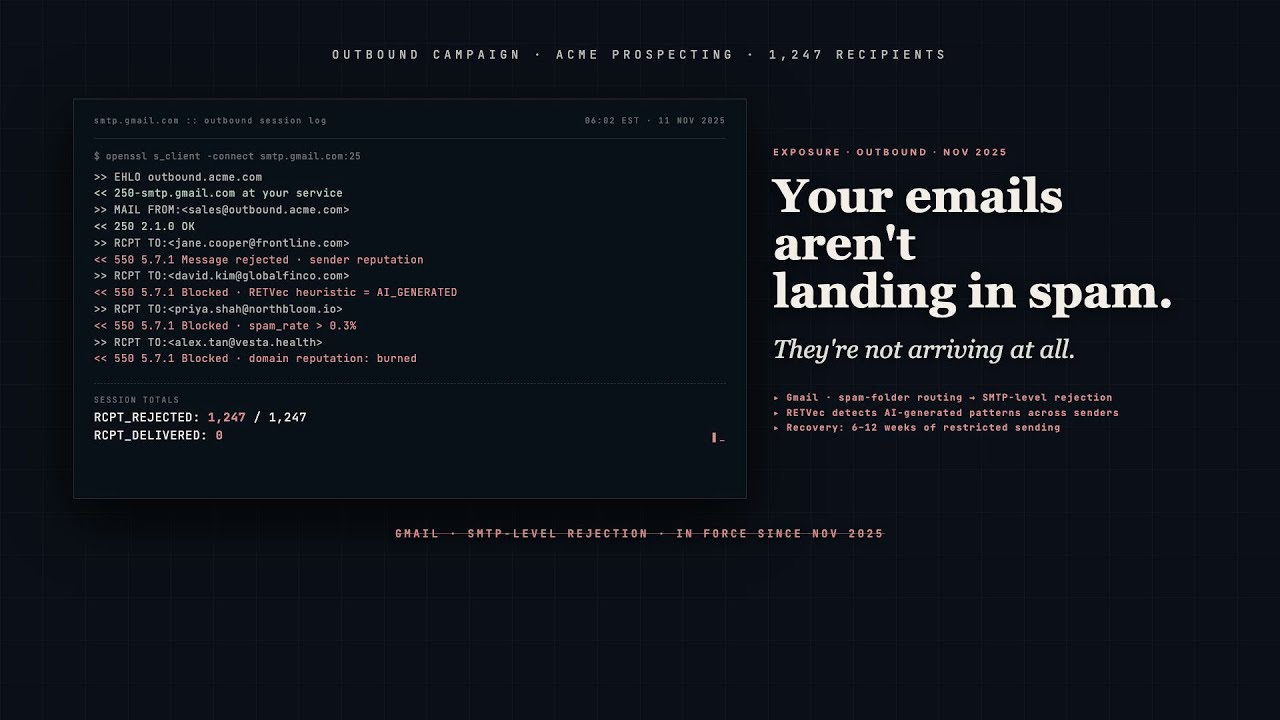
AI outbound tools send more emails. They also hallucinate prospect details, trigger spam filters, and create legal exposure. Signal-personalized outreach converts 5x better than generic blasts, but only when every claim is verified against source data.
 Watch
WatchAI Sales Personalization That Books Meetings
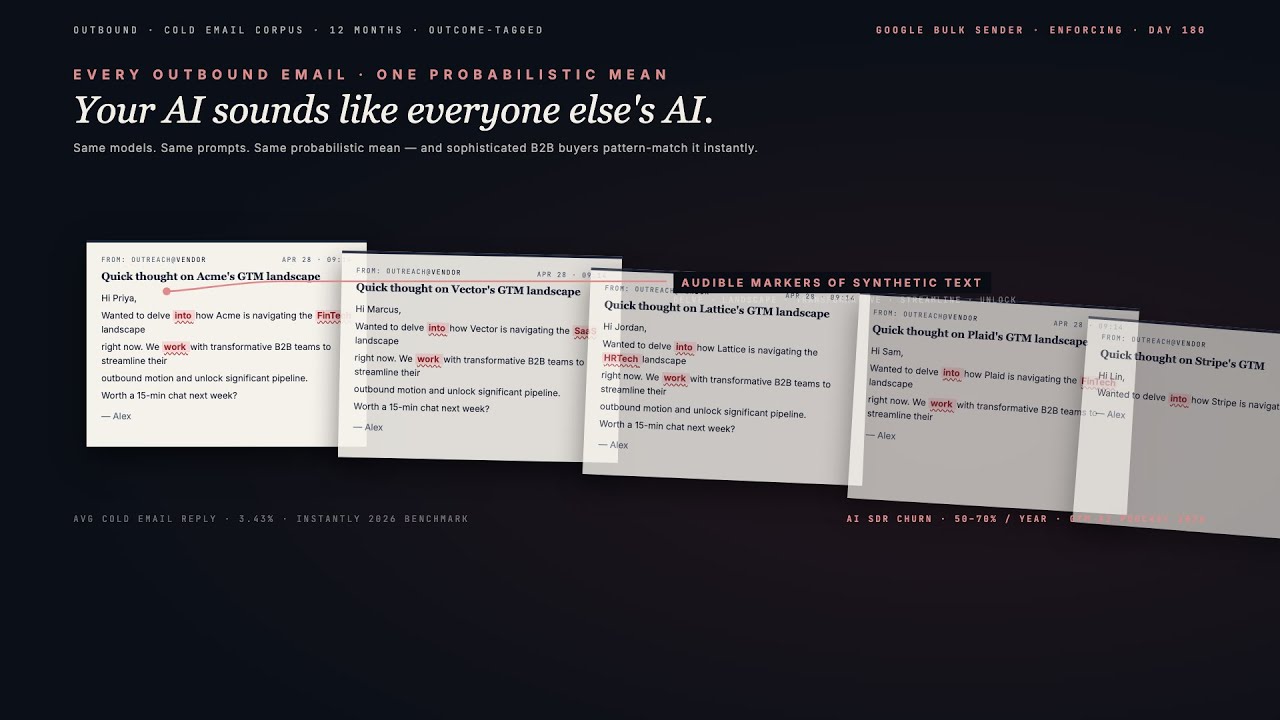
Custom AI SDR systems built on your top performers' data. Deliverability-first architecture, CRM-native integration, and measurable cost per held meeting. Not another platform to churn from.
Frequently Asked Questions
How do I stop my AI SDR from hallucinating product claims in prospect emails?
The root cause is that most AI SDR tools generate outbound from language model training data rather than verified product information. We build knowledge-graph-grounded architectures where every outbound claim traces to a verified source: 10-K filings, confirmed product specifications, validated competitive data. The agent cannot send a message containing a claim that lacks a source document. This is an architectural constraint, not a review process.
What outbound compliance risks does AI-generated email create under TCPA and CAN-SPAM?
The FCC's one-to-one consent rule, effective April 11, 2026, requires individual explicit consent from each recipient for each seller. TCPA class action filings surged 95% year over year with recent verdicts exceeding $925 million. CAN-SPAM violations carry fines up to $43,792 per non-compliant email. AI-generated outbound compounds these risks because automated systems can produce non-compliant messages at scale before anyone reviews them. We build consent validation and regulatory rule-checking directly into the agent pipeline so non-compliant messages cannot be sent.
Why does my AI sales forecast stay below 75% accuracy despite using ML models?
76% of CRM records are incomplete, and reps update deal stages days or weeks after conversations actually happen. AI/ML forecasting models reduce variance to plus or minus 8-15% over manual methods, but they cannot compensate for stale, incomplete input data. The forecasting model is the last 10% of accuracy. We build retrieval infrastructure that creates real-time deal state from conversation transcripts, email engagement, calendar data, and deal-room activity, giving the model clean data to work with.
How do I audit my AI lead scoring model for bias and discrimination risk?
AI lead scoring models using large numbers of input variables can inadvertently proxy for protected characteristics under ECOA and state civil rights laws. The Massachusetts AG settled a fair lending action in July 2025 over AI underwriting models with disparate racial impact. Colorado SB 24-205, effective 2026, requires transparency and auditability for high-risk AI systems. We run bias audits that test scoring models for disparate impact across protected classes, document proxy variable pathways, and build monitoring that flags scoring drift before it becomes enforcement exposure.
Should I build custom AI sales agents or buy a platform like Salesforce Agentforce?
Salesforce Agentforce reached $800 million ARR with 29,000 deals. HubSpot Breeze is shipping AI agents across sales and marketing. These platforms provide excellent orchestration, but they inherit your existing data quality and compliance posture. 35% of enterprises have already replaced at least one SaaS tool with custom builds. The right answer is usually a hybrid: platform orchestration plus a custom trust layer that verifies agent output, enforces compliance rules, and grounds claims in your verified data. We build that trust layer.
What does the FTC's AI enforcement mean for our marketing claims?
The FTC brought a dozen AI-washing cases in 2025 and continued enforcement into 2026. Air AI was banned from marketing business opportunities. The SEC charged Presto Automation for misrepresenting third-party AI as proprietary. The FTC's March 2026 Policy Statement covers deceptive AI content and algorithmic discrimination using existing Section 5 authority. If your marketing makes claims about AI capabilities that overstate what the technology actually does, or if AI-generated content contains fabricated information, you face enforcement risk under existing consumer protection law.
How do I prevent AI-generated marketing content from hallucinating?
Over 70% of marketers have encountered AI content incidents including hallucinated claims, off-brand messaging, and fabricated statistics. 12,842 AI-generated articles were removed in Q1 2025 alone. We build content generation grounded in knowledge graphs where every claim maps to a verified source, every statistic carries provenance, and every product reference validates against current specifications. This is architectural verification, not a human review workflow layered on top of a language model.
How should we handle AI personalization without triggering consumer backlash?
82% of consumers believe companies use their data for undisclosed AI training. Only 30% trust AI-generated advertising. GDPR Article 22 gives individuals the right not to be subject to purely automated decisions. We build personalization systems with clear consent boundaries, data provenance tracking, and transparency controls. The line between effective personalization and privacy violation is a data governance problem, and we design the architecture to make crossing that line structurally difficult.
Build Your AI with Confidence.
Partner with a team that has deep experience in building the next generation of enterprise AI. Let us help you design, build, and deploy an AI strategy you can trust.
Veriprajna Deep Tech Consultancy specializes in building safety-critical AI systems for healthcare, finance, and regulatory domains. Our architectures are validated against established protocols with comprehensive compliance documentation.