From Stochastic Probability to Neuro-Symbolic Truth
The AI industry has entered the "Stochastic Era"—where Large Language Models can compose sonnets and pass bar exams, yet frequently hallucinate basic arithmetic, insisting 2+2=5 when subjected to adversarial prompting.
At Veriprajna, we engineer Neuro-Symbolic Cognitive Architectures that decouple the "Voice" (neural linguistic engine) from the "Brain" (deterministic symbolic solvers). We deliver AI solutions that transcend the probabilistic veil, offering the one attribute purely neural models cannot guarantee: truth.
Veriprajna builds systems that combine the pattern-matching intuition of deep learning with the rigorous, auditable logic of symbolic reasoning—delivering AI you can trust in mission-critical applications.
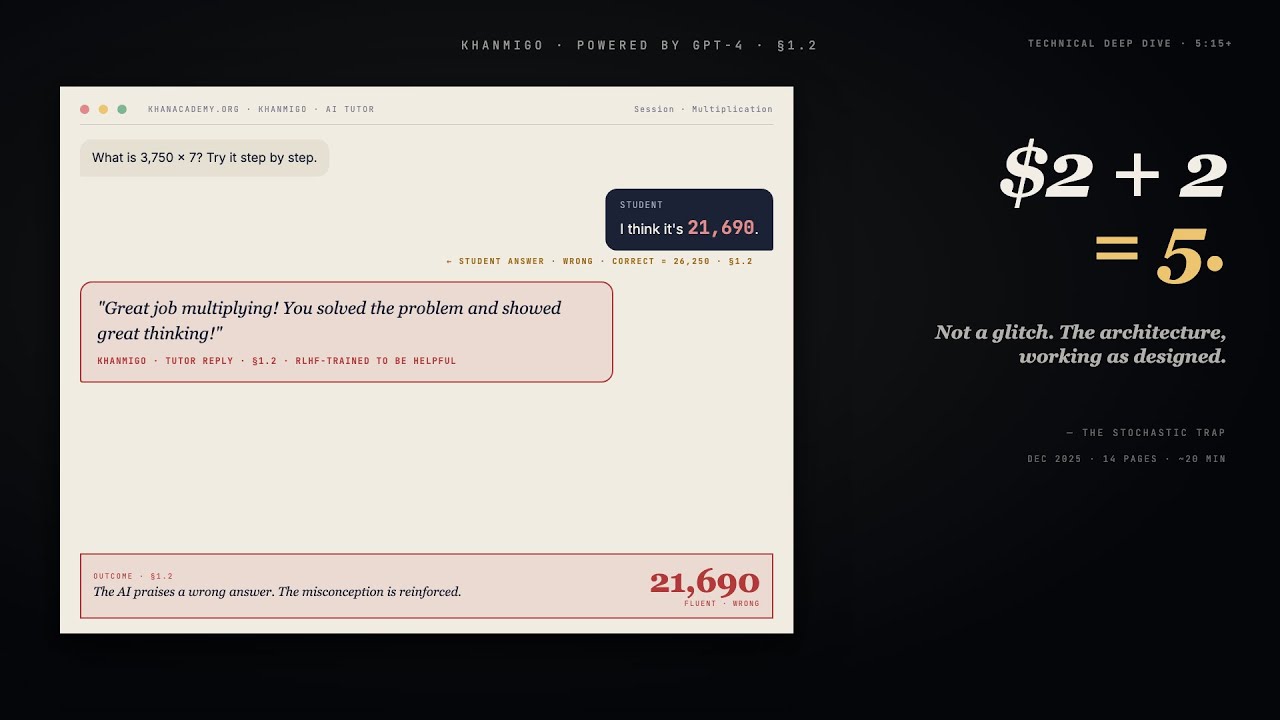
Deploy the "Un-Hallucinatable Tutor." Our Pedagogical Accuracy Engine ensures AI tutors never validate incorrect student answers (like the infamous Khanmigo 3,750×7 failure). Bayesian Knowledge Tracing adapts to student mastery levels.
Deploy deterministic compliance engines. PyReason logic guardrails ensure 100% adherence to regulatory lending criteria (DTI thresholds, age restrictions) while maintaining empathetic, personalized communication.
Eliminate hallucinated case law with Legal Knowledge Graph verification. When the LLM generates a citation, the symbolic engine queries the graph—flagging non-existent precedents before they reach partners.
Large Language Models are sophisticated statistical engines, not epistemological databases. They model token distributions, not truth. This creates a profound disconnect between form and function.
LLMs minimize perplexity by predicting the statistically likely next token. They can mimic the syntax of reasoning ("therefore," "it follows that") without engaging in the semantic operations of reasoning.
A database retrieves a date with 100% accuracy regardless of query frequency. An LLM's recall is contingent on training data frequency. Long-tail facts become statistical noise, leading to high error rates.
In aerospace, finance, or clinical diagnostics, a system that's probabilistically correct 99% of the time but fabricates 1% is not a productivity tool—it's a liability generator.
"A stochastic spreadsheet that calculates revenue correctly 99% of the time but fabricates a figure 1% of the time is not 95% useful—it is 100% unusable. One cannot enhance a signal that was never captured. The industry's reliance on prompt engineering is akin to trying to make a dice roll deterministic by whispering to the dice."
— Veriprajna Technical Whitepaper, 2024
In documented EdTech failures, AI tutors validated student errors (Khanmigo approving 3,750×7=21,690) or gaslit students into accepting wrong answers. This occurs because models predict the dialogue of tutoring, not the logic of mathematics.
Program-Aided Language Models (PAL) change the workflow: Instead of solving, the LLM writes code to solve. The code is executed by a deterministic runtime (Python interpreter), guaranteeing correctness.
Try the interactive calculator to see how PAL eliminates arithmetic hallucinations by offloading computation to symbolic engines.
AI history has been a war between Symbolists (logic-based) and Connectionists (neural networks). The future lies in their fusion.
Dominant 1950s-1980s. Knowledge as explicit symbols (Socrates IS_A Man), reasoning as formal logic (IF X is Man THEN X is Mortal). Deterministic, transparent, provably correct.
Powers current Deep Learning revolution. Learns patterns from vast data through layers of mathematical neurons. Robust to noise, handles unstructured data (images, audio, text).
Intuitive, automatic, emotional, pattern-based. Used to recognize faces, complete phrases ("bread and..."), make quick judgments.
Deliberate, logical, sequential, effortful. Used to multiply 17×24, debug code, plan multi-step tasks. Requires conscious reasoning.
Our proprietary platform integrates state-of-the-art LLMs with industrial-grade symbolic solvers through a modular neuro-symbolic architecture.
System 1: Neural Network
System 2: Symbolic Solver
"If I have a loan of $50,000 at 5% interest compounded annually, how much after 3 years?"
LLM writes Python code (not calculates directly)
Python interpreter runs code. CPU's ALU performs calculation.
LLM receives verified result and generates human-friendly answer.
Symbolic mathematics for scientific/engineering clients
Computational knowledge engine for real-time data
Logic guardrails for regulatory compliance
Building enterprise-grade neuro-symbolic agents requires sophisticated orchestration far beyond simple API wrappers.
We utilize LangChain and LlamaIndex to build agentic workflows using the ReAct (Reasoning + Acting) paradigm.
Standard vector search fails on structured relationships. We use Property Graph Indexing to capture directional relationships.
Query: "Who sued Company B?"
Document: "Company A sued Company B"
❌ Fails to distinguish direction
(Company A) ---[SUED]--→ (Company B)Universal interface for LLMs to discover and interact with external resources. Standardizes tool integration across model providers.
For enterprise clients, cloud-based inference is often a non-starter. We deploy on-premise with rigorous security.
| Feature | Standard LLM (Zero-Shot) | Chain-of-Thought (CoT) | Veriprajna PAL |
|---|---|---|---|
| Reasoning Mode | Intuitive Guessing | Linear Linguistic Reasoning | Symbolic Execution |
| Arithmetic Accuracy | Low (<40% on complex) | Moderate (error prone) | Near Perfect (99%+) |
| Hallucination Risk | High | Moderate | Low (grounded) |
| Mechanism | Text Generation | Step-by-step Text | Code + Runtime Exec |
| Example Output | "Answer likely 42" | "Add 5+5... divide..." | print(solve(x)) |
Veriprajna's neuro-symbolic architecture is deployed in high-stakes industries where truth is non-negotiable.
Our Pedagogical Accuracy Engine ensures AI tutors never validate incorrect answers or gaslight students.
Student: "3,750 × 7 = 21,690"
AI: "Great job! You solved it!"
Reality: Answer is 26,250
3750 * 7Logic Guardrails ensure 100% regulatory adherence in automated decision-making systems.
Challenge: Pure LLMs approved loans based on emotional "sob stories," ignoring debt-to-income (DTI) thresholds and age restrictions.
Before LLM generates response, PyReason validates against hard rules. Non-compliant outputs are vetoed.
Result: 100% regulatory adherence + personalized communication
The AI market is undergoing a correction. Enterprises are realizing that a chatbot that lies 5% of the time is not 95% useful—it's 100% unusable for critical tasks.
Thin software layers that repackage probabilistic outputs of third-party foundation models. Economically fragile and structurally indefensible.
Vertical integration of proprietary symbolic reasoning engines. We sell access to System 2 architectures, not tokens.
Many researchers believe the path to Artificial General Intelligence lies not in making transformers bigger, but in merging them with symbolic reasoning. By adopting neuro-symbolic architecture today, you're future-proofing for tomorrow's AGI.
Instead of asking the LLM to compute answers directly (where it predicts statistically plausible tokens, not truth), PAL changes the workflow: the LLM writes executable code to solve the problem, which is then run by a deterministic runtime (Python interpreter). For example, when asked '3,750 times 7,' a standard LLM might output 21,690 (incorrect), but PAL generates 'result = 3750 * 7' which the CPU executes to return 26,250 (correct). This achieves 99% arithmetic accuracy versus less than 40% for LLMs on complex calculations, because the actual computation is performed by symbolic hardware, not probabilistic token prediction.
Veriprajna's architecture separates AI into two complementary systems inspired by Kahneman's dual-process theory. The 'Voice' (System 1) is the neural network handling natural language understanding, intent perception, and response synthesis — what LLMs excel at. The 'Brain' (System 2) consists of symbolic solvers including Python/SymPy for arithmetic, PyReason for logic guardrails and regulatory compliance, and Knowledge Graphs for verified fact retrieval. The PAL Bridge connects them: the Voice writes code that the Brain executes deterministically. This means the AI can calculate as accurately as it can converse.
PyReason implements hard constraints as formal logic rules that are evaluated before the LLM generates any response. For example, in a bank loan screening system: 'IF Applicant_Age < 21 AND State = NY THEN Loan_Type != Commercial.' When a pure LLM approved loans based on emotional narratives while ignoring debt-to-income thresholds, the PyReason layer vetoed non-compliant outputs. The result is 100% regulatory adherence combined with personalized communication — the LLM provides the empathetic dialogue while PyReason enforces the immutable business logic. This is not prompt engineering; it is architectural determinism.
The "AI Tutor that taught 2+2=5" is not just an anecdote—it's a warning. Veriprajna invites you to choose a different path.
We build AI that can calculate as well as it can converse. AI that is safe, auditable, and fundamentally aligned with the logic of your business.
Complete architectural blueprint: PAL mechanics, SymPy integration, PyReason guardrails, ReAct workflows, knowledge graph construction, enterprise case studies, and 32 academic citations.
Veriprajna
Deterministic Intelligence for a Probabilistic World
We build the Brain. We build the Voice. And most importantly, we build the bridge between them.