Why AI Wrappers Fail Enterprises & How Deep Technical Integration Delivers Real Value
The era of "thin wrappers" around foundation models is over. Enterprise success requires Deep Solutions—hybrid architectures combining AI with deterministic physics engines, DSP, and compliance frameworks.
Veriprajna's philosophy: Deterministic Core, Probabilistic Edge. We solve problems that generic models cannot—specifically, problems requiring adherence to the laws of physics or the laws of copyright.
Since the release of foundation models, the AI landscape has split into two philosophies: the fast but fragile "Wrapper" and the resilient "Deep Solution."
While excitement around foundation models is palpable, sustainable economic value accrues to companies that figure out how to make AI work in complex, regulated workflows where "mostly right" is insufficient.
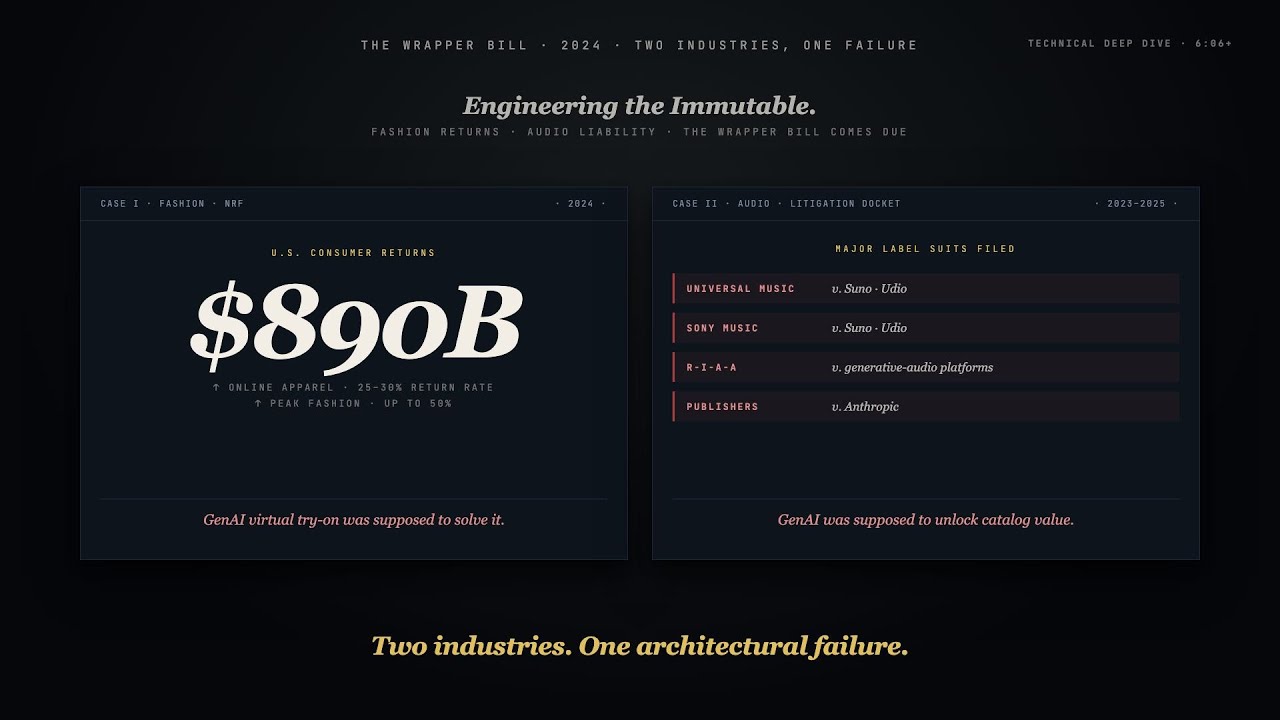
Online apparel returns exceed 25-30% because standard AI VTO tools hallucinate fit. Veriprajna replaces probabilistic image generation with deterministic cloth simulation.
Diffusion models optimize for pixel coherence, not cloth physics. If a user selects a too-small dress, GenAI warps the garment or the body to "make it look right"—creating a fantasy mirror that guarantees a return.
GANs suffer from "mode collapse"—fine details like lace, embroidery, or logos get blurred or replaced with generic patterns. Diffusion models may invent new details that don't exist on the physical product.
2D-based AI VTOs paste flat images over users, lacking depth perception. They cannot model how fabric drapes over complex body topologies—the curve of a hip, the breadth of shoulders.
We ingest digital CAD patterns and assign measured physical properties from real fabric counterparts:
PBR models light interaction with surfaces using physically accurate formulas:
This is where AI enters—not to generate the cloth, but to solve lighting and integration:
GenAI optimizes for Click-Through Rate (sells fantasy). Veriprajna optimizes for Net Sales & Return Reduction (shows truth).
System outputs data: "95% Match for Waist, 60% Match for Hips." Empowers informed decisions, reduces bracketing behavior.
Assets derived from actual CAD patterns integrate directly with Product Lifecycle Management systems—design to e-commerce.
| Feature | Generative AI Wrapper | Veriprajna Deep Solution |
|---|---|---|
| Core Technology | Diffusion Models (Stable Diffusion, etc.) | Physics Simulation (FEM/Mass-Spring) + PBR |
| Fit Accuracy | ❌ Low: Hallucinates fit; warps garment to body | ✓ High: Simulates tension, stretch, drape |
| Material Fidelity | ❌ Low: Guesses texture; struggles with complex fabrics | ✓ High: Uses measured physical properties |
| Input Data | 2D Image + Text Prompt | 3D CAD Pattern + Fabric Physics Data |
| Lighting Integration | ❌ Poor: Often flat or inconsistent | ✓ Excellent: AI-driven HDR + Differential Rendering |
| Primary KPI | Conversion Rate (Sales) | Net Margin (Sales - Returns) |
| Consumer Trust | ❌ Erosive (Disappointment upon delivery) | ✓ Cumulative (Accurate predictions → loyalty) |
| Enterprise Risk | ❌ High (Misleading advertising/Returns) | ✓ Low (Data-backed visualization) |
Music and voice industries face existential copyright challenges with Generative AI. Veriprajna uses Deep Source Separation + RVC to create a traceable, licensed workflow.
Most GenAI audio models trained on scraped copyrighted music. If output mimics training set ("regurgitation"), enterprise is strictly liable for infringement. Black box = no provenance verification.
Per U.S. Copyright Office: Works created solely by AI without significant human intervention are NOT copyrightable. Brand cannot own asset—it enters public domain, letting competitors use freely.
Unauthorized voice cloning triggers Right of Publicity litigation. Using "sound-alike" that mimics celebrity—even without their name—leads to damages. Midler v. Ford, Waits v. Frito-Lay precedents.
We reject "generate from scratch." Instead: Transformative workflow using licensed/owned works, creating clear chain of title.
Unmix mono/stereo audio into constituent stems (Vocals, Drums, Bass, Other). "Un-baking the cake" using Deep Learning.
Speech-to-Speech framework: Change voice timbre while preserving prosody (rhythm, pitch, emotion). Not TTS—maintains original performance.
RVC output is a derivative work based on human performance (source guide track) + human-created composition. The "human authorship" requirement is met by original vocal performance, source composition, and creative direction. Result: Output is copyrightable. Enterprise can own the asset, unlike pure GenAI which enters public domain.
| Feature | Generative Audio (Black Box) | Veriprajna RVC/DSS (Deep Tech) |
|---|---|---|
| Input Mechanism | Text Prompt ("Make a pop song") | Existing Audio (Guide Track/Stem) |
| Control & Nuance | ❌ Low: Random seed variance | ✓ High: Preserves timing, pitch, emotion |
| Copyright Status | ❌ High Risk: Potential infringement; Public Domain | ✓ Clear: Derivative of licensed works; Copyrightable |
| Voice Identity | ❌ Uncontrolled: Prone to accidental deepfaking | ✓ Controlled: White-Listed consented models |
| Auditability | ❌ None: Black box training data | ✓ Full: Watermarking & FAISS logs |
| Enterprise Use Case | Ideation, Background Muzak | Dubbing, Localization, Post-Production, Remixing |
Security, Infrastructure, and Governance for Enterprise Deployment
On-Premise/VPC Deployment: Pipelines containerized (Docker/Kubernetes). Run entirely within client's infrastructure—no internet required.
Edge Computing & GPU Cost Reduction: Neural rendering shortcuts + model quantization for real-time performance.
Invisible, Robust Watermarks: Every output embedded with licensing ID, user ID, timestamp for permanent audit trail.
Adjust parameters based on your e-commerce operation
Industry average for online apparel: 25-30%
Assumption: Veriprajna's physics-based VTO reduces returns by 40% (conservative estimate based on fit-related returns constituting 55% of total returns).
The era of the "AI Wrapper" is drawing to a close. As foundation models become commoditized, sustainable value accrues to those solving domain-specific problems that generic models ignore.
For enterprise, accuracy, compliance, and defensibility are paramount. Deep Solutions respect the laws of physics and the laws of copyright—building technical moats that wrappers cannot.
From hallucinating fit to simulating physics—turning the returns crisis into a margin opportunity.
From generating piracy to engineering derivatives—turning the copyright crisis into a licensing opportunity.
"For the enterprise leader, the choice is strategic: Build on a shifting foundation of third-party APIs, or engineer a deep, owned solution that respects reality."
— Veriprajna Whitepaper, 2024
AI wrappers fail enterprises because they are thin API layers around foundation models with no control over model behavior, resulting in hallucinations in high-stakes contexts (medical diagnosis, copyright content, security code), vendor lock-in where pricing changes destroy margins, zero defensibility since competitors can replicate easily, and black box liability where the wrapper developer is powerless to fix hallucinated outputs. Deep Solutions solve these by combining AI with deterministic physics engines and compliance frameworks in a 'deterministic core, probabilistic edge' pattern.
Veriprajna replaces probabilistic image generation with deterministic cloth simulation using measured fabric properties (bending stiffness, shear stiffness, tensile stretch, buckling ratio). If a garment is too tight, the simulation displays stress lines rather than hallucinating a perfect fit. Physically Based Rendering (PBR) handles light interaction accurately (albedo, roughness, metallic, normal maps). AI enters only at the edge — for lighting estimation, differential rendering, and shadow casting — not for generating the cloth. This optimizes for net sales and return reduction rather than click-through rate.
Veriprajna uses a transformative workflow instead of generative-from-scratch: Deep Source Separation (U-Net architecture) deconstructs licensed audio into stems, then Retrieval-Based Voice Conversion (HuBERT content encoding + FAISS retrieval + HiFi-GAN synthesis) transforms the vocal timbre using consented voice actors. The output is a copyrightable derivative work with clear chain of title. Voice actors sign AI Commercialization Releases, royalties are tracked via licensing ledger, and FAISS indices prove which voice model was used — providing irrefutable legal defense.
Veriprajna architects intelligence that solves real business problems—combining AI with physics, DSP, and compliance frameworks.
Schedule a consultation to explore how Deep Solutions can transform your enterprise operations.