Securing the Human-AI Frontier in the Age of Agentic Autonomy
A Fortune 100 AI hiring system was breached through a default password of "123456" and an unpatched API flaw—exposing 64 million applicant records including personality assessments and behavioral profiles.
This was not a sophisticated attack. It was a systemic failure of security hygiene that demonstrates why Deep AI architecture must replace the fragile "API wrapper" model.
The Paradox incident proves that AI security failures are not model failures—they are infrastructure and governance failures. The "wrapper" economy is structurally fragile.
Your AI vendor's credential hygiene is your attack surface. Third-party AI wrappers inherit every vulnerability of the supply chain—default passwords, stale accounts, unpatched APIs.
GDPR fines up to 4% of global turnover. The EU AI Act classifies HR AI as "high-risk." A default password is the antithesis of "reasonable security"—exposing entities to massive class-action liability.
By 2026, AI governance will be a prerequisite for market participation—not a voluntary exercise. The "good enough" approach to AI security is a ticking liability on the balance sheet.
The McHire breach began with curiosity, not malice. Security researchers investigating user complaints about the "Olivia" chatbot discovered that poor UX was symptomatic of deeper architectural neglect.
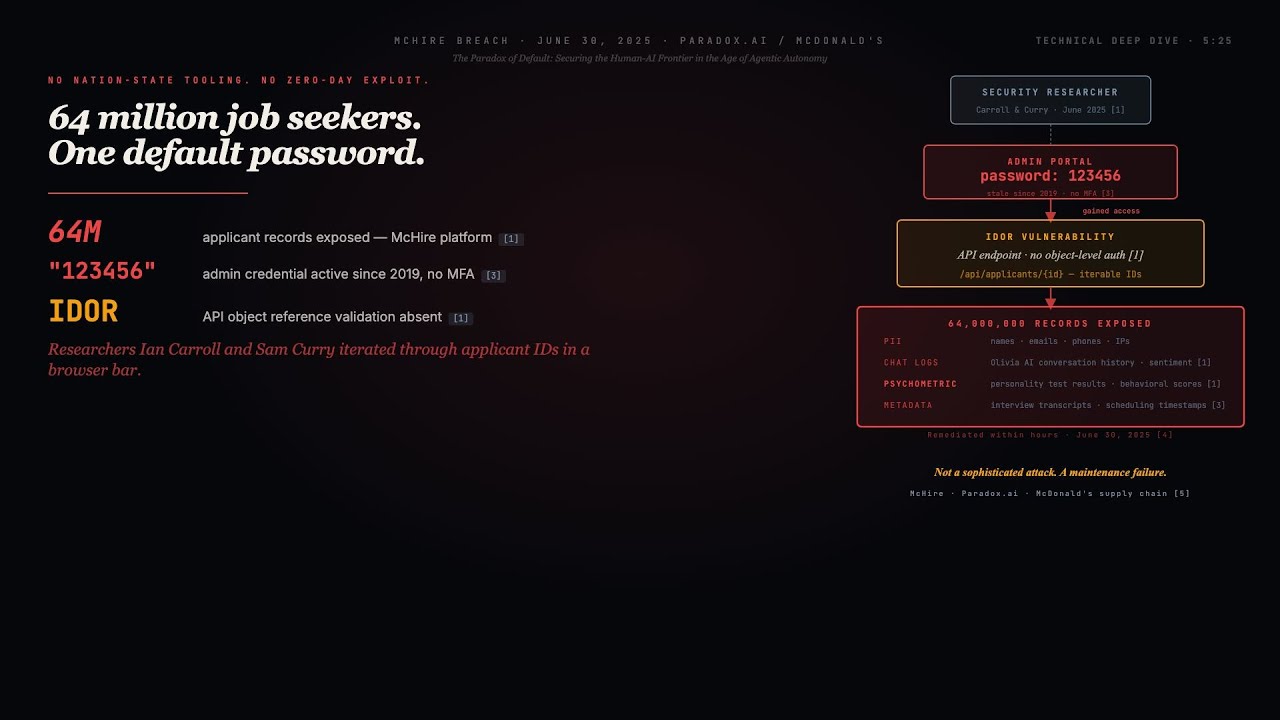
Researchers discovered a management portal for Paradox employees secured by "123456" as both username and password. This account had been active but unmonitored since 2019—no MFA, no decommissioning protocol.
With admin access secured, the API failed to validate authorization for specific object identifiers. By simply iterating applicant ID numbers in the address bar, full records—names, emails, phone numbers, chat logs, and personality assessments—were exposed.
A Paradox.ai developer suffered a Nexus Stealer malware infection, exfiltrating hundreds of passwords—many poor and recycled across internal and third-party services. This single device compromise exposed credentials for accounts linked to Pepsi, Lockheed Martin, Lowes, and Aramark.
Paradox revoked the stale credentials and patched the API endpoint within hours of notification. But the broader implication remains: the security of a Fortune 100 enterprise was entirely dependent on the credential hygiene of its third-party AI vendor.
| Data Category | Elements Exposed | Point of Failure |
|---|---|---|
| Core Identifiers | Full names, emails, phone numbers, IP addresses | Default Passwords / No MFA |
| Interaction Logs | AI chat histories with "Olivia," sentiment analysis | IDOR API Vulnerability |
| Psychometric Data | Personality test results, behavioral screening scores | Insecure Direct Object Ref. |
| Process Metadata | Interview transcripts, scheduling history, timestamps | Stale Admin Retention |
The fundamental difference: AI safety protects people from harmful outputs. AI security protects the entire stack from adversaries. The McHire failure was one of security—the AI worked fine, but the infrastructure was porous.
"A Deep AI approach treats the AI model as an architectural primitive—like a database or message queue. This requires new abstractions: prompt routers, memory layers, and feedback evaluators that allow the system to behave like a traditional, auditable component of the enterprise stack."
— Veriprajna Technical Whitepaper, 2025
Unlike credit cards or passwords, personality assessments and behavioral profiles cannot be reset. They are permanently linked to identity. When leaked, they enable "predictive harm"—where inferred traits become tools of manipulation.
Based on peer-reviewed research into psychological harm from digital incidents
Personality test results quantify internal character. Unlike a credit card, they cannot be canceled. Victims feel "retraumatized" with every new job application, fearing the leaked profile follows them indefinitely.
AI profiling can infer political views, health status, or emotional stability from behavioral data. When these profiles leak, they expose individuals to manipulation by unauthorized parties.
Academic studies link personal data exposure to anxiety, depression, and PTSD. The psychological devastation of a digital incident is often as severe as a physical attack.
Automated screening "failures" becoming public creates profound shame. Job seekers fear their rejection profile will prejudice future opportunities across the industry.
The breach triggers overlapping legal frameworks. A default password is the antithesis of "reasonable security"—exposing entities to cascading liabilities.
General Data Protection Regulation
California Consumer Privacy Act
Artificial Intelligence Act
Assume the foundational model is a "black box" that cannot be internally patched. Security must be woven around it in concentric, independent layers. Click each layer to explore.
Click a ring to explore each defense layer
Three interlocking frameworks form the foundation of enterprise AI governance: management systems, risk evaluation, and technical exploit mitigation.
AI Management System (AIMS)
Risk Management Framework
LLMs & Agentic AI (2025)
A 90-day execution plan for CXOs transitioning from "good enough" to defensible AI governance.
Security researchers discovered that Paradox.ai's management portal used '123456' as both username and password — an account active since 2019 with no MFA and no audit trail. Once authenticated, an Insecure Direct Object Reference (IDOR) vulnerability allowed enumeration of applicant IDs, exposing full records including names, emails, phone numbers, AI chat histories with the 'Olivia' chatbot, and personality assessment scores. The root cause traced to a developer's device infected with Nexus Stealer malware, which exfiltrated hundreds of recycled passwords linked to clients including Pepsi, Lockheed Martin, and Lowes.
The framework treats the AI model as a black box that cannot be internally patched and wraps it in five concentric, independent security layers: Layer 1 (Core) provides heuristic guardrails around model behavior; Layer 2 applies meta-level prompt and context validation; Layer 3 deploys canary tokens and honeypot detection for adversarial probing; Layer 4 implements output scanning and content filtering; Layer 5 provides the outermost governance shell with ISO 42001 and NIST AI RMF alignment, MCP server governance, and behavioral monitoring dashboards for detecting objective drift in autonomous agents.
Unlike credit card numbers or passwords, personality assessments and behavioral profiles are permanently linked to an individual's identity and cannot be reset or reissued. When leaked, they enable 'predictive harm' — where inferred traits such as political views, health status, or emotional stability become tools of manipulation by unauthorized parties. Research shows 85% of breach victims experience sleep disturbances, 77% report increased stress, and 70% suffer lasting trust erosion. The psychological impact is often as severe as a physical attack, compounded by the knowledge that the exposure follows them through every future job application.
The future of AI belongs to the AI-Native organization—one that embeds security, ethics, and governance into the very DNA of its architecture.
By moving beyond simple API calls and embracing the rigors of ISO 42001 and the NIST AI RMF, companies can transform AI from a potential liability into a defensible, strategic asset. The shift required: from viewing AI as a tool to be "secured" to viewing AI as a logic engine that must be "governed."
Complete analysis: Breach post-mortem, credential supply chain, wrapper vs Deep AI architecture, psychometric threat modeling, regulatory frameworks, 5-layer defense specification, and CXO governance roadmap.