At Vdara's pool deck and London's 20 Fenchurch St, concentrated reflected sunlight damaged materials and drove retrofit work. Those buildings made a difficult lesson visible: a compelling curved-glass form can have a physical consequence that a render does not reveal.
That is why we built Caustic, our Facade Solar-Convergence Firewall. It is a concept-stage screen for curved glass facades, designed to put reflected-sunlight risk into the same design iteration as massing and material choices. The runnable demo is at https://veriprajna.com/demos/ai-architecture-structural-engineering.
Generative tools produce pixels, not load paths.
The phrase applies to more than structural calculations. A design system can produce an attractive image without evaluating where reflected sunlight will converge. For architecture principals, facade-engineering directors, computational-design leads, and construction-technology teams, the practical question arrives before permits and procurement: has anyone tested the geometry against the occupied places around it?
A screen that shows its work
Caustic starts with an illustrative FacadeSpec: curvature, orientation, dimensions, glazing reflectance, site latitude, and an occupied target plane. It then runs a deterministic geometric-optics ray trace over a relevant summer-solstice sweep. The Ray Tracer discretizes the facade, reflects parallel sun rays across 15 sun positions, and records peak concentration, focal surface temperature, and focal dwell.
The mechanism matters because the conclusion is constrained. The Policy Gate applies fixed thresholds of 1.45x concentration, 80 C focal temperature, and 30 minutes of above-threshold dwell. The Screening Agent can explain the selected protocol, but it cannot alter a computed number or the resulting verdict. A Critic Agent checks that the narration agrees with the result.
That is a more useful role for AI in an early engineering decision. It can bring a defined protocol into the concept loop and make the result legible. The physics and the fixed gate remain inspectable.
The Crescent Tower result is a design decision, not a mood
Our concrete anchor is Crescent Tower, a synthetic, illustrative 38-storey concave south-glass hotel concept over a pool deck. The live demo returns FLAGGED after its 15-position sweep: 2.07x peak concentration, approximately 106 C focal surface temperature, and 6.0 h/day of focal dwell.
Those values are not a generic warning label. They are the evidence for the gate. Concentration exceeds 1.45x. Temperature exceeds 80 C. Dwell is far beyond 30 minutes. The interface places the verdict, metrics, solar-study sheet, and agent trace together so a reviewer can see what the screen evaluated rather than receiving an opaque declaration.
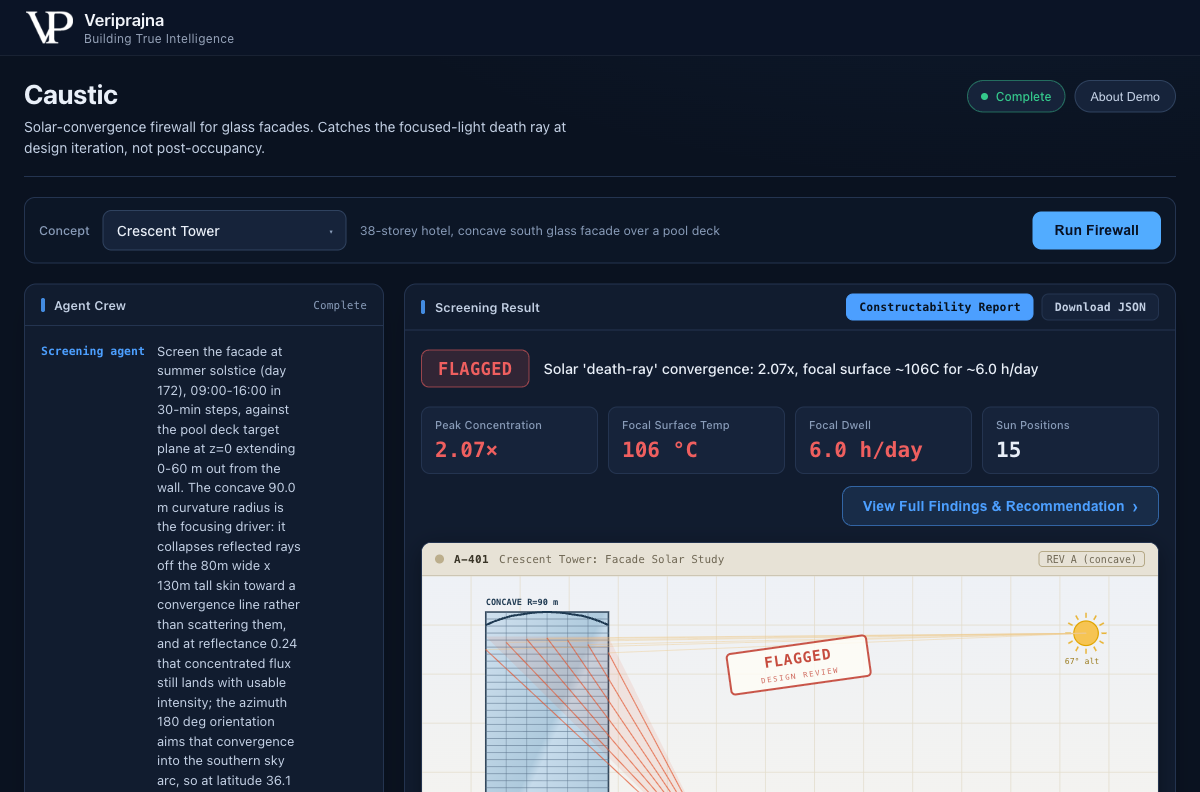
Crescent Tower's real demo screen shows the FLAGGED verdict alongside the 2.07x, 106 C, 6.0 h/day result and the 15-position solar sweep.
The comparison is deliberately concrete. A synthetic, illustrative remediated Crescent Tower uses convex curvature and fritted low-e glazing. In the demo's tested sweep, it returns SCREEN-CLEAR at 1.10x, approximately 74 C, and 0.0 h/day of focal dwell. That does not make the configuration approved, certified, or safe for construction. It clears continued concept exploration under this pre-screen.
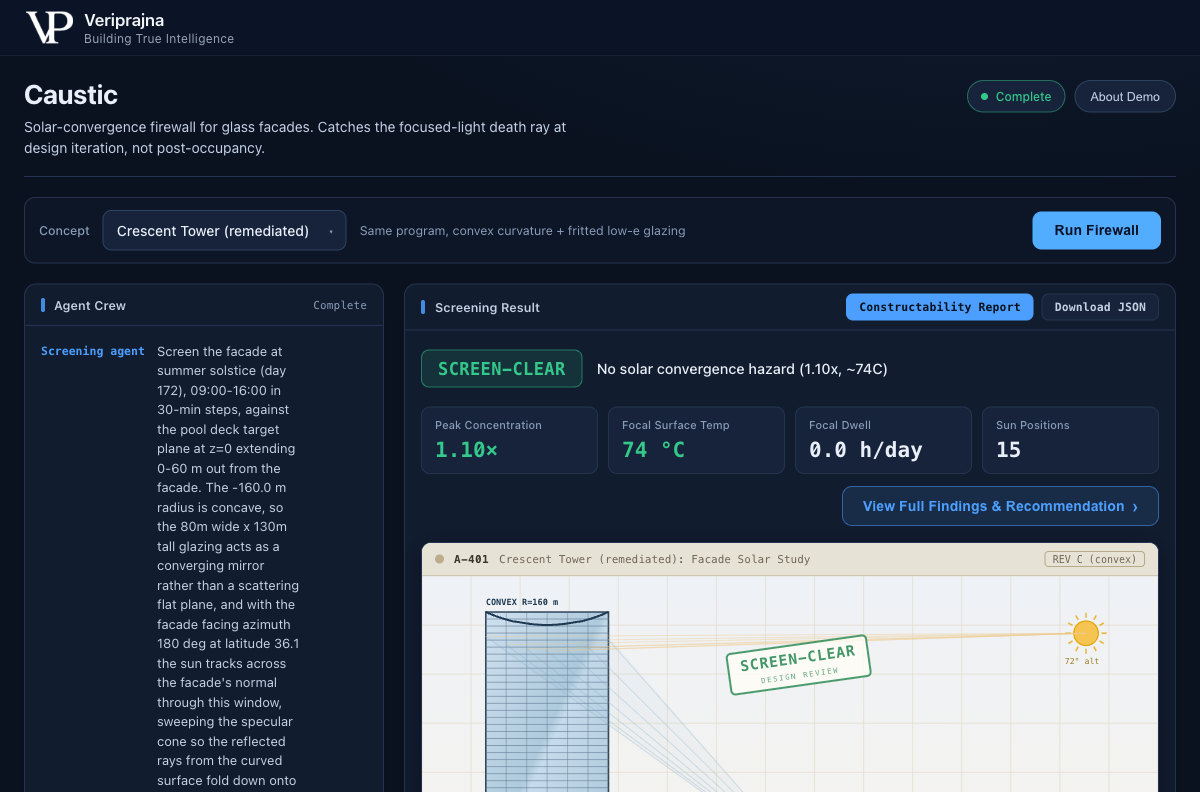
The remediated illustrative configuration is shown as SCREEN-CLEAR in the tested sweep: 1.10x concentration, approximately 74 C, and 0.0 h/day focal dwell.
SCREEN-CLEAR supports continued concept exploration. It is not a permit approval.
A credible screen also knows when it cannot resolve the geometry
The most important result is sometimes the refusal to produce a number. Helix Pavilion, another synthetic illustrative concept, is a freeform doubly-curved diagrid shell without a resolvable single curvature radius. Caustic returns ESCALATE, asserts no focal figure, and directs the team to full optical simulation and specialist review.
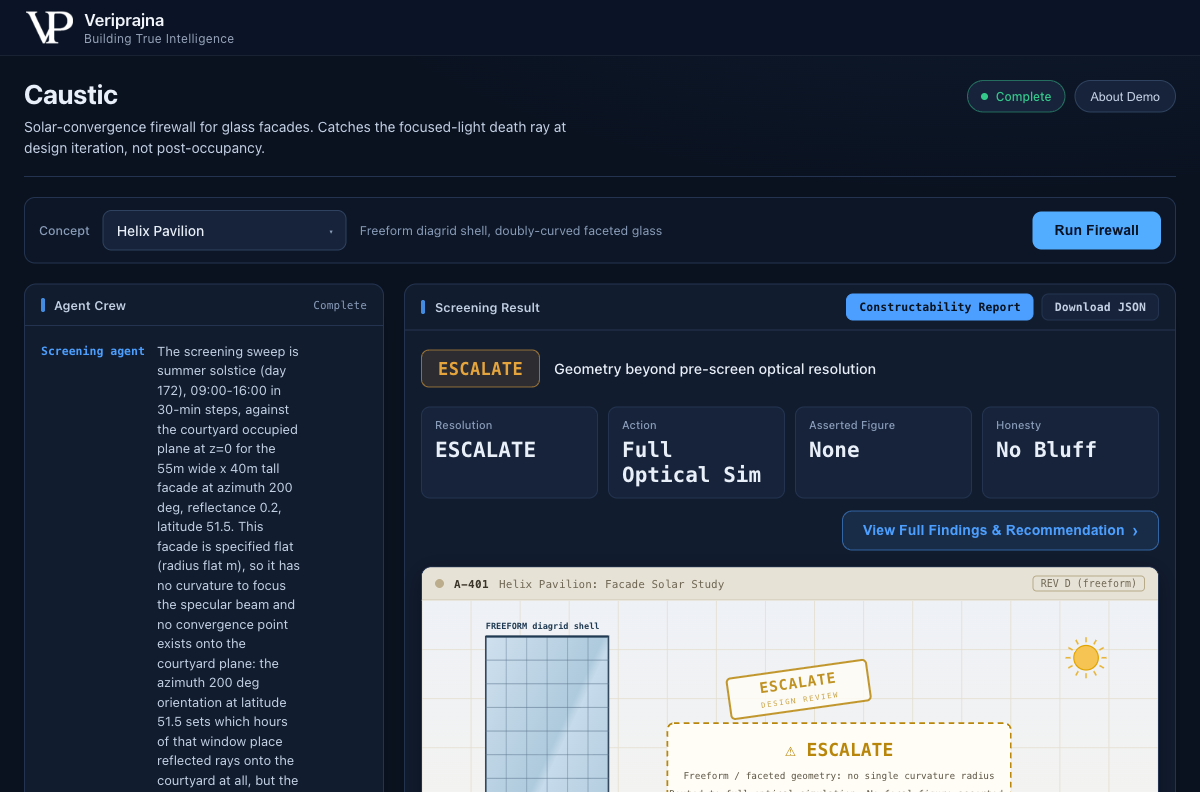
Helix Pavilion's screen records ESCALATE, “Asserted Figure: None,” and full optical simulation as the required next step.
That limit is intentional. Freeform geometry should not receive invented precision because a concept tool is expected to have an answer. Caustic is pre-screening only, not a stamped analysis. It does not replace an architect, a specialist optical study, or a licensed professional's final analysis.
The receipt belongs in the review
Early decisions become easier to revisit when the record travels with them. Caustic's Constructability Report exports the concept input, screened protocol, raw result, thresholds, critic note, verdict, provenance, and pre-screening disclaimer in HTML and JSON. The output turns a visual concern into a reviewable design artifact.
This is the engineering standard we think concept-stage AI should meet. It should make the physical question visible while the geometry can still change, preserve the assumptions behind a decision, and direct the work to a fuller simulation when its own resolution ends.
You can run the 15-position Crescent Tower screen, compare the illustrative remediation, and inspect the escalation path at https://veriprajna.com/demos/ai-architecture-structural-engineering.
We are comparing how facade and computational-design teams assign the reflected-sunlight check today: during massing review, at glazing selection, or in the handoff to specialist analysis. That workflow decision determines whether the issue is visible while the form is still cheap to change.