Vdara's pool deck and London's 20 Fenchurch showed me that reflected sunlight can damage materials and drive retrofit work after an ambitious glass facade is built. I built Caustic around that concrete risk: a concept-stage solar screen that makes the physics visible while there is still time to change the geometry.
Caustic is not a stamped analysis, a permit decision, or a replacement for a specialist optical study. It is pre-screening only, not a stamped analysis. Its job is narrower and useful: catch the focused-light hazard during design iteration, not post-occupancy.
The two buildings I could not leave as a footnote
I kept returning to Vdara and 20 Fenchurch while defining the boundary of this demo. Their documented concentrated-reflected-sunlight problems are not interchangeable case studies, and Caustic does not claim to have measured either building or recreated its geometry. They made a more basic design question hard to ignore: how can a concept team see a possible convergence problem before the form hardens into drawings, procurement, and construction?
I did not want the answer to be an aesthetic warning from a language model. Generative tools produce pixels, not load paths. A curved-glass concept needs a method that can show where parallel sunlight goes, what assumptions it used, and what fixed rule produced its verdict.
That is why I made the central interaction a synthetic, illustrative concept called Crescent Tower: a 38-storey concave south-glass hotel facade over a pool deck. The synthetic framing matters. It gives the demo a concrete design problem to inspect without pretending that it is a customer project or a measurement of a real building.
The run where the glass stopped being a render
I watched the first Crescent Tower screen as a 15-position summer-solstice sweep, rather than a single convincing image. The Ray Tracer discretizes the facade, reflects parallel sun rays to the occupied plane, and records peak concentration, focal surface temperature, and focal dwell. The Policy Gate then applies its fixed thresholds: 1.45x concentration, 80 °C focal temperature, and 30 minutes of above-threshold dwell.
For the illustrative Crescent configuration, the result is FLAGGED: 2.07x peak concentration, approximately 106 °C focal surface temperature, and 6.0 h/day focal dwell. Those are not numbers a Screening Agent can edit into a reassuring verdict. The agent explains the protocol, while the deterministic ray trace and fixed policy set the result.
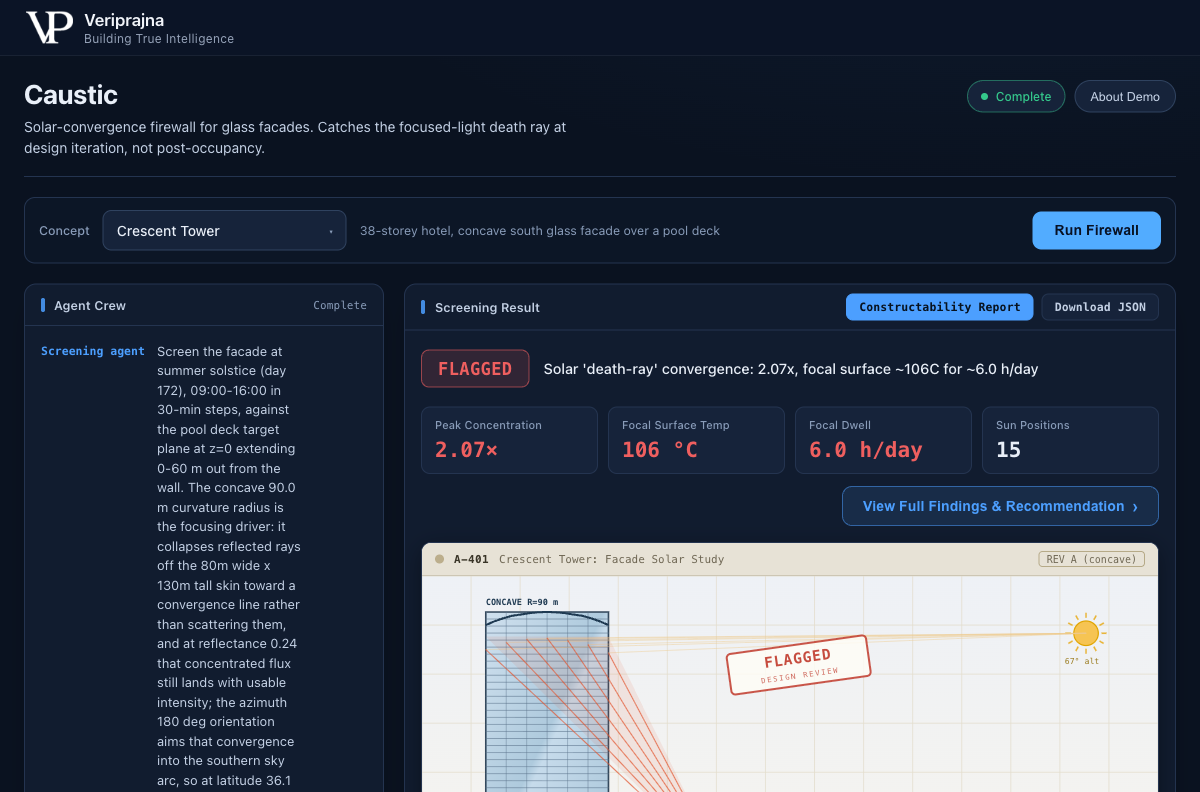
Crescent Tower's illustrative screen: the flagged result stays tied to the 15-position sweep and displayed measures.
I found that separation useful because it lets a design review argue with something inspectable. A team can challenge the FacadeSpec, the solar sweep, the curvature, the occupied target plane, or the policy threshold. It cannot mistake a fluent explanation for an optical result.
The change I wanted the concept loop to preserve
I made the comparison in Caustic because I wanted the decision to be more useful than a red stamp. Crescent Tower (remediated) keeps the illustrative program but uses convex curvature and fritted low-e glazing. In the demo's tested sweep, it returns SCREEN-CLEAR at 1.10x, approximately 74 °C, and 0.0 h/day.
That SCREEN-CLEAR verdict permits continued concept exploration. I would not present it as permit approval, certification, or a safety guarantee. The value is earlier: the team can see a materially different configuration and carry the right questions into full optical simulation and licensed review.
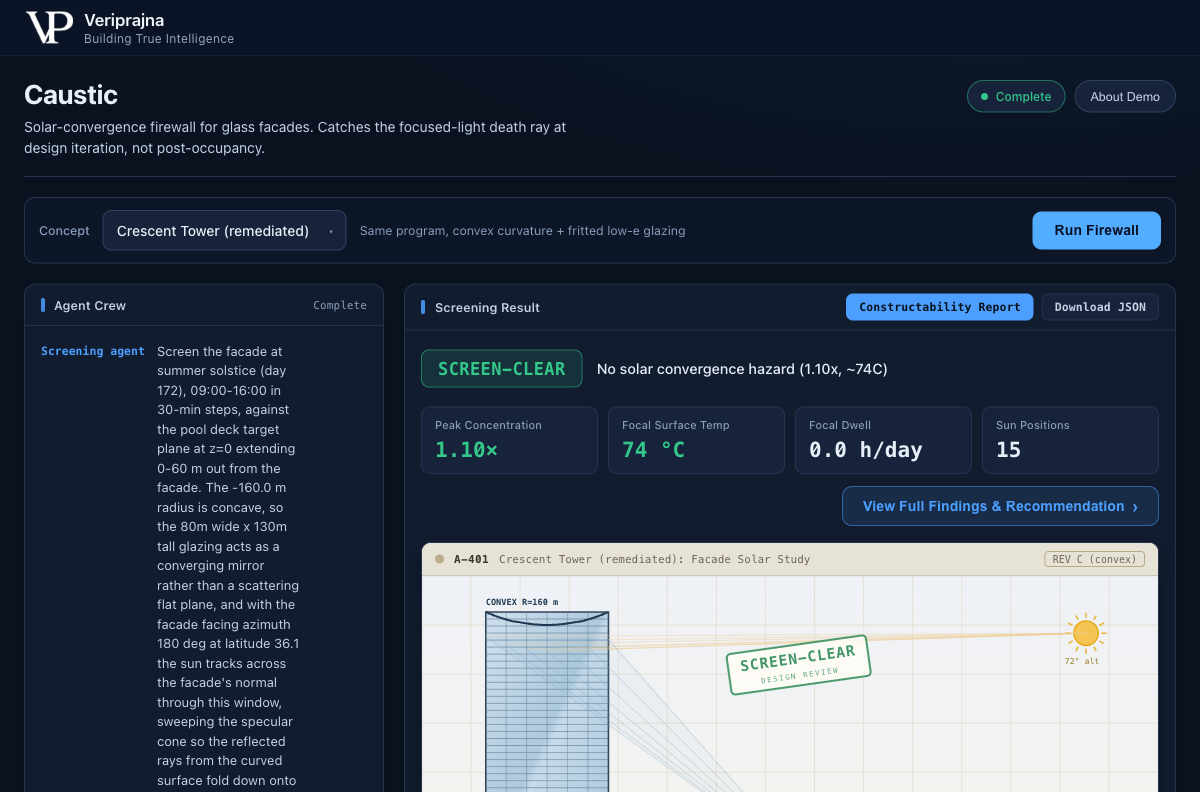
The illustrative remediated configuration: a screen-clear result for the tested sweep, not an approval.
I also included an opposite kind of result because an engineering tool needs a way to decline false precision. Helix Pavilion is a synthetic freeform, doubly-curved diagrid shell. Since the pre-screen cannot resolve a single confident curvature radius, it returns ESCALATE with no focal figure asserted and directs the work to full optical simulation and specialist review.
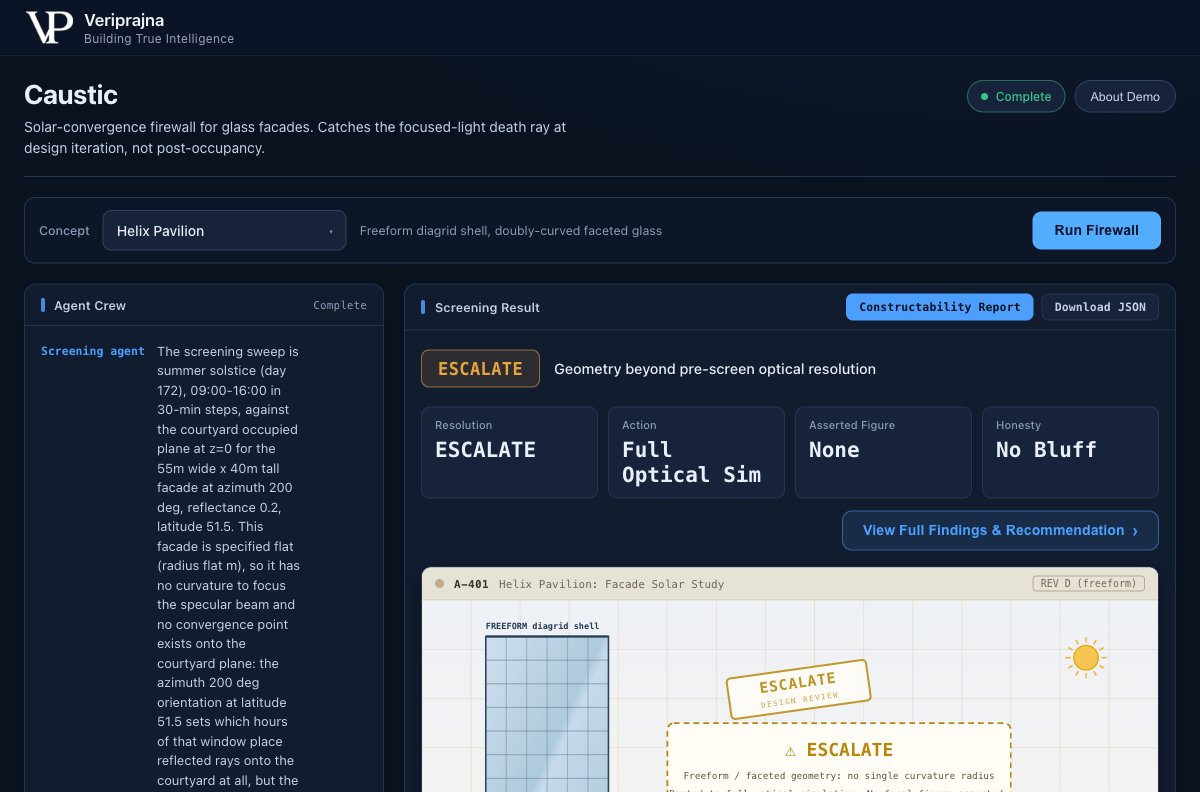
Helix Pavilion's escalation: the pre-screen withholds a focal figure when its geometric resolution is insufficient.
The record I would carry into review
I built the Constructability Report so the screen did not end at an interface verdict. Its HTML and JSON exports carry the concept input, screened protocol, raw result, thresholds, critic note, verdict, provenance, and the pre-screening disclaimer. I want a reviewer to be able to see what Caustic saw, which rule fired, and where its scope ended.
I also made the evaluation deliberately narrow. On the offline five-case fixed golden set, Caustic reports precision 1.0 and recall 1.0: two true positives, three true negatives, and no false positives or false negatives. That result belongs to that defined set of public-description approximations and controls. It is not a production accuracy claim, a measured temperature for Vdara or 20 Fenchurch, or a guarantee about every facade.
I have put the runnable Caustic demo in one place for people who want to inspect the FLAGGED, SCREEN-CLEAR, and ESCALATE paths themselves.
I built this as a small discipline for the moment when form is still negotiable: show the calculation, preserve the assumptions, and let uncertain geometry remain uncertain.